Artwork
Iisus cu vița de vie
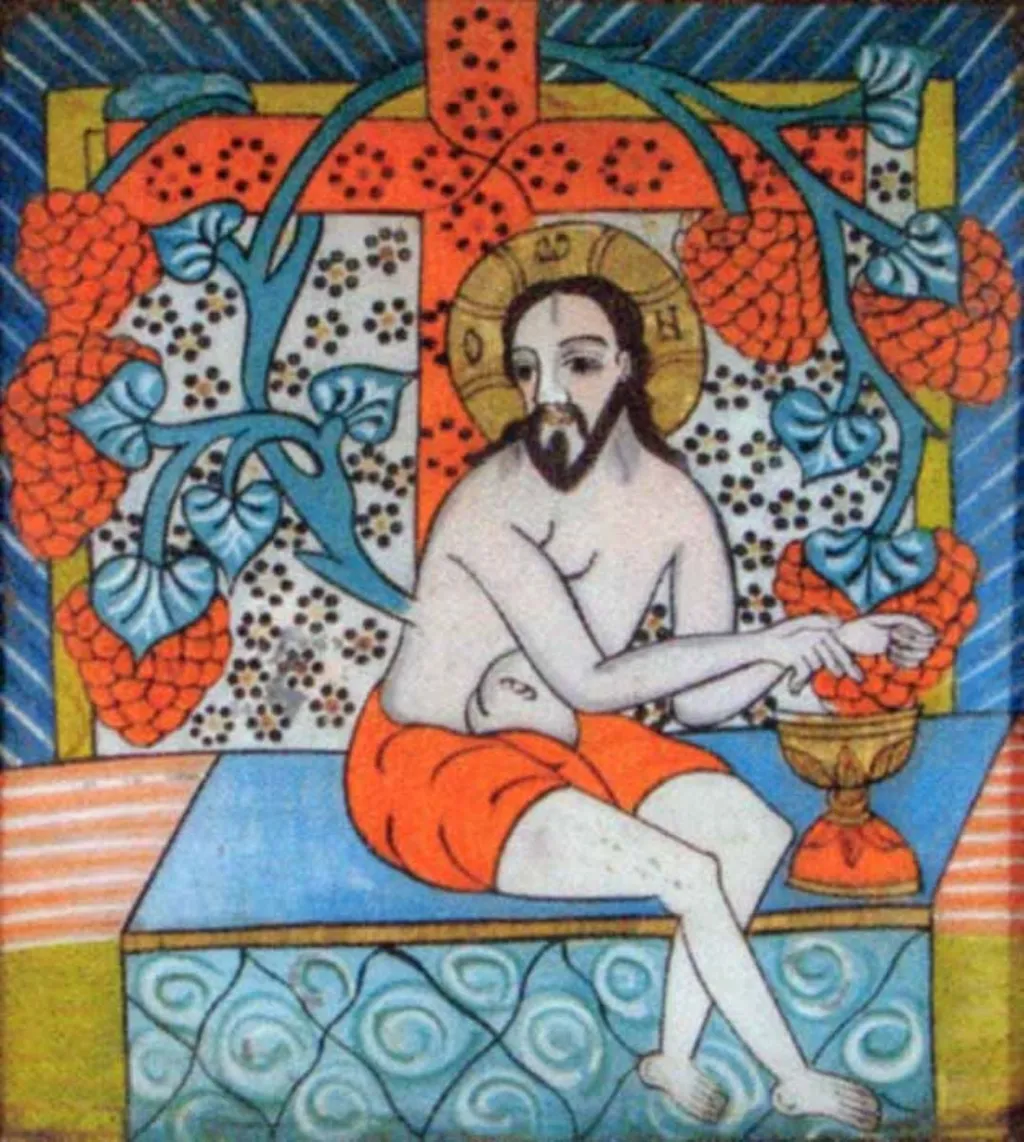
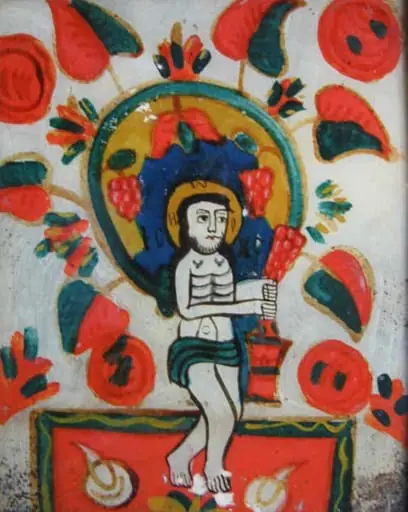
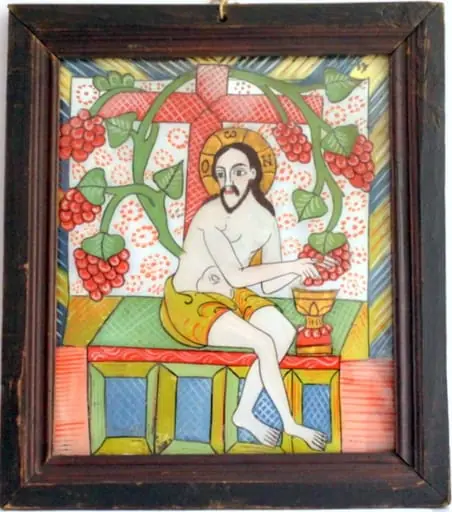
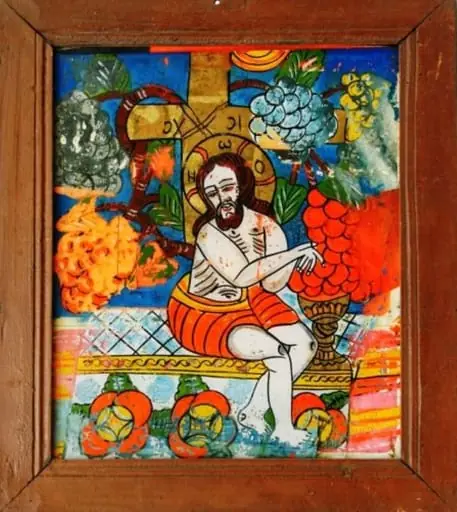
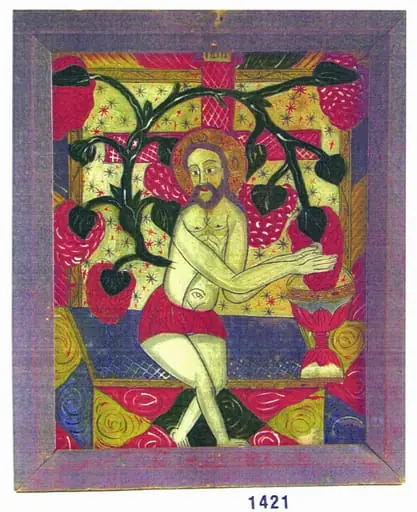
Iisus cu vița de vie is a drawing by Unknown. It dates from 1850 and is held in the collection of the Romanian Academy in Bucharest. This drawing depicts a bearded male figure seated on a bench, adorned with a golden halo and dressed in bright orange trousers.
About this work
Overview
This drawing depicts a bearded male figure seated on a bench, adorned with a golden halo and dressed in bright orange trousers. He holds a golden cup, while a vine with blue leaves and red blossoms arches behind him, forming a decorative crown-like frame. The entire composition is rendered in bold, saturated hues—reds, blues, and greens—each surface densely covered in fine, uniform dots.
Subject & Meaning
The figure’s halo and the vine suggest a religious or symbolic identity, possibly Christ as the Vine from biblical metaphor. The absence of a shirt and the vibrant attire may reflect a fusion of sacred imagery with stylized, non-traditional representation. The cup could signify the Eucharist, while the vine reinforces themes of growth, connection, and divine sustenance.
Technique & Style
The artwork employs stippling, a method where form and tone are built through countless small dots rather than lines or washes. This technique creates texture and depth across the figure, foliage, and background. The consistent density of dots unifies the composition, giving the image a rhythmic, almost textile-like surface that emphasizes pattern over naturalism.
History & Provenance
No documented origin or creator is provided for this work. It is classified as an image without contextual details about its creation date, location, or prior ownership. Its style suggests possible influence from folk, outsider, or devotional art traditions, though its precise cultural or historical roots remain unidentified.
Context
The use of stippling alongside vivid, non-naturalistic color and symbolic vegetation aligns with certain 20th-century vernacular or religious art practices, where spiritual themes are expressed through decorative abstraction. The absence of traditional iconographic elements—such as robes or a cross—points to a personal or localized reinterpretation of sacred imagery.
Legacy
As a standalone work without known lineage or institutional record, its legacy lies in its unique visual language. The piece exemplifies how stippling can transform simple forms into richly textured compositions, offering insight into individual artistic responses to religious symbolism outside mainstream traditions.
Artist & collection
 Domestic Scene
 Giacomo and Cardinal Marco, investing Andrea, Abbot of San Zeno, with his Benefice
 The Nymph of Fontainebleau
 Portrait of a Woman
 Madonna and Child with Saints in the Enclosed Garden
 Venus and Minerva
 Family Group of Four on Sofa
 Wall painting from Room H of the Villa of P. Fannius Synistor at Boscoreale