Artwork
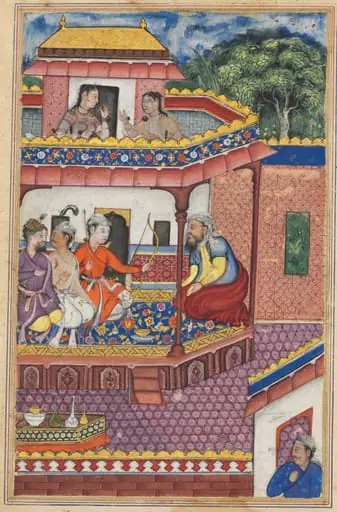
Kaiwan, Latif, and Sharif arrive at a house of worship, where they seek help from Khurshid who has become a mystical healer, from a Tuti-Nama (Tales of a Parrot): Thirty-second Night
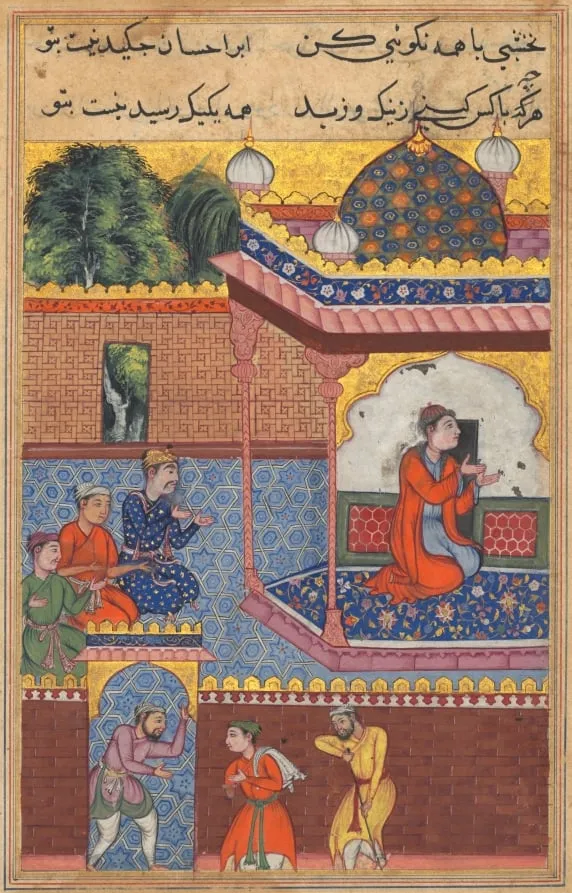
Kaiwan, Latif, and Sharif arrive at a house of worship, where they seek help from Khurshid who has become a mystical healer, from a Tuti-Nama (Tales of a Parrot): Thirty-second Night is an unspecified painting by the Mughal Painting artist Unknown. It dates from 1560 and is held in the collection of the Cleveland Museum of Art. This painting illustrates a scene from the Tuti-Nama, a collection of tales compiled for Emperor Akbar’s court.
About this work
To see more stories like this, look up subject: mughal india, court of akbar (reigned 1556–1605).
You see three sick men kneeling before a woman in a blue robe who sits like a holy man. One man is blind, one has lost a hand, and the third shakes with palsy.
This painting is from a book of parrot tales told to Emperor Akbar. The woman, Khurshid, was wronged by these men and now heals them as penance. Her shaved head and robes show she’s taken on a spiritual role.
To see more stories like this, look up subject: mughal india, court of akbar (reigned 1556–1605).
Overview
This painting illustrates a scene from the Tuti-Nama, a collection of tales compiled for Emperor Akbar’s court. It depicts the moment three men who once wronged Khurshid arrive at a place of worship, seeking her healing. She has renounced her former life, adopting the appearance of a mystic, and now serves as a spiritual intermediary. The scene unfolds within a structured architectural setting, typical of Mughal manuscript illustration.
Subject & Meaning
Khurshid, once wronged by the three men, now embodies moral retribution and spiritual redemption. Her transformation into a shaven-headed ascetic signifies detachment from worldly identity and the embrace of divine authority. The men’s physical afflictions—blindness, amputation, and palsy—mirror their moral failings. Their kneeling posture and proximity to her suggest a ritual of atonement, where healing is tied to contrition.
Technique & Style
Executed in the Mughal miniature tradition, the painting employs fine brushwork, precise line definition, and layered pigments to render texture and detail. Figures are arranged in hierarchical composition, with Khurshid centrally positioned and elevated. The use of vivid blues and oranges contrasts with muted backgrounds, directing focus to the emotional exchange. Architectural elements are rendered with architectural clarity, grounding the scene in a tangible space.
History & Provenance
The painting originates from a manuscript commissioned during Akbar’s reign (1556–1605), part of a series illustrating the Tuti-Nama, a Persian-derived collection of animal fables adapted for the Mughal court. Likely produced by artists in the imperial atelier, it reflects Akbar’s interest in moral storytelling and cross-cultural narratives. The manuscript’s survival attests to its continued value within royal collections.
Context
The Tuti-Nama was one of several literary projects patronized by Akbar to synthesize Persian, Indian, and Islamic traditions. These tales served both entertainment and ethical instruction, aligning with his broader efforts to cultivate a pluralistic court culture. Khurshid’s role as a female mystic healer reflects contemporary interest in Sufi spirituality and the subversion of social norms through religious devotion.
Legacy
This image contributes to a broader corpus of Mughal manuscript art that blends narrative depth with visual precision. It preserves a unique portrayal of female spiritual authority in a male-dominated courtly context. The painting’s endurance in collections today underscores its significance as both artistic artifact and cultural document of early modern India’s literary and religious imagination.
Artist & collection

 Domestic Scene
 Giacomo and Cardinal Marco, investing Andrea, Abbot of San Zeno, with his Benefice
 The Nymph of Fontainebleau
 Portrait of a Woman
 Madonna and Child with Saints in the Enclosed Garden
 Venus and Minerva
 Family Group of Four on Sofa
 Wall painting from Room H of the Villa of P. Fannius Synistor at Boscoreale
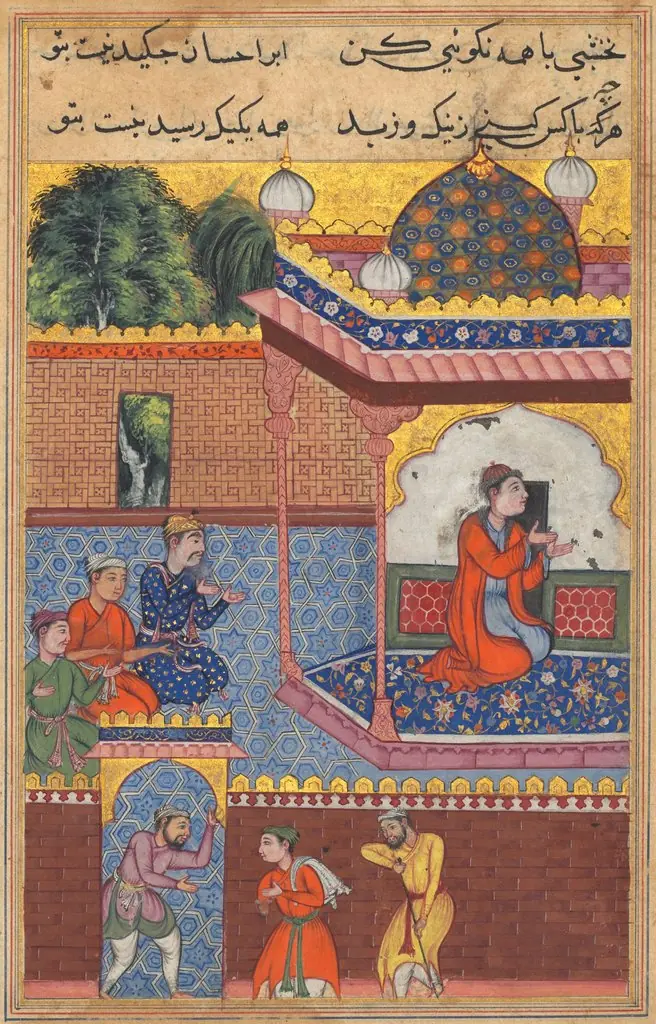 Kaiwan, Latif, and Sharif arrive at a house of worship, where they seek help from Khurshid who has become a mystical healer, from a Tuti-Nama (Tales of a Parrot): Thirty-second Night
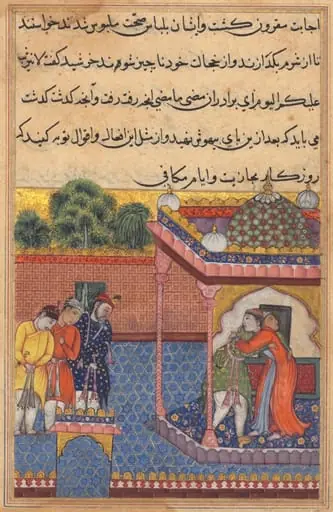 Khurshid reunited with her husband Utarid, from a Tuti-nama (Tales of a Parrot): Thirty-second Night
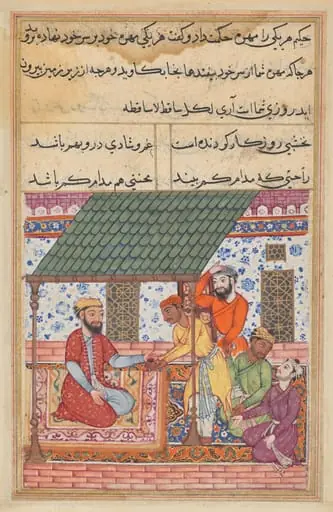 The four destitute friends go to a wise man who gives each one of them a magic shell to be placed on top of the turban, from a Tuti-nama (Tales of a Parrot): Forty-seventh Night
 The three young men present themselves as suitors for the hand of Zuhra, the daughter of the merchant of Kabul, from a Tuti-nama (Tales of a Parrot): Thirty-fourth Night