Artwork
Krishna and Radha
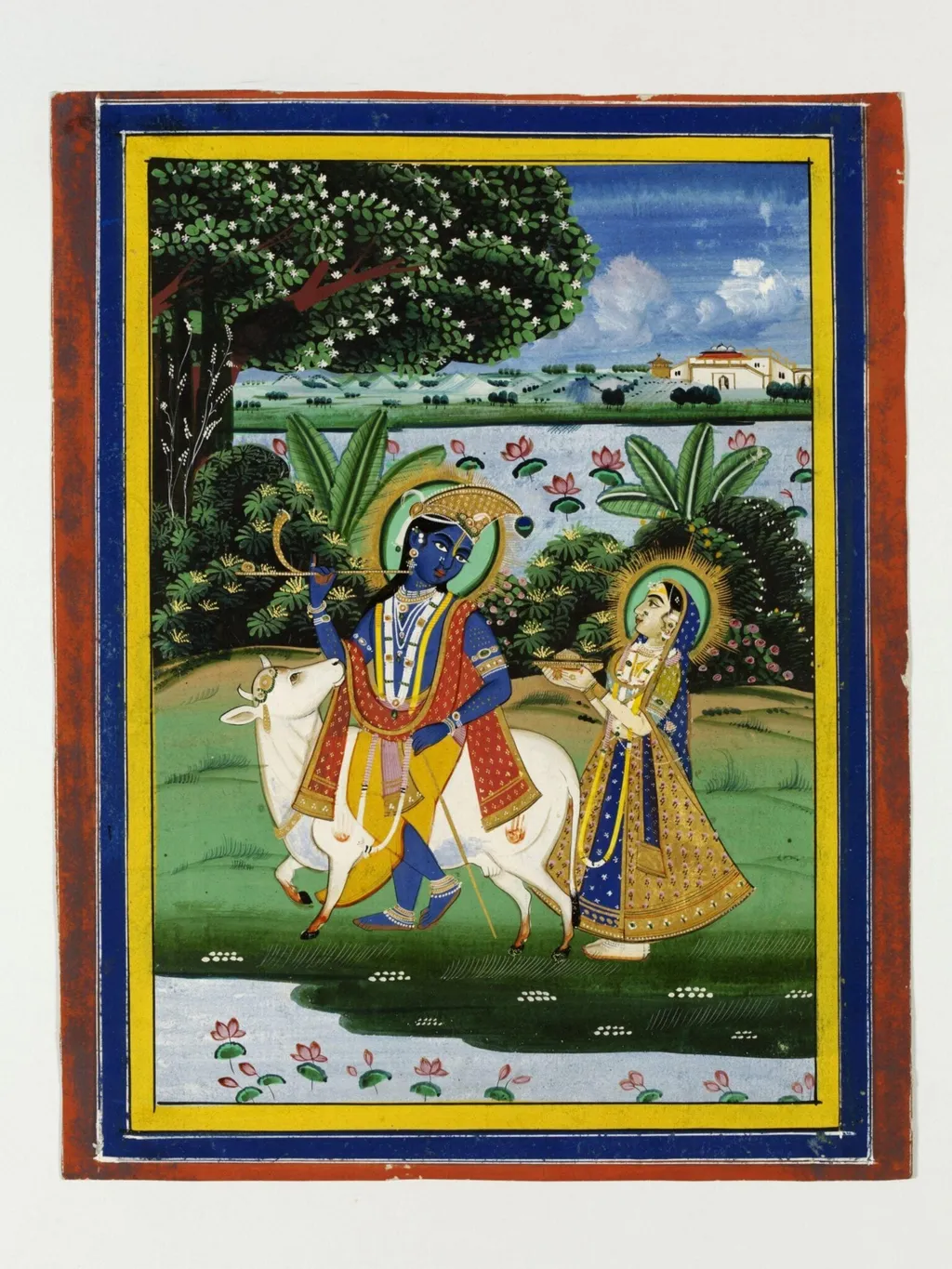
Krishna and Radha is a paint painting by Unknown. It dates from 1850 and is held in the collection of the Victoria and Albert Museum.
About this work
Overview
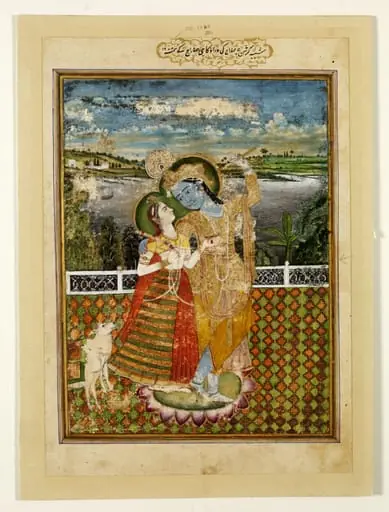
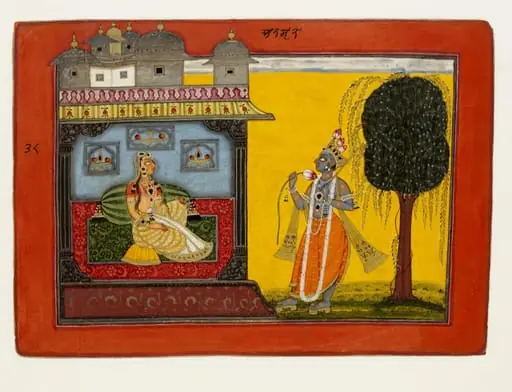
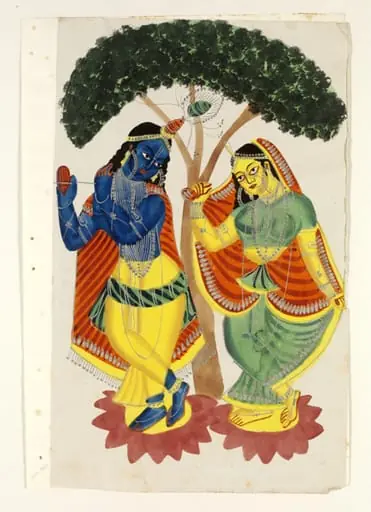
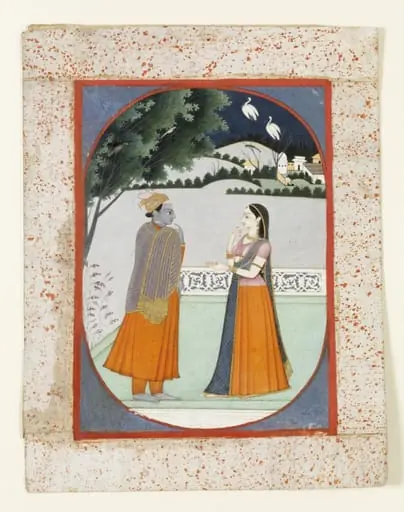
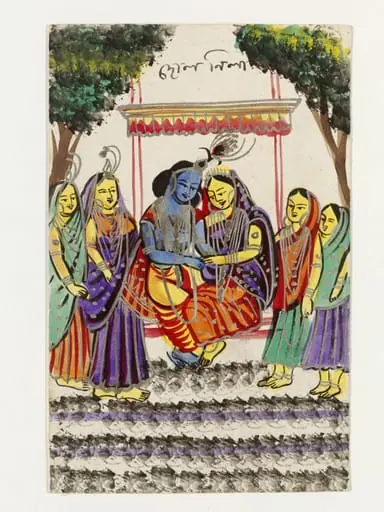
This painting, executed in opaque watercolour on paper, portrays Krishna and Radha riding a white cow through a lush, stylized landscape.
This painting, executed in opaque watercolour on paper, portrays Krishna and Radha riding a white cow through a lush, stylized landscape. It was one of 196 works compiled by J. Lockwood Kipling between 1865 and 1893, primarily consisting of lithographs and drawings from Upper India and Bengal. The album was later presented to a museum by his son, Rudyard Kipling, in 1917, preserving a significant collection of regional artistic output from the 19th century.
Subject & Meaning
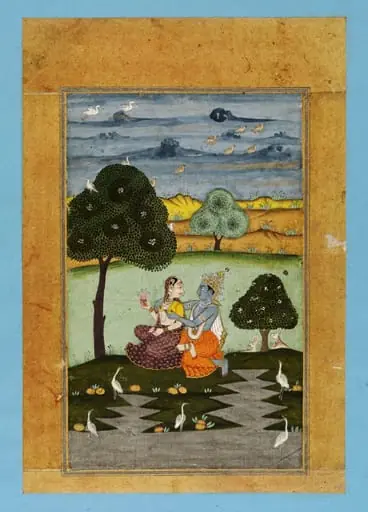
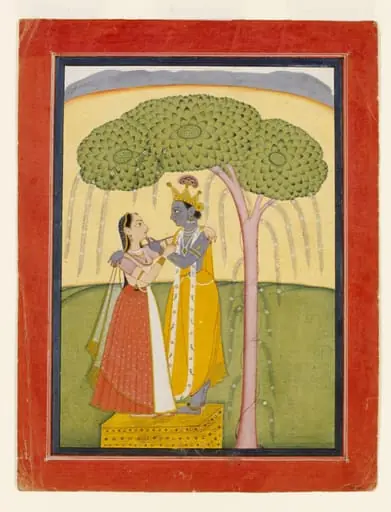
Krishna, identified by his blue skin and ornate crown, is shown with Radha, his divine consort, in a moment of intimate companionship. The presence of the cow references Krishna’s pastoral origins and his role as a protector of cattle. Radha’s luminous halo signifies her spiritual status, a convention in devotional art to denote sanctity. Together, they embody the ideal of divine love, a central theme in Vaishnavite tradition, rendered here with quiet reverence rather than dramatic intensity.
Technique & Style
The painting employs flat, unmodulated areas of bold colour with minimal shading, characteristic of regional Indian miniature traditions. Outlines are crisp, and details such as gold patterning on Radha’s dress and white blossoms on trees are rendered with precision. The background lacks perspective, instead presenting a harmonious, decorative arrangement of landscape elements. This stylistic approach prioritizes symbolic clarity and visual rhythm over naturalistic depth.
History & Provenance
The work was assembled by J. Lockwood Kipling during his time in British India, where he collected vernacular art forms as cultural artifacts. His son, Rudyard Kipling, donated the entire album to a museum in 1917, ensuring its preservation within a public institution. The collection reflects 19th-century colonial interest in indigenous art, though the album itself was curated with attention to regional diversity and craftsmanship rather than exoticism.
Context
This painting belongs to a broader tradition of Pahari and Bengal miniature art, where scenes from Krishna’s life were popular subjects for devotional albums. Such works were often created for private contemplation or ritual use, not public display. The use of opaque watercolour and paper aligns with techniques common in northern Indian studios during the 18th and 19th centuries, where artists adapted older styles to contemporary tastes and materials.
Legacy
The inclusion of this painting in the Kipling album helped preserve a genre of art that was often overlooked by Western collectors. Its presence in a major museum collection underscores the value placed on regional Indian aesthetics during the colonial era. Today, it contributes to scholarly understanding of how devotional imagery was produced, collected, and transmitted across cultural boundaries in the 19th century.
Artist & collection

 Domestic Scene
 Giacomo and Cardinal Marco, investing Andrea, Abbot of San Zeno, with his Benefice
 The Nymph of Fontainebleau
 Portrait of a Woman
 Madonna and Child with Saints in the Enclosed Garden
 Venus and Minerva
 Family Group of Four on Sofa
 Wall painting from Room H of the Villa of P. Fannius Synistor at Boscoreale