Artwork
Radha and Krishna
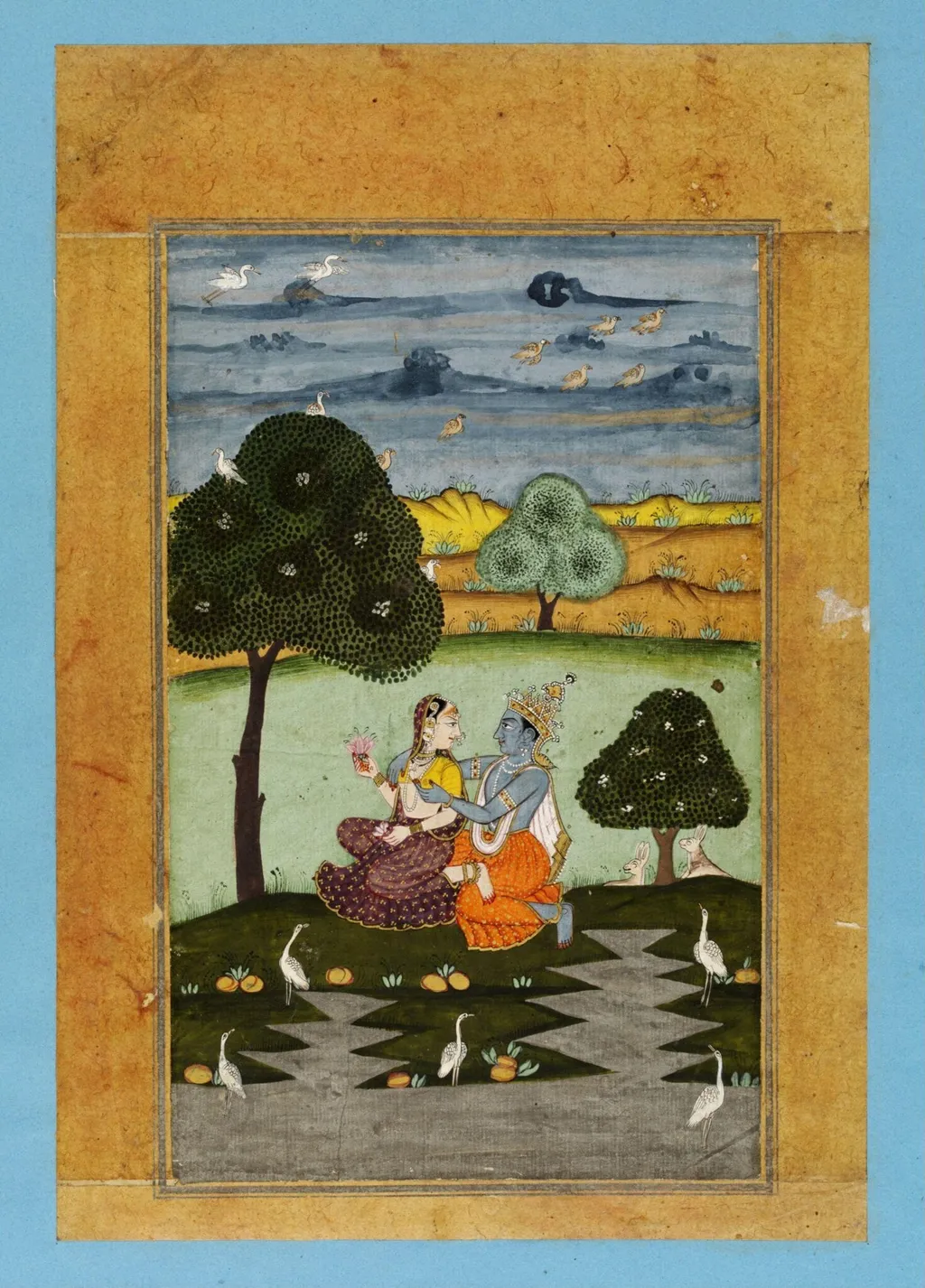
Radha and Krishna is a paint painting by the Mughal Painting artist Unknown. It dates from 1850 and is held in the collection of the Victoria and Albert Museum.
About this work
Overview
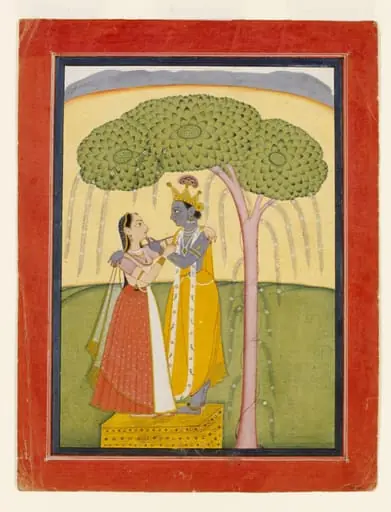
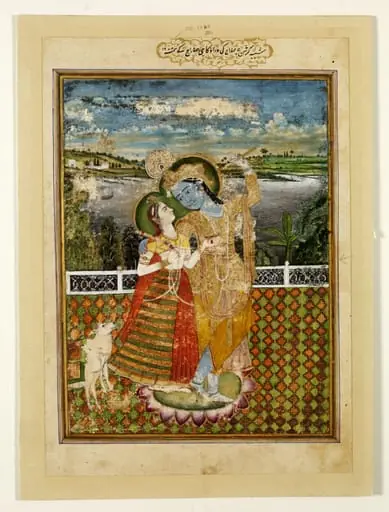
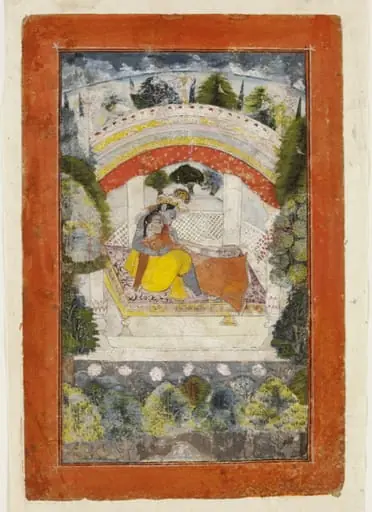
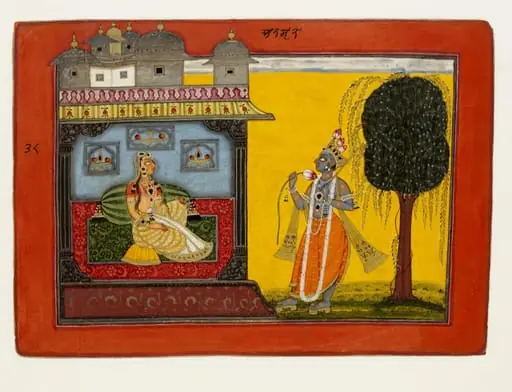
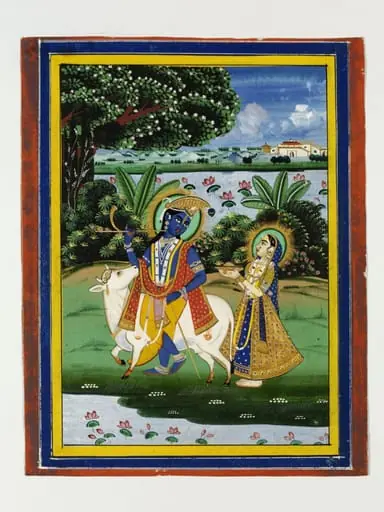
This opaque watercolour and gold painting on paper, dated circa 1850, portrays Radha and Krishna in an intimate moment within a natural setting.
This opaque watercolour and gold painting on paper, dated circa 1850, portrays Radha and Krishna in an intimate moment within a natural setting. Executed with fine detail and luminous pigments, it reflects the artistic traditions of North Indian courtly painting. The work was originally catalogued under the Department of Engraving, Illustration & Design with the reference RP 51/2237 before being integrated into the V&A’s collection.
Subject & Meaning
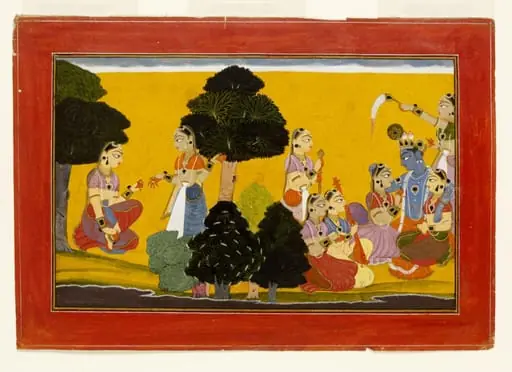
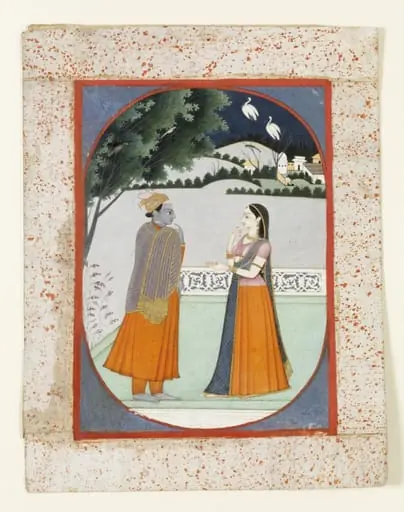
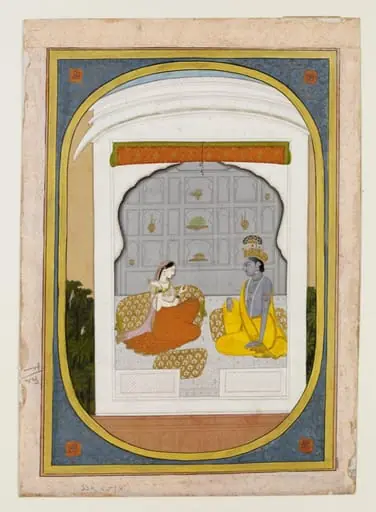
The scene captures Radha and Krishna in a tender embrace, a recurring theme in Vaishnavite devotional art symbolizing divine love and spiritual union. Krishna, identified by his blue complexion and ornate crown, rests behind Radha, who holds flowers as an offering. Their setting—lush trees, birds, and a tranquil pond—evokes the sacred groves of Vrindavan, reinforcing the mythological context of their bond as both romantic and transcendent.
Technique & Style
The painting employs opaque watercolour with gold leaf accents, typical of Pahari or Rajasthani miniatures. Fine brushwork defines the foliage, feathers, and textile patterns, while the flat, decorative space and elevated horizon suggest a stylized landscape rather than naturalistic perspective. The palette is rich but restrained, emphasizing harmony between figures and environment through balanced composition and delicate detail.
History & Provenance
The work entered the Victoria and Albert Museum’s collection through the Department of Engraving, Illustration & Design, where it was catalogued as RP 51/2237. Its transfer reflects 19th-century British institutional efforts to classify and preserve South Asian artworks collected during colonial administration. While its exact origin and patronage remain undocumented, its style aligns with mid-19th-century courtly workshops in northern India.
Context
Created during a period when regional Indian courts continued to commission devotional art despite British political influence, this painting belongs to a tradition that sustained Hindu iconography through visual storytelling. Similar works were produced in workshops linked to Rajput and Pahari rulers, often for private devotion or ceremonial display, blending spiritual themes with refined aesthetic sensibilities.
Legacy
As part of the V&A’s broader collection of South Asian miniatures, this painting contributes to scholarly understanding of 19th-century Indian artistic practices. It exemplifies how devotional imagery persisted in formal artistic contexts even as colonial institutions reclassified and recontextualized such works. Its preservation allows ongoing study of iconography, technique, and cultural continuity in pre-modern Indian painting.
Artist & collection

 Domestic Scene
 Giacomo and Cardinal Marco, investing Andrea, Abbot of San Zeno, with his Benefice
 The Nymph of Fontainebleau
 Portrait of a Woman
 Madonna and Child with Saints in the Enclosed Garden
 Venus and Minerva
 Family Group of Four on Sofa
 Wall painting from Room H of the Villa of P. Fannius Synistor at Boscoreale