Artwork
Narasimha and Hiranyakasipu
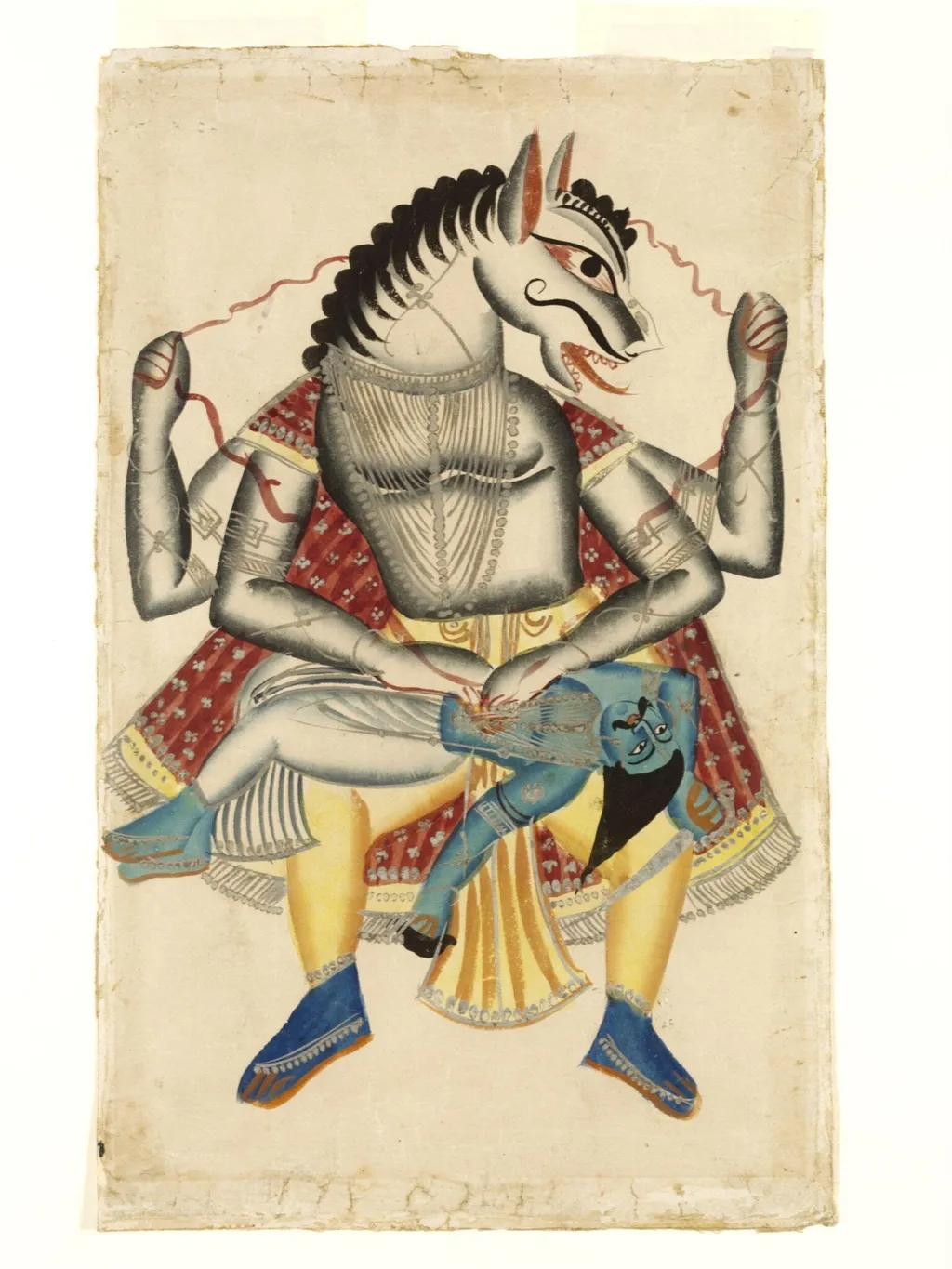
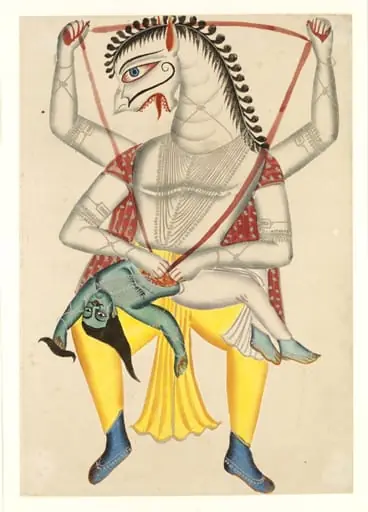
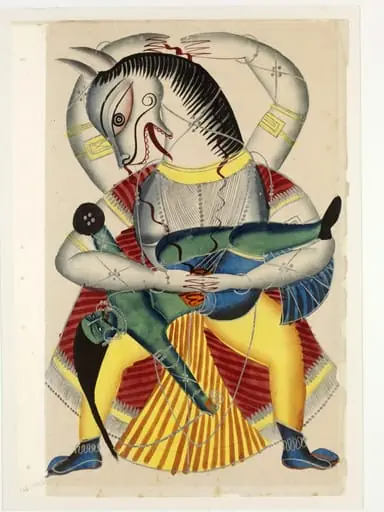
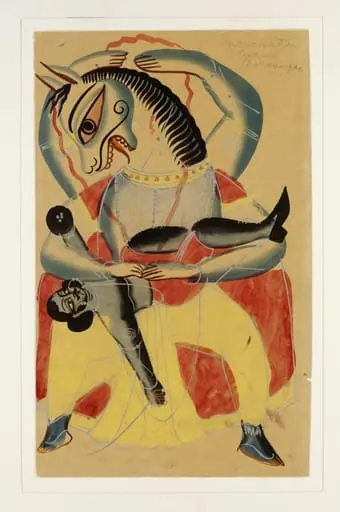
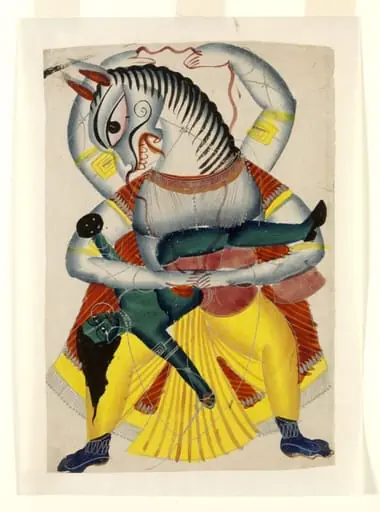
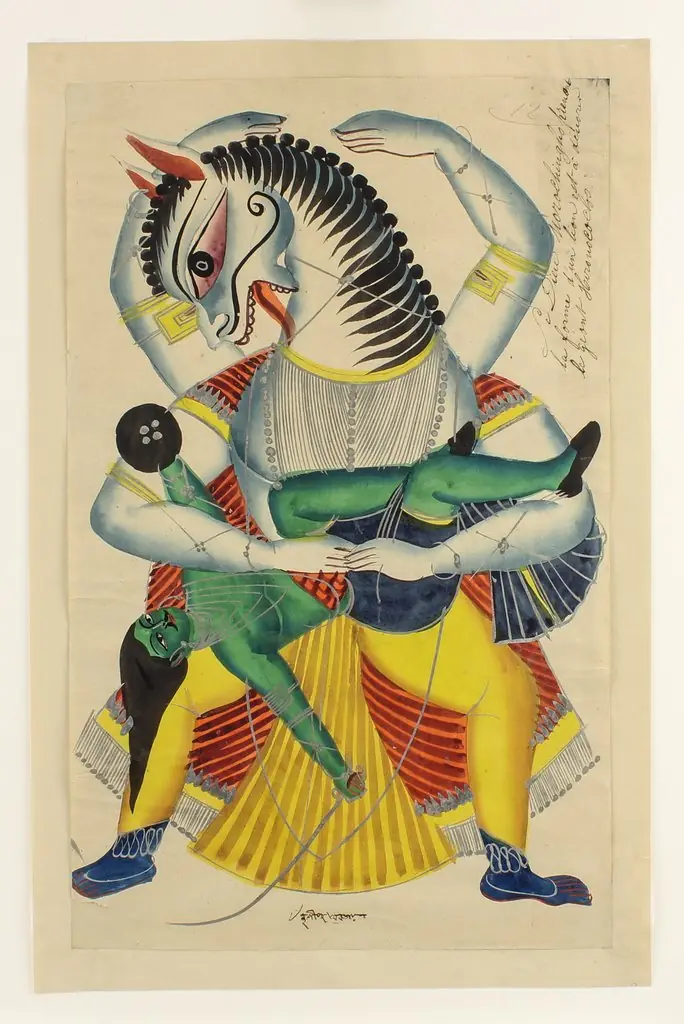
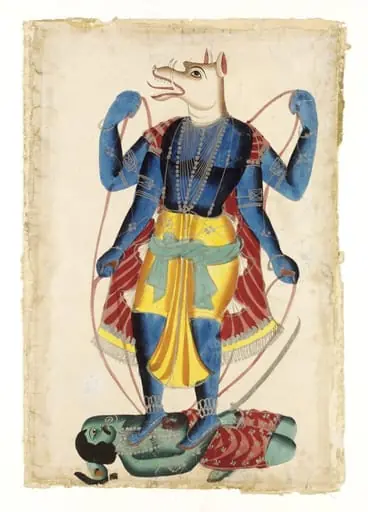
Narasimha and Hiranyakasipu is a paint painting by the Patna School of Painting artist Unknown. It dates from 1835 and is held in the collection of the Victoria and Albert Museum. The work portrays the Hindu deity Vishnu in his Narasimha form, a hybrid of man and lion, confronting the demon monarch Hiranyakashipu.
About this work
Overview
The work portrays the Hindu deity Vishnu in his Narasimha form, a hybrid of man and lion, confronting the demon monarch Hiranyakashipu.
The work portrays the Hindu deity Vishnu in his Narasimha form, a hybrid of man and lion, confronting the demon monarch Hiranyakashipu. The god’s claws are shown splitting the king’s torso while the ruler’s crown is displaced, emphasizing the violent climax of the myth. The composition is set against a deep red backdrop, with stark contrasts between the figures’ garments and the surrounding space.
Subject & Meaning
The scene visualizes the episode in which Narasimha defeats Hiranyakashipu, who had challenged the devotion of his son Prahlada. By slaying the tyrant, the avatar reaffirms divine authority and the triumph of righteousness over hubris. The dramatic dismemberment underscores the narrative’s moral urgency, while the positioning of the king’s body across the deity’s thighs conveys both domination and the restoration of cosmic order.
Technique & Style
Executed in the Kalighat school of painting, the piece employs bold, saturated pigments alongside pronounced chiaroscuro to heighten tension. Both characters are embellished with ornamental jewelry characteristic of the regional aesthetic, and the brushwork combines fluid outlines with flat areas of colour. The artist’s handling of light and shadow creates a theatrical effect, while the stylised forms retain the folk sensibility of early nineteenth‑century Bengal.
History & Provenance
Created in Calcutta during the 1830s, the painting belongs to a wave of Kalighat artworks that merged indigenous mythological subjects with the visual influences of a colonial milieu. It reflects the period’s artistic response to shifting cultural dynamics under British rule. The work has since entered museum collections, illustrating the broader diffusion of Bengal’s popular painting tradition beyond its original market.
Artist & collection

 Domestic Scene
 Giacomo and Cardinal Marco, investing Andrea, Abbot of San Zeno, with his Benefice
 The Nymph of Fontainebleau
 Portrait of a Woman
 Madonna and Child with Saints in the Enclosed Garden
 Venus and Minerva
 Family Group of Four on Sofa
 Wall painting from Room H of the Villa of P. Fannius Synistor at Boscoreale