Artwork
Official of the Fourth Rank
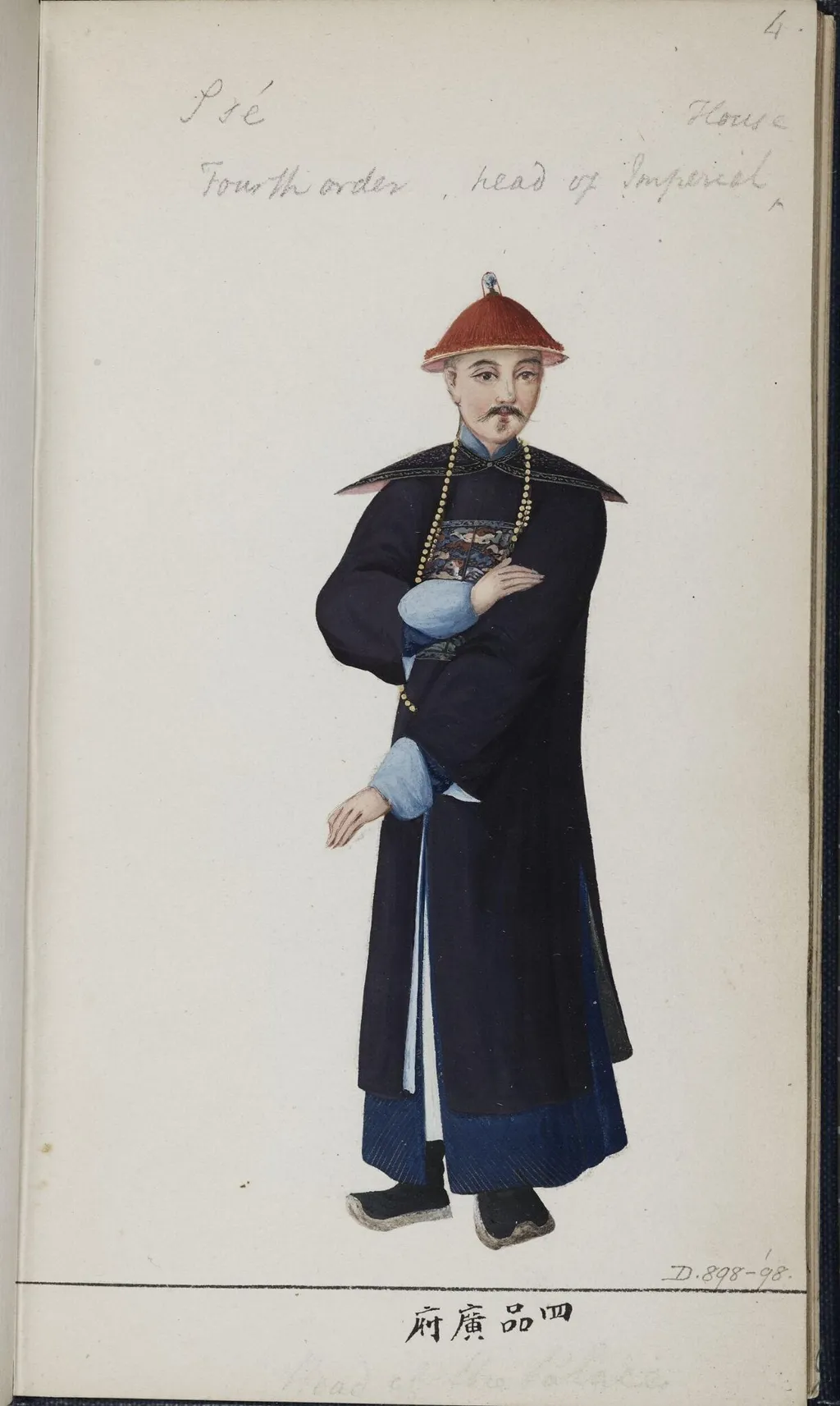
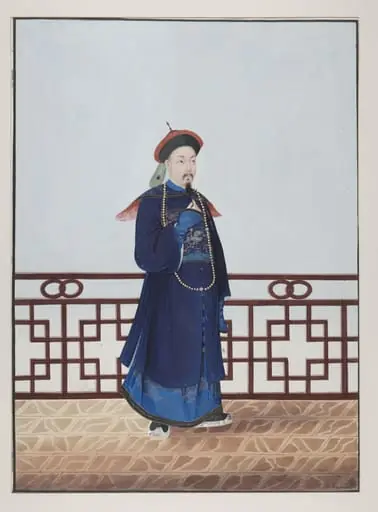
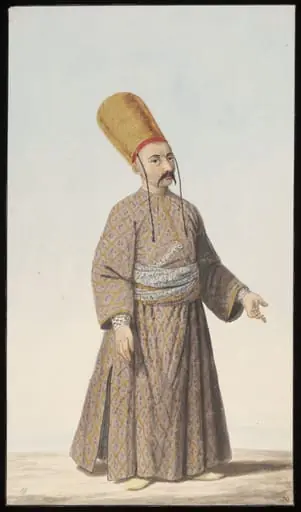
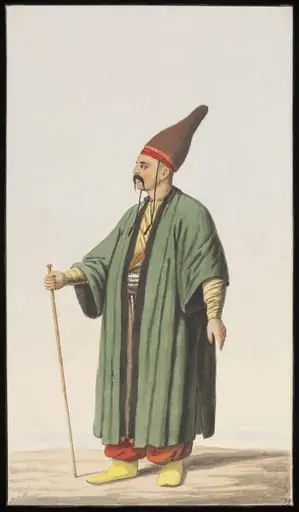
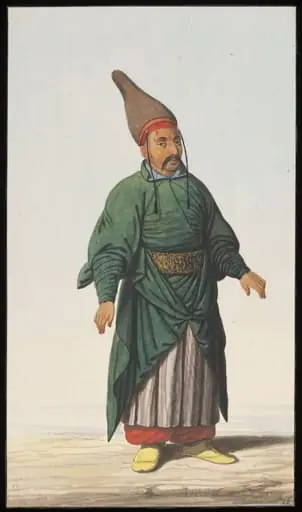
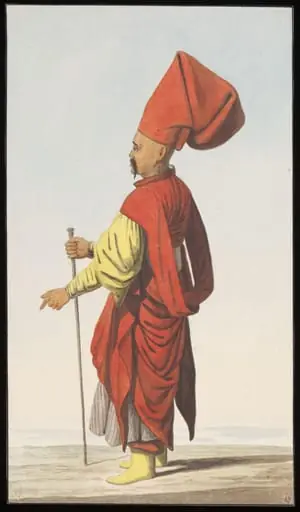
Official of the Fourth Rank is a paint painting by the Romanticist artist Unknown. It dates from 1795 and is held in the collection of the Victoria and Albert Museum.
About this work
Overview
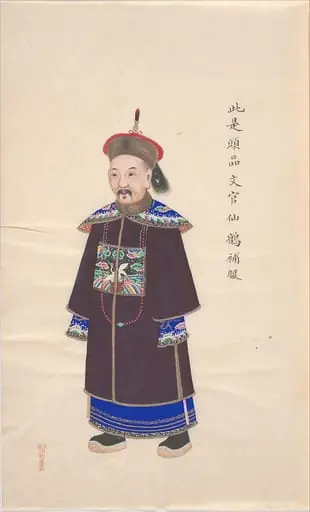
This painting is one of twenty-eight portraits from a late Qing dynasty album documenting the dress and rank insignia of Chinese civil and military officials.
This painting is one of twenty-eight portraits from a late Qing dynasty album documenting the dress and rank insignia of Chinese civil and military officials. It depicts a fourth-rank official, identified by his robe and accessories, though the accompanying inscription contains a title error. The work was likely produced for foreign audiences or administrative reference, reflecting a systematic effort to catalog bureaucratic hierarchy through visual means.
Subject & Meaning
The figure is a civil official of the fourth rank, likely serving as Prefect of Guangzhou, despite the mislabeled title. His attire follows strict sumptuary codes: navy blue robe with red trim, red hat, and a single rank badge featuring a qilin, symbolizing authority. The cane and bare feet within formal shoes suggest ceremonial posture, not domestic informality. The portrait conveys status through regulated symbols, not individual expression.
Technique & Style
Executed in watercolor on paper, the painting employs fine brushwork to render textile patterns and subtle gradations in color. The robe’s embroidery is delicately outlined, and the red accents contrast sharply against the dark blue fabric. The background is left plain, focusing attention on the figure’s form and regalia. Handwritten annotations in Chinese and English indicate dual-purpose use, possibly for diplomatic or commercial circulation.
History & Provenance
The portrait belongs to a set commissioned during the Qianlong or Jiaqing era, likely by Chinese artists for foreign traders or diplomats in Canton. Such albums circulated in Europe and America as ethnographic curiosities. The mislabeling suggests the inscriptions were added by non-Chinese handlers unfamiliar with bureaucratic titles. The album’s survival indicates its value as a historical record, though its original intent remains ambiguous.
Context
During the late 18th and early 19th centuries, foreign merchants in Guangzhou sought detailed knowledge of Qing administrative structures. This album responded to that demand, offering visual guides to official hierarchy. While Western collectors often viewed such images as exotic documentation, they were rooted in China’s rigid Confucian bureaucracy, where clothing directly signaled rank, function, and legitimacy.
Legacy
The portrait contributes to a broader corpus of Qing-era visual records used to decode imperial administration. Though inaccurately labeled, it remains a reliable source for studying official dress, rank badges, and cross-cultural misinterpretations. Today, such albums are studied not for their precision in translation, but for what they reveal about the intersection of Chinese institutional norms and foreign curiosity.
Artist & collection

 Domestic Scene
 Giacomo and Cardinal Marco, investing Andrea, Abbot of San Zeno, with his Benefice
 The Nymph of Fontainebleau
 Portrait of a Woman
 Madonna and Child with Saints in the Enclosed Garden
 Venus and Minerva
 Family Group of Four on Sofa
 Wall painting from Room H of the Villa of P. Fannius Synistor at Boscoreale