Artwork
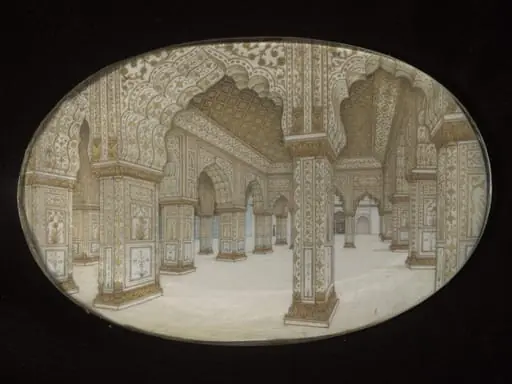
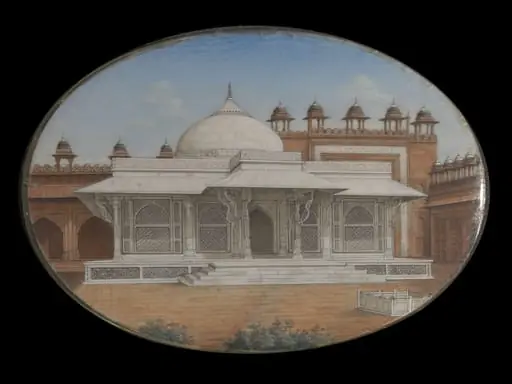
One of five views of Delhi and one of Lahore.
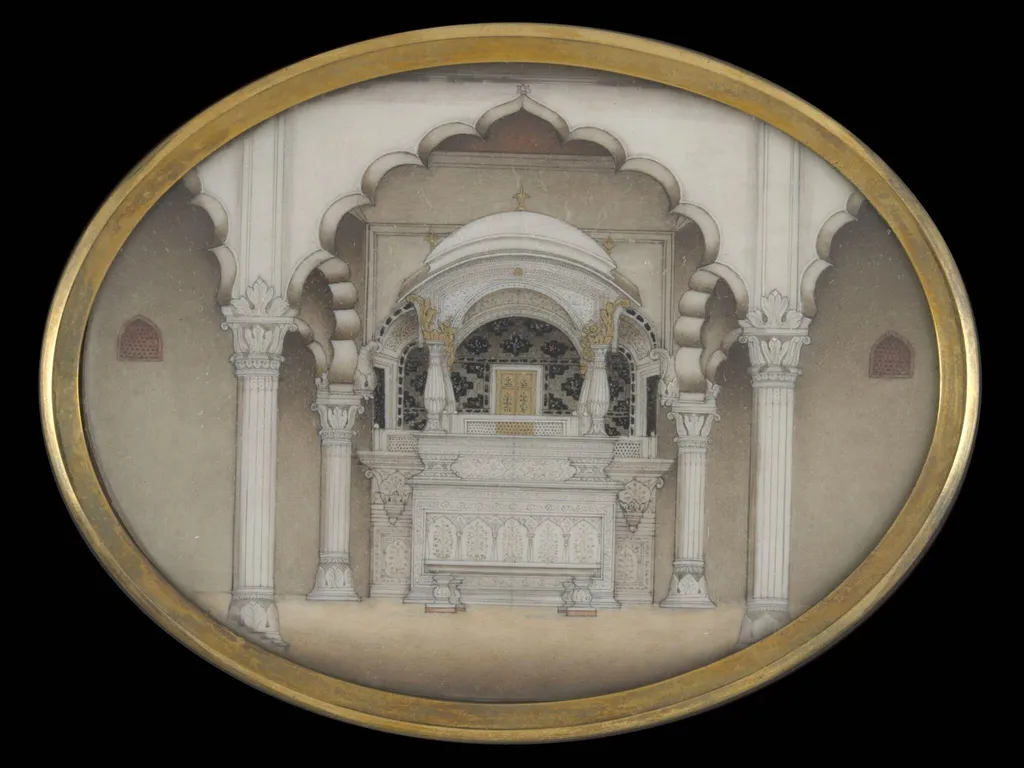
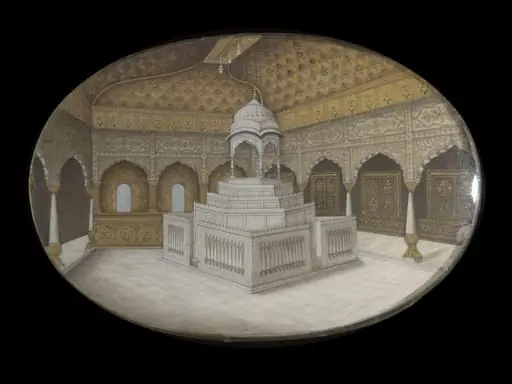
One of five views of Delhi and one of Lahore. is a paint painting by the Impressionist artist Unknown. It dates from 1850 and is held in the collection of the Victoria and Albert Museum. This oval ivory plaque depicts a view of the Diwan-i Am in Delhi’s Red Fort, one of six such panels created as a set.
About this work
This painting shows a view of the emperor's seat in the Diwan-i Am, a hall in the Red Fort.
The Red Fort was built by Shah Jahan in 1639 as part of a new imperial capital. It's interesting that this plaque is part of a set of six, made for Europeans in India who wanted souvenirs of their travels.
This artwork uses a skilled technique, similar to that of chiaroscuro.
Overview
This oval ivory plaque depicts a view of the Diwan-i Am in Delhi’s Red Fort, one of six such panels created as a set.
This oval ivory plaque depicts a view of the Diwan-i Am in Delhi’s Red Fort, one of six such panels created as a set. Produced in the mid-19th century, it was intended as a travel souvenir for European residents and visitors in India. The work reflects a shift in artistic production as Mughal court patronage waned, and painters adapted their skills to meet new commercial demands from foreign patrons.
Subject & Meaning
The scene captures the emperor’s throne platform within the Diwan-i Am, the public audience hall commissioned by Shah Jahan in 1639. Rather than emphasizing imperial power, the focus is on architectural detail and spatial depth, framing the seat as a quiet, empty center. This suggests the image served more as a topographical record than a political statement, aligning with its role as a keepsake for foreign observers.
Technique & Style
Executed in fine brushwork on ivory, the painting draws from the miniature tradition of Mughal court art, with precise lines and layered pigments. Subtle gradations of light and shadow suggest volume without full chiaroscuro, maintaining the delicate aesthetic of Indian painting. The scale and medium reflect adaptation to European tastes for portable, refined objects, while preserving indigenous craftsmanship.
History & Provenance
The plaque belongs to a series of six views of Mughal monuments, likely commissioned by Indian artists working outside royal courts during the 19th century. As Mughal authority declined, former court painters turned to the European market in cities like Delhi and Lahore. These works were collected as mementos by British officials, soldiers, and travelers, forming part of a broader souvenir industry by the 1840s.
Context
During the early 19th century, British presence in India expanded rapidly, fueling demand for culturally specific artifacts. Artists in Delhi and Lahore responded by producing small-scale, detailed views of imperial architecture. These works bridged Indian artistic heritage and colonial curiosity, offering foreign buyers a tangible connection to a fading Mughal legacy, now reinterpreted for a Western audience.
Legacy
This plaque exemplifies the transition of Indian painting from courtly service to commercial enterprise. It preserves the technical precision of miniature traditions while adapting to new markets and functions. Such works remain important records of how indigenous art forms evolved under colonial influence, documenting both architectural heritage and the cultural exchanges of the period.
Artist & collection

 Domestic Scene
 Giacomo and Cardinal Marco, investing Andrea, Abbot of San Zeno, with his Benefice
 The Nymph of Fontainebleau
 Portrait of a Woman
 Madonna and Child with Saints in the Enclosed Garden
 Venus and Minerva
 Family Group of Four on Sofa
 Wall painting from Room H of the Villa of P. Fannius Synistor at Boscoreale