Artwork
One of twenty mica paintings depicting Hindu deities and festival processions with decorated cars.
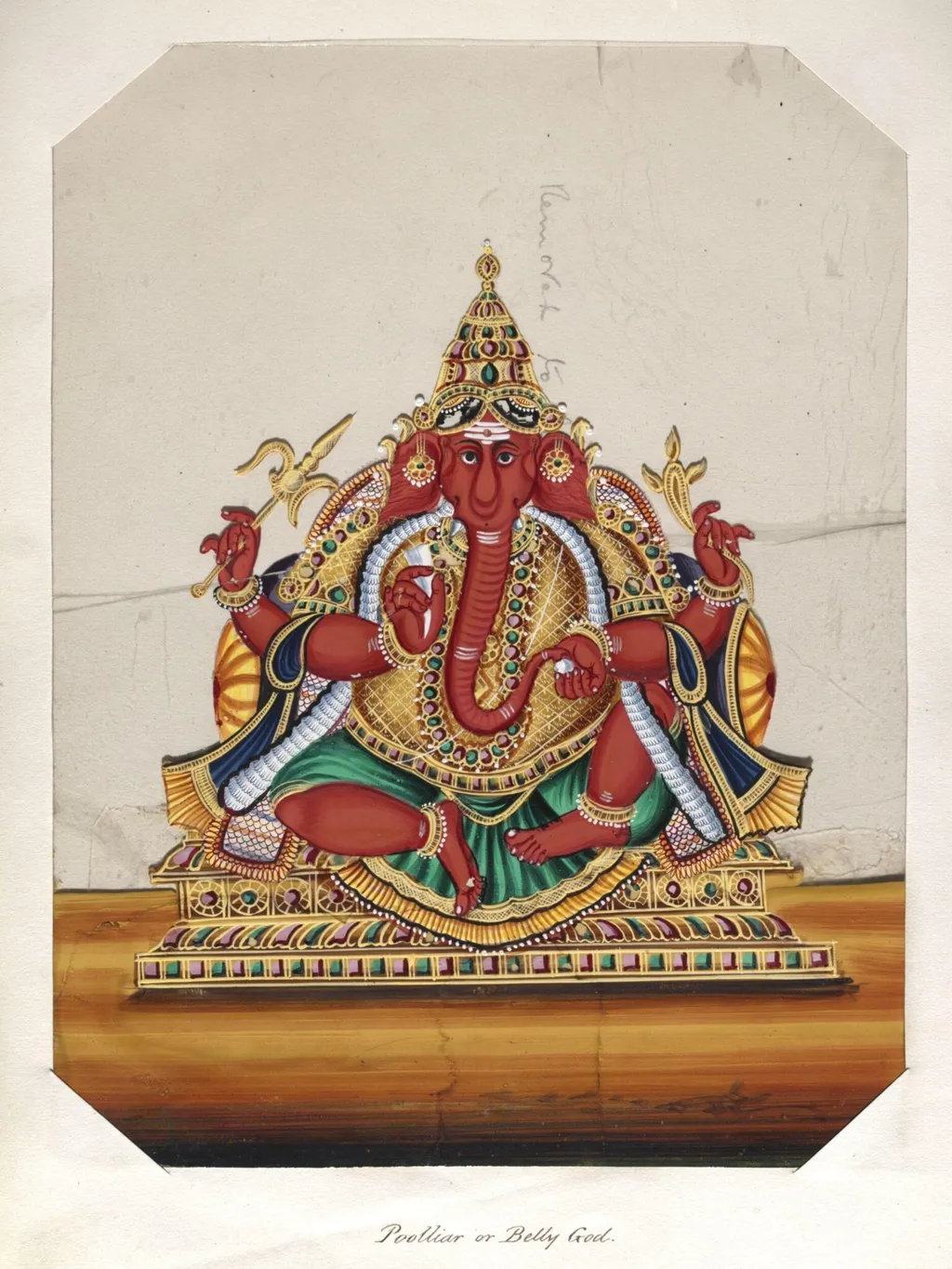
One of twenty mica paintings depicting Hindu deities and festival processions with decorated cars. is a paint painting by the Patna School of Painting artist Unknown. It dates from 1850 and is held in the collection of the Victoria and Albert Museum.
About this work
Overview
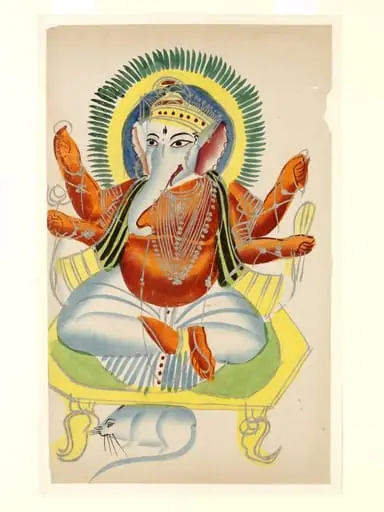
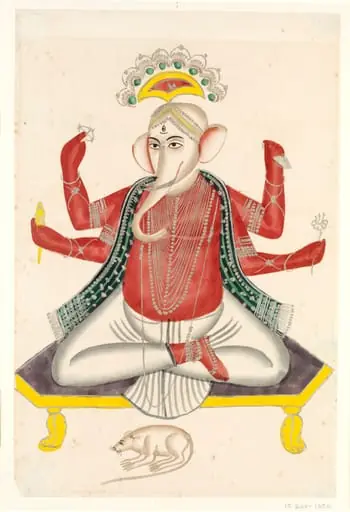
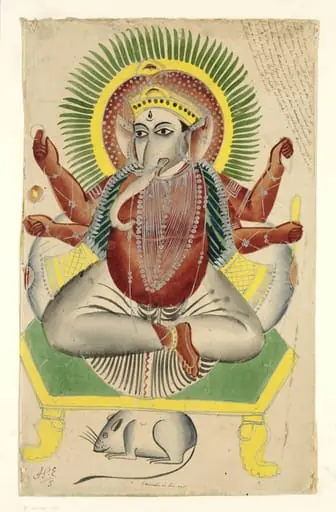
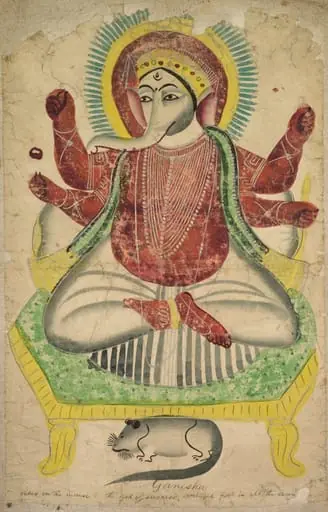
This work is one of a series of twenty small paintings executed on mica, a translucent mineral sheet, that illustrate Hindu deities and the lively processions of festivals featuring elaborately adorned ceremonial cars. The composition centers on a red, elephant‑headed figure seated on a gilded throne, rendered with vivid pigments and inlay that catch and reflect light.
Subject & Meaning
The central figure represents a Hindu god commonly associated with wisdom and strength, identifiable by the elephant head, four arms, and attributes such as a drum and a small pot. The iconography follows traditional religious conventions, conveying the deity’s power and benevolence within the context of a celebratory procession.
Technique & Style
Painted on mica, the artist employed mineral pigments and gold leaf to achieve a luminous surface. The throne is covered with multicolored, reflective stones, and the figure’s facial features—large eyes and a nasal ring—are delineated with fine brushwork, creating a striking contrast between the opaque colors and the translucent support.
History & Provenance
The series was likely produced for a patron or temple in the Indian subcontinent during the late 19th or early 20th century, a period when mica paintings were commissioned for devotional and decorative purposes. The piece entered the collection of the Victoria and Albert Museum, where it is displayed alongside related works from the same set.
Context
Mica paintings served both religious and aesthetic functions, often accompanying festivals that featured richly decorated processional vehicles. By portraying the deity on a throne amid such a scene, the work reflects the integration of ritual performance and visual splendor characteristic of Hindu celebratory culture.
Legacy
The surviving set of twenty mica panels offers scholars insight into regional artistic practices, material choices, and devotional iconography of the period. Their preservation in a major museum enables comparative study with other South Asian media and highlights the cross‑cultural interest in Indian festival imagery.
Artist & collection

 Domestic Scene
 Giacomo and Cardinal Marco, investing Andrea, Abbot of San Zeno, with his Benefice
 The Nymph of Fontainebleau
 Portrait of a Woman
 Madonna and Child with Saints in the Enclosed Garden
 Venus and Minerva
 Family Group of Four on Sofa
 Wall painting from Room H of the Villa of P. Fannius Synistor at Boscoreale