Artwork
Prăznicar, "Răstignirea”
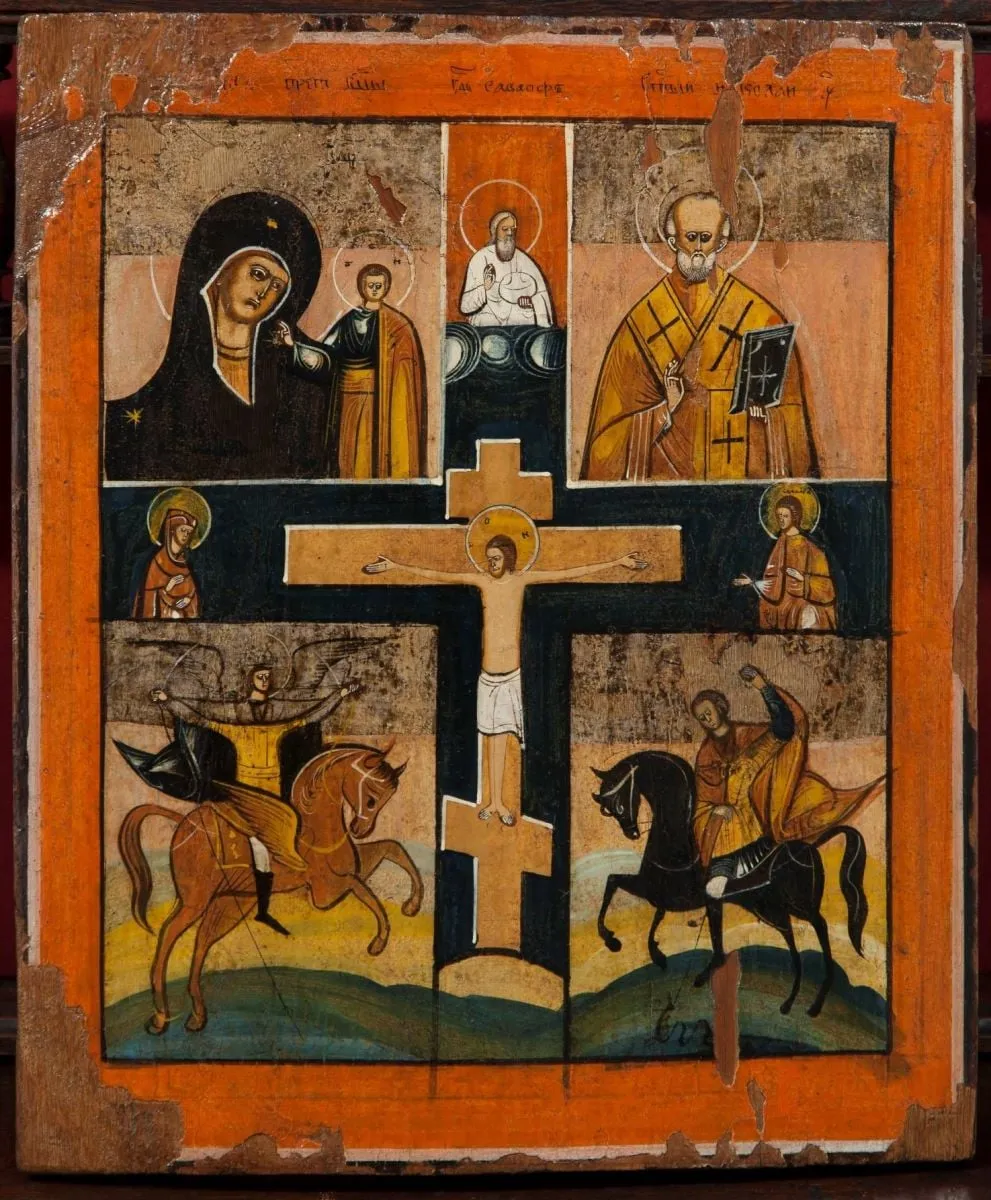
Prăznicar, "Răstignirea” is a drawing by Unknown. It dates from 1850 and is held in the collection of the National Museum of Art of Romania. This small devotional panel presents six compact scenes arranged in a grid, centered on the Crucifixion.
About this work
Overview
The composition organizes sacred narrative into a structured visual hierarchy, with the crucified Christ as the focal point.
This small devotional panel presents six compact scenes arranged in a grid, centered on the Crucifixion. The composition organizes sacred narrative into a structured visual hierarchy, with the crucified Christ as the focal point. Above him, three haloed figures—likely the Virgin Mary, Christ, and John the Baptist—observe the event, while two mounted riders flank the lower edges, their gestures suggesting movement or witness.
Subject & Meaning
The central Crucifixion anchors the panel as the theological core, surrounded by figures representing divine witness and earthly response. The haloed individuals above signify sacred presence, while the horsemen may symbolize apostles or angels in motion, reinforcing the event’s cosmic significance. The arrangement invites contemplation of Christ’s sacrifice as both historical and transcendent, framed by figures who embody faith and testimony.
Technique & Style
The artist employs fine linear detailing to model form, particularly in the use of cross-hatching to suggest volume and shadow without relying on color gradation. Figures are stylized, with elongated proportions and simplified drapery, typical of medieval iconographic traditions. The gold halos function as both identifiers of holiness and visual anchors, reinforcing the spiritual hierarchy within the confined space.
History & Provenance
The panel originates from a Romanian Orthodox context, likely created in the 15th or 16th century for private or monastic devotion. Its small scale suggests use in domestic prayer or as part of a larger altarpiece. Though its exact provenance is undocumented, stylistic parallels link it to regional icon-painting workshops in Moldavia or Transylvania, where such narrative grids were common in liturgical objects.
Context
In Eastern Orthodox tradition, multi-scene panels served as visual catechisms, guiding the faithful through key moments of salvation history. The grid format allowed sequential storytelling within a single sacred object, suited to illiterate congregations. The inclusion of horsemen may reflect local interpretations of apocalyptic or angelic intervention, blending biblical narrative with regional devotional customs.
Legacy
This panel exemplifies the enduring influence of Byzantine iconography in Romanian religious art, preserving compositional conventions that persisted into the early modern period. Its structured narrative and symbolic clarity reflect a broader medieval aesthetic that prioritized spiritual meaning over naturalism. Such works continue to inform contemporary understandings of Eastern Christian visual theology.
Artist & collection

 Domestic Scene
 Giacomo and Cardinal Marco, investing Andrea, Abbot of San Zeno, with his Benefice
 The Nymph of Fontainebleau
 Portrait of a Woman
 Madonna and Child with Saints in the Enclosed Garden
 Venus and Minerva
 Family Group of Four on Sofa
 Wall painting from Room H of the Villa of P. Fannius Synistor at Boscoreale
 Răstrile
 Icoană în patru registre, în centru Iisus Crucificat
 Răst res
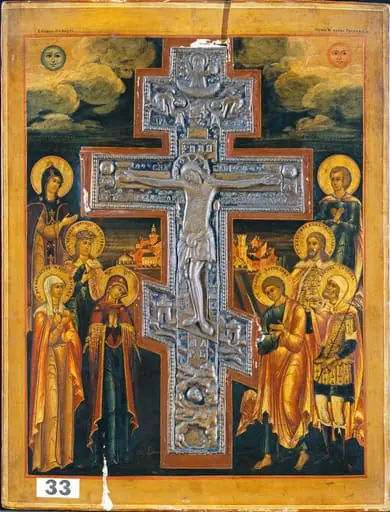 The Crucifixion
 Răstshka
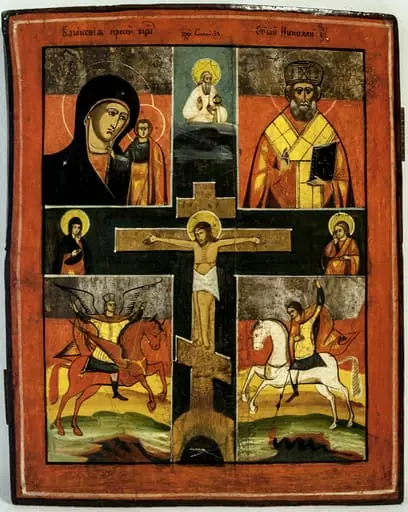
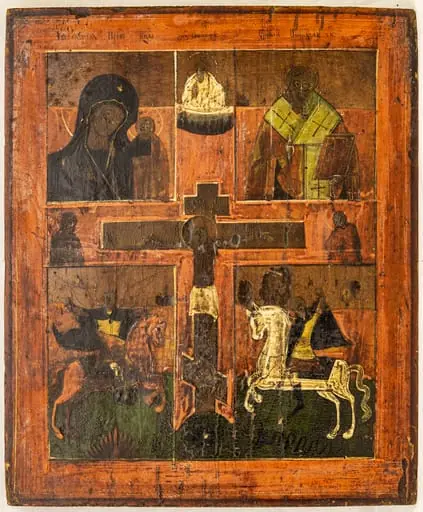
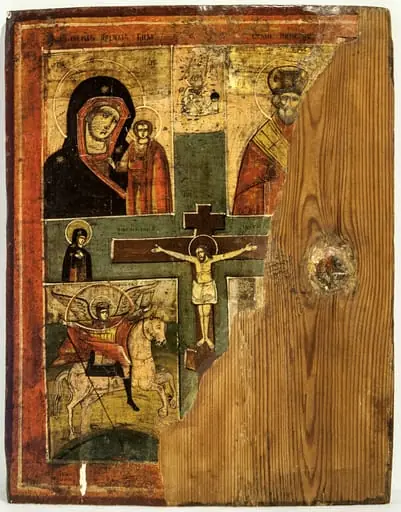
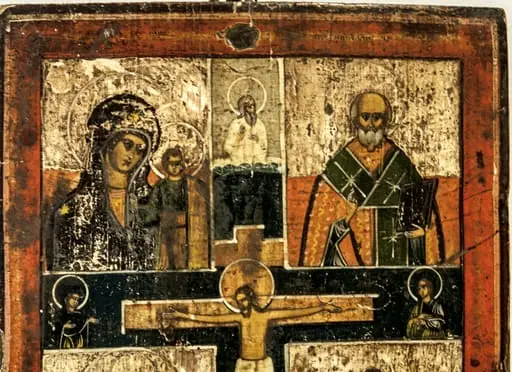
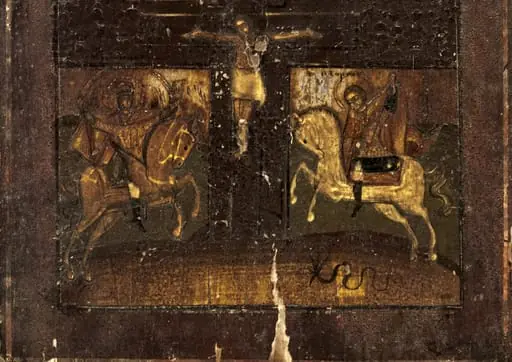 Răstignirea lui Iisus Hristos plasată pe un câmp central sub formă de cruce, împarte spațiul pictural în patru casete dreptunghiulare, Iisus Hristos răstignit pe crucea cu 6 brațe (specifică ortodoxiei ruse), cu un veșmânt alb în jurul mijlocului, ochii închiși, nimbul cu inscripțiile consacrate. Cele 4 casete conțin următoarele scene: Stânga sus Maica Domnului cu Pruncul tipul Kazanskaia. Este reprezentată până la piept, nu se văd mâinile. Are chipul îndurerat, privirea tristă, îndreptată în jos, capul ușor înclinat spre Prunc. Maforion negru. Iisus – Emanuel, binecuvintează cu dreapta, nimbul cruciger. Înveșmântat cu chiton verde și himation bej. Dreapta sus - Sf. Nicolae în veșminte de arhiereu, cărunt, cu barba rotundă și scurtă, capul descoperit. Înveșmântat cu sacos grena decorat cu șiruri de motive verticale de culoare galbenă, omofor verde cu cruci albe, binecuvântând cu mâna dreaptă, în stânga ținând Evanghelia închisă.; Stânga jos- Sf. Arh. Mihail, înaripat, purtând coroană, cu mantia în vânt, călare pe un cal roșu, de asemenea înaripat, în poziție cambrată. Dreapta jos - Sf. Gheorghe, oștean, călare pe un cal alb în poziție cambrată, înfigând, cu ambele mâini, sulița în gura balaurului, minimizat, redat schematic. Fondul: negru(scena centrală), scenele de sus: 3/4 grena, 1/4 foița metalică, nimburile cu linie discretă, la scenele de jos porțiune de relief redat printr-o zonă de brun care traversează spațiul cruciform și se continuă cu relief colinar în cele două casete. Chenarul marginal specific icoanelor tip krasnushka.Inscripții caligrafice cu negru.Vernis îmbătrânit, care acoperă inscripțiile.
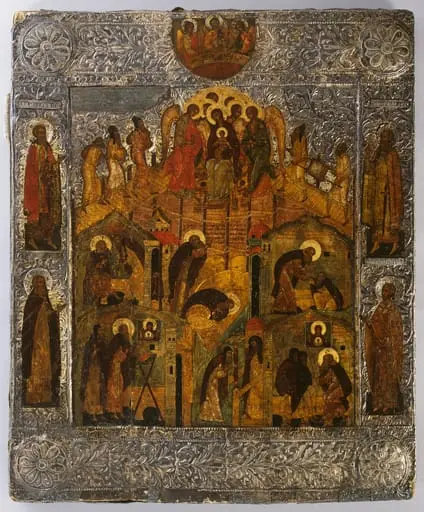 Neitsyt Marian ilmestyminen pyhittäjä Aleksanteri Syväriläiselle kirkon perustuksella
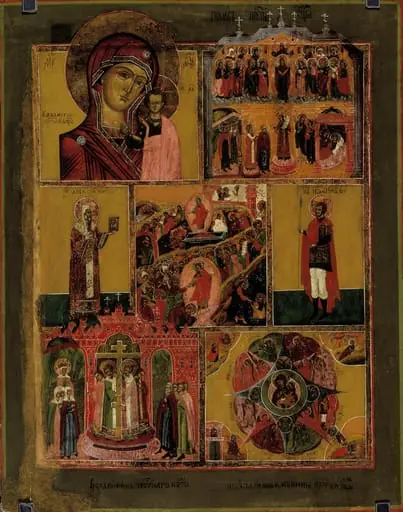 Pääsiäinen ja kirkkovuoden juhlia, venäläinen ikoni
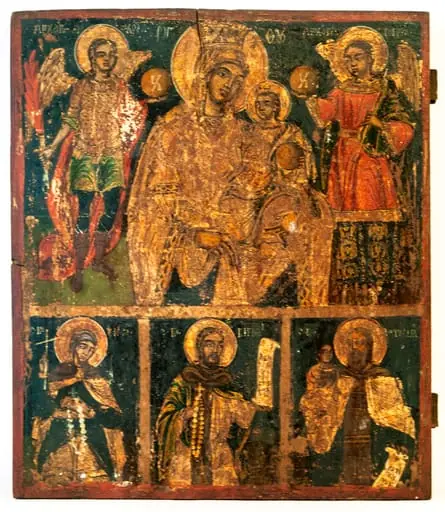 Icoașat
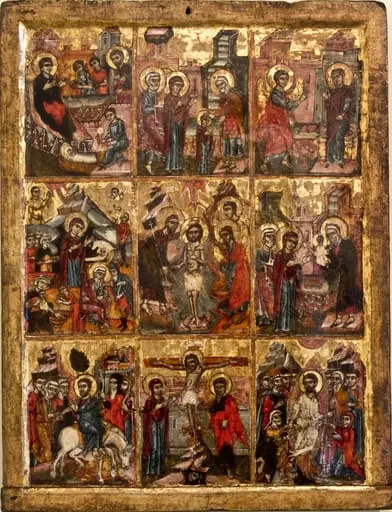 Scene din viața lui Iisus și a Maicii Domnului