Artwork
Răstignirea și învierea Mântuitorului Iisus Hristos
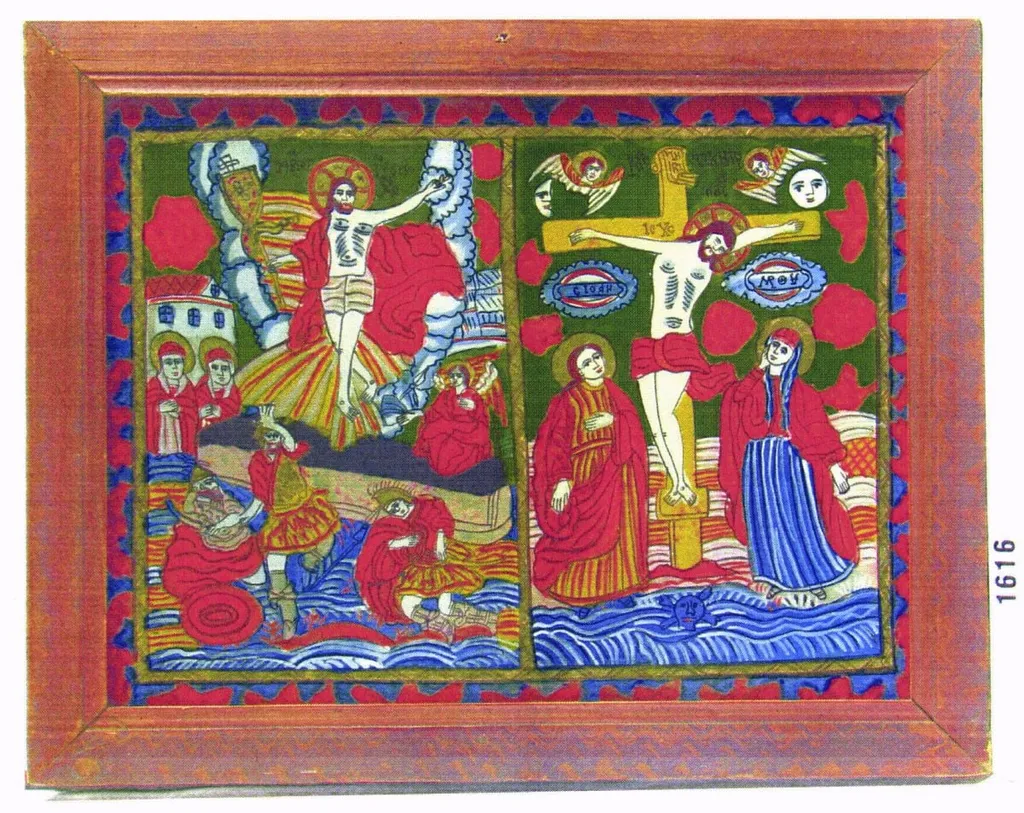
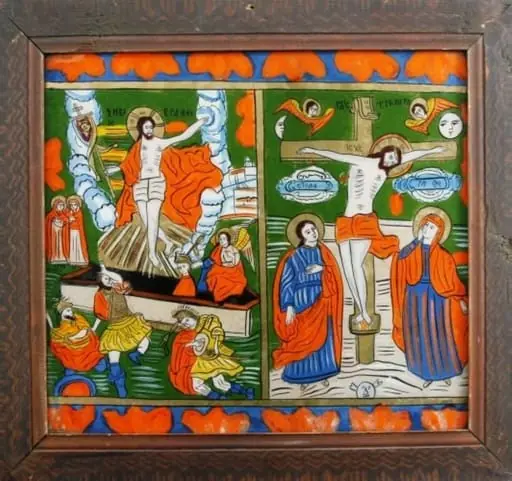
Răstignirea și învierea Mântuitorului Iisus Hristos is a drawing by Unknown. It dates from 1850 and is held in the collection of the ASTRA National Museum Complex. This artwork presents two distinct biblical moments—Crucifixion and Resurrection—arranged side by side on a single surface.
About this work
Overview
Rendered in a folk-art idiom, the composition uses bold outlines and vivid, flat colors against a green ground, emphasizing spiritual narrative over naturalism.
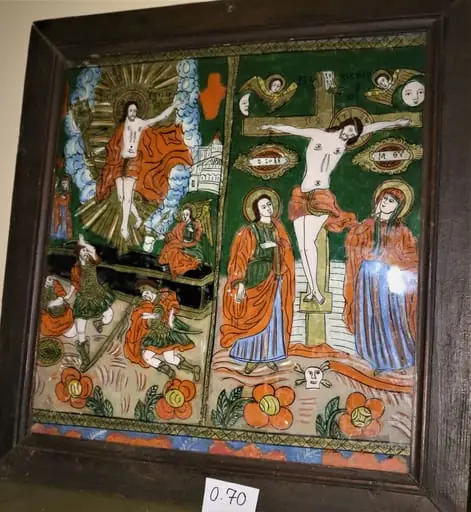
This artwork presents two distinct biblical moments—Crucifixion and Resurrection—arranged side by side on a single surface. Each scene centers on a haloed figure with outstretched arms, framed by figures in red robes, some kneeling in reverence. Rendered in a folk-art idiom, the composition uses bold outlines and vivid, flat colors against a green ground, emphasizing spiritual narrative over naturalism.
Subject & Meaning
The left panel depicts Christ’s resurrection, shown as a triumphant figure surrounded by witnesses, while the right portrays his crucifixion, emphasizing sacrifice. The dual scenes together convey the Christian doctrine of death and rebirth. The consistent use of halos and posture links the two events as inseparable parts of salvation, reinforcing theological unity through visual symmetry.
Technique & Style
The painting employs a simplified, non-illusionistic style typical of regional religious folk art. Figures are outlined in strong lines, colors are unmixed and saturated, and spatial depth is minimized. The red robes, blue accents, and green background create a symbolic palette rather than a realistic one, prioritizing devotional clarity over anatomical or environmental accuracy.
History & Provenance
Though specific origins are unrecorded, the style aligns with Orthodox Christian iconographic traditions from rural Eastern Europe, likely produced in the 19th or early 20th century by itinerant or local artisans. Such works were often commissioned for home altars or village churches, serving as aids to personal prayer and communal worship.
Context
This piece reflects a broader tradition of vernacular religious art in Orthodox communities, where literacy was limited and visual storytelling was essential. Similar double-scene compositions appear in wall paintings and portable icons, blending canonical themes with regional aesthetics to make sacred narratives accessible to lay audiences.
Legacy
As an example of untrained religious art, it preserves a devotional aesthetic distinct from academic traditions. Its continued presence in collections highlights the enduring value of folk expressions in religious culture, offering insight into how faith was visually sustained outside institutional frameworks.
Artist & collection

 Domestic Scene
 Giacomo and Cardinal Marco, investing Andrea, Abbot of San Zeno, with his Benefice
 The Nymph of Fontainebleau
 Portrait of a Woman
 Madonna and Child with Saints in the Enclosed Garden
 Venus and Minerva
 Family Group of Four on Sofa
 Wall painting from Room H of the Villa of P. Fannius Synistor at Boscoreale