Artwork
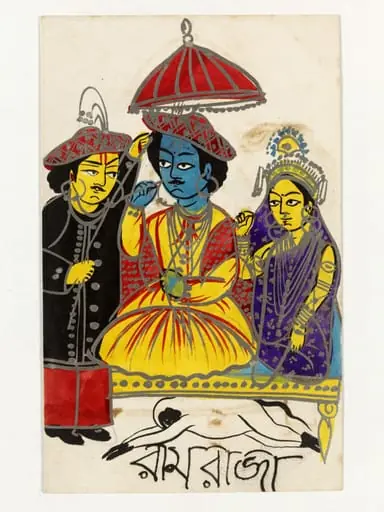
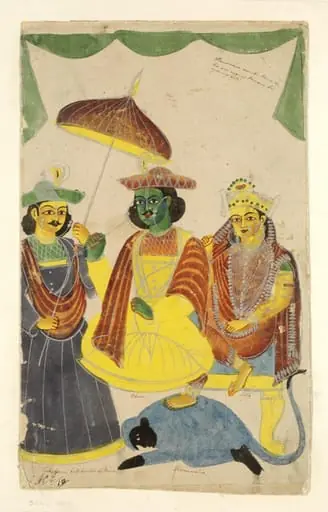
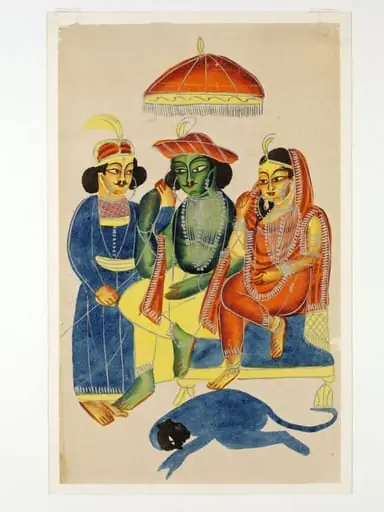
Rama and Sita, Hanuman and Satyabhama
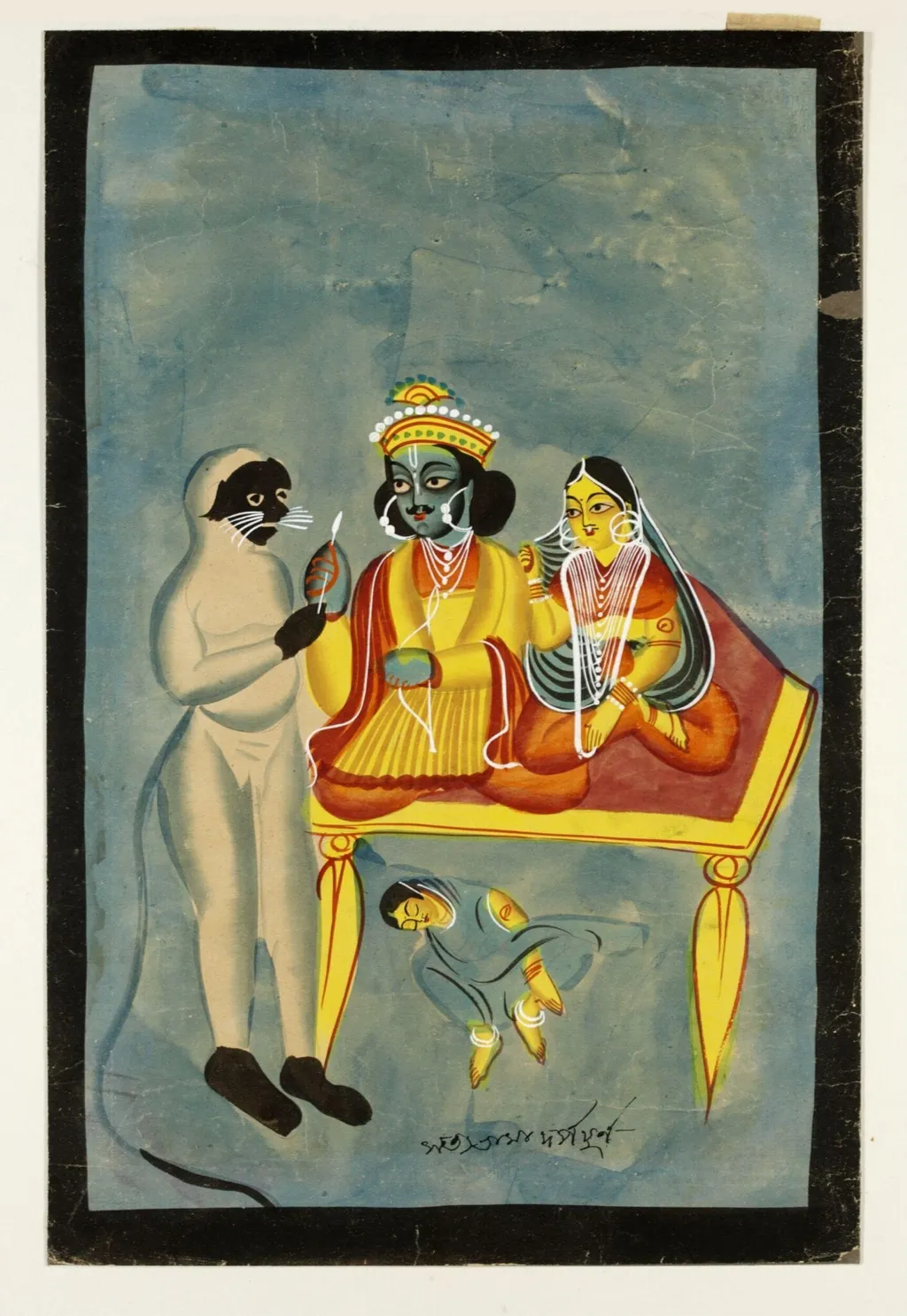
Rama and Sita, Hanuman and Satyabhama is a paint painting by the Impressionist artist Unknown. It dates from 1885 and is held in the collection of the Victoria and Albert Museum.
About this work
Overview
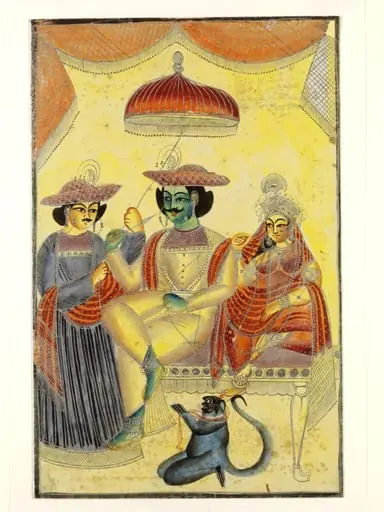
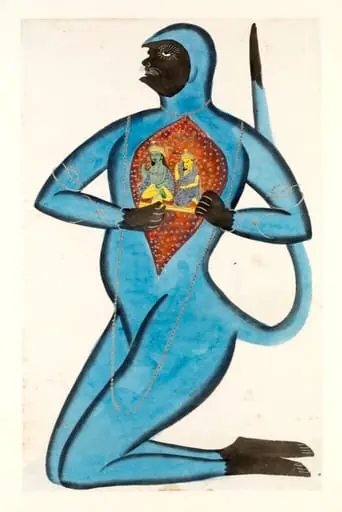
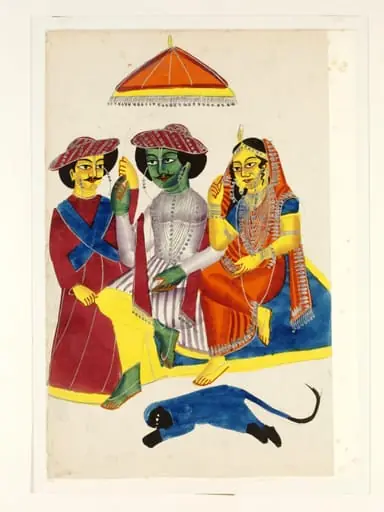
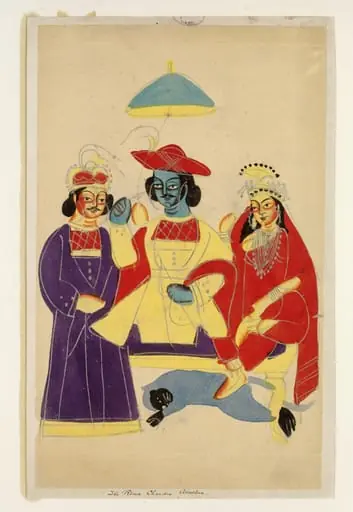
The work is an opaque watercolor on paper created in 1885, portraying four figures from Hindu mythology in a flat, brightly colored composition. Rama and Sita sit together on a couch, while the monkey‑god Hanuman stands nearby, and Satyabhama, a consort of Krishna, kneels at their feet. The background is a uniform blue, lacking any perspective.
Subject & Meaning
The scene brings together characters from two distinct epic narratives: Rama and Sita from the Ramayana, and Satyabhama from the Krishna legends. Their juxtaposition suggests a syncretic devotional theme, highlighting the interconnectedness of divine couples and heroic figures within Hindu religious art.
Technique & Style
Executed in opaque watercolour, the painting employs the characteristic flat planes and vivid hues of the Kalighat school of Kolkata. The figures feature stylised facial markings, such as Rama’s blue skin with white accents, a hallmark of Kalighat portraiture that emphasizes narrative clarity over naturalistic depth.
History & Provenance
The piece entered the collection through Miss M. Steele in 1894. Steele’s mother, a Sanskrit scholar at Cambridge, had inherited the work, and Steele recorded that her grandmother, who had lived in India, may have originally acquired it. The artist remains unidentified.
Context
Kalighat paintings emerged in the 19th‑century bustling waterfront of Kolkata, catering to pilgrims and travelers. They frequently depicted scenes from Hindu epics, rendered in a commercial yet expressive manner that blended folk aesthetics with emerging urban tastes.
Artist & collection

 Domestic Scene
 Giacomo and Cardinal Marco, investing Andrea, Abbot of San Zeno, with his Benefice
 The Nymph of Fontainebleau
 Portrait of a Woman
 Madonna and Child with Saints in the Enclosed Garden
 Venus and Minerva
 Family Group of Four on Sofa
 Wall painting from Room H of the Villa of P. Fannius Synistor at Boscoreale