Artwork
Ranjit Singh and Hira Singh
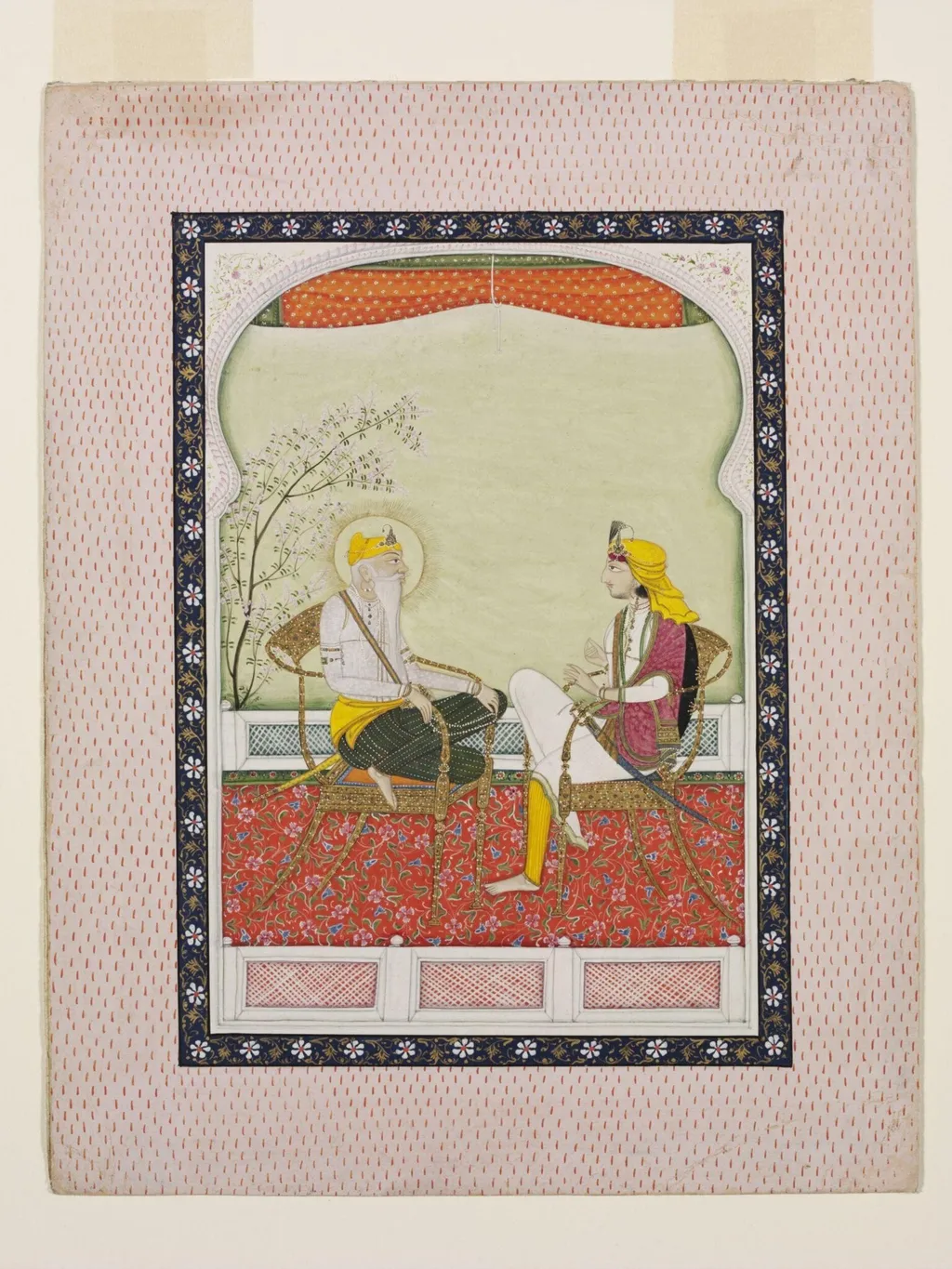
Ranjit Singh and Hira Singh is a paint painting by the Romanticist artist Unknown. It dates from 1838 and is held in the collection of the Victoria and Albert Museum. This portrait depicts Ranjit Singh, the first Sikh maharaja of the Punjab (r.
About this work
Overview
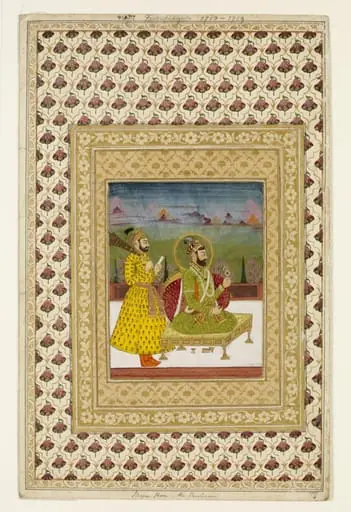
This portrait depicts Ranjit Singh, the first Sikh maharaja of the Punjab (r. 1801–1839), alongside Hira Singh, a young courtier. The composition reflects a moment of patronage, capturing the maharaja in a pose frequently observed by European visitors. The painting offers a visual record of the relationship between ruler and protégé within the Sikh court.
Subject & Meaning
The work portrays Ranjit Singh seated on a Western-style chair, a gesture aligning with his diplomatic engagements with foreign dignitaries.
The work portrays Ranjit Singh seated on a Western-style chair, a gesture aligning with his diplomatic engagements with foreign dignitaries. Hira Singh, introduced by his father Dhian Singh, a prominent court figure, stands beside him. In 1828, Ranjit Singh bestowed upon the boy the title of raja and later honored him as ‘Farzand-i khas’—‘the favoured son,’ signaling a bond of mentorship and political alliance.
Technique & Style
Executed in a manner attuned to European tastes, the painting employs controlled shading and refined detail to convey likeness and status. The treatment of fabric, posture, and facial features suggests an awareness of Western portrait conventions, though it retains elements of South Asian courtly representation. The restrained use of sfumato softens transitions between forms, lending the figures a lifelike presence.
History & Provenance
The painting entered the collection of Lord Auckland, Governor-General of India (1836–1842), following his visit to Ranjit Singh’s court in 1838. It was subsequently brought to England in 1842 and remained in private hands until 1953, when Auckland’s great-nephew, O.E. Dickinson, donated it to the Victoria and Albert Museum.
Context
The portrait emerges from a period of cultural exchange between the Sikh court and British colonial officials. Ranjit Singh’s adoption of Western seating and attire in formal settings reflects his strategic engagement with European visitors, while the inclusion of Hira Singh underscores the maharaja’s role as a patron of loyal courtiers. Such images served both as diplomatic gestures and as records of courtly hierarchy.
Artist & collection

 Domestic Scene
 Giacomo and Cardinal Marco, investing Andrea, Abbot of San Zeno, with his Benefice
 The Nymph of Fontainebleau
 Portrait of a Woman
 Madonna and Child with Saints in the Enclosed Garden
 Venus and Minerva
 Family Group of Four on Sofa
 Wall painting from Room H of the Villa of P. Fannius Synistor at Boscoreale