Artwork
Ratan Singh
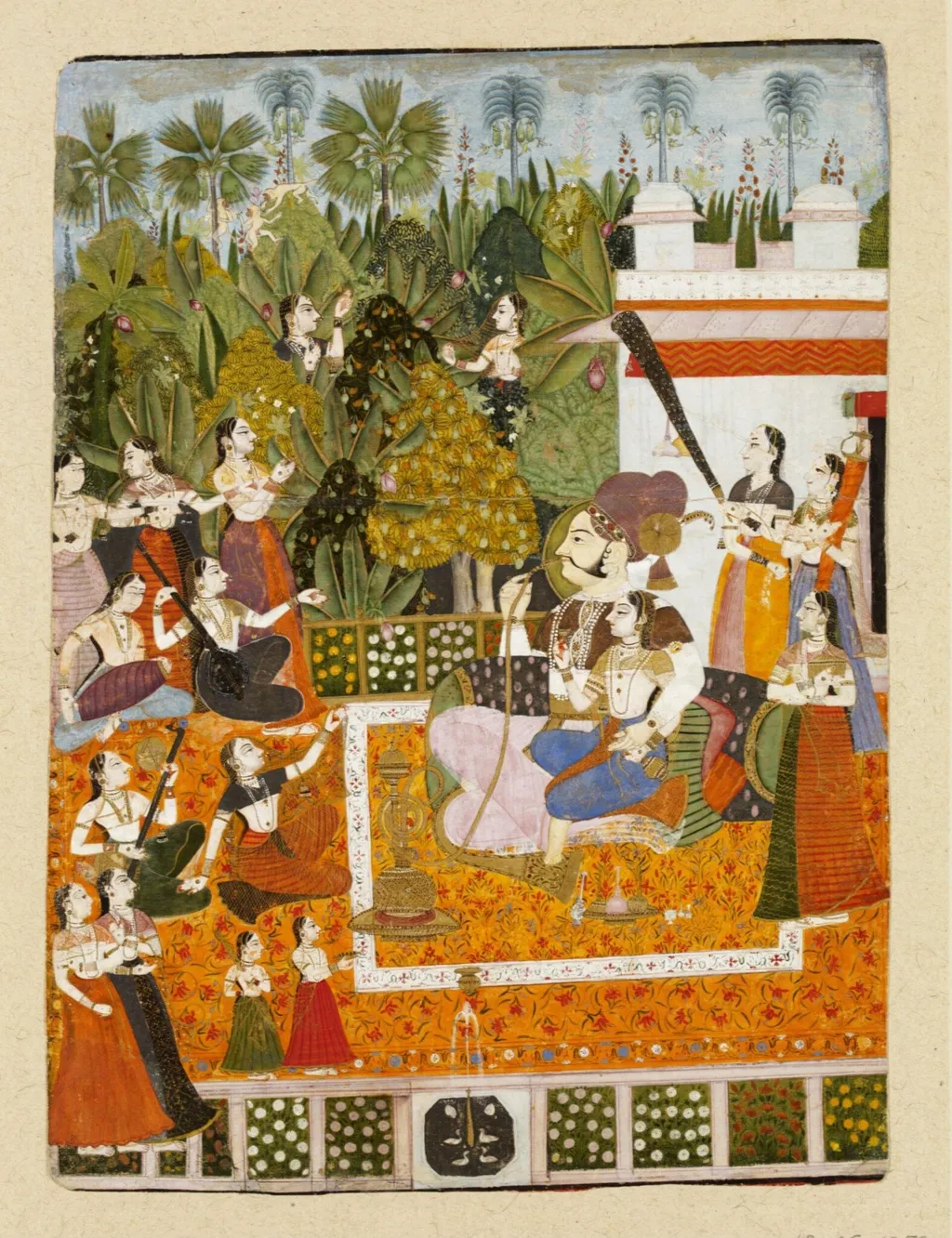
Ratan Singh is a paint painting by Unknown. It dates from 1750 and is held in the collection of the Victoria and Albert Museum.
About this work
Overview
Executed by an anonymous artist, the work exemplifies the Indian miniature painting tradition, characterized by intricate detail and vivid pigments.
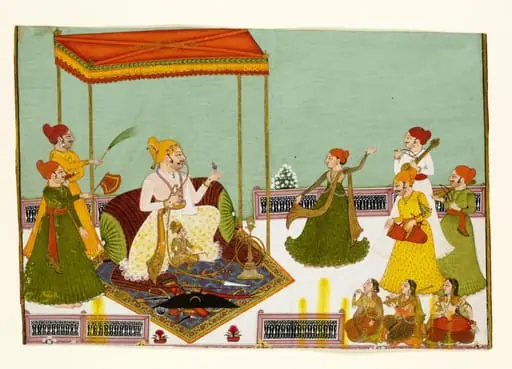
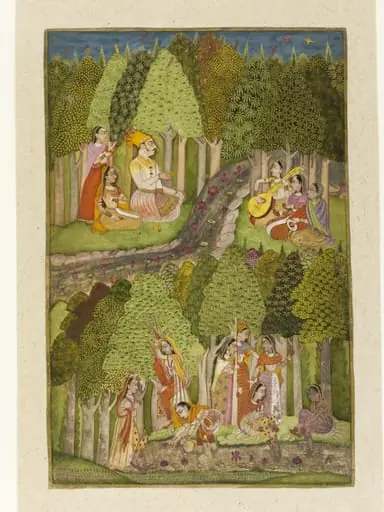
This opaque watercolor on paper, dated to approximately 1750, portrays Ratan Singh, a regional ruler, in a cultivated garden setting. Executed by an anonymous artist, the work exemplifies the Indian miniature painting tradition, characterized by intricate detail and vivid pigments. The composition centers on the figure of the ruler, surrounded by attendants and musicians, reflecting courtly leisure as a subject of artistic patronage in 18th-century North India.
Subject & Meaning
Ratan Singh is depicted seated on an elevated platform, holding a fan, symbolizing authority and repose. Around him, female musicians and dancers engage in performance, while attendants stand in attentive groups. The garden setting, rich with flora and ornamental tiles, evokes an idealized space of royal retreat. The scene conveys not merely recreation but the cultural and social order of a court, where music, beauty, and hierarchy are mutually reinforced.
Technique & Style
The painting employs fine brushwork and opaque watercolor to achieve luminous, saturated hues—emerald greens, crimson reds, and gold accents—typical of Rajput and Pahari schools. Details in textiles, jewelry, and architectural elements are rendered with precision, suggesting close observation and skilled execution. The flat, decorative space, layered with patterned tiles and stylized foliage, avoids perspective in favor of symbolic arrangement, aligning with regional miniature conventions.
History & Provenance
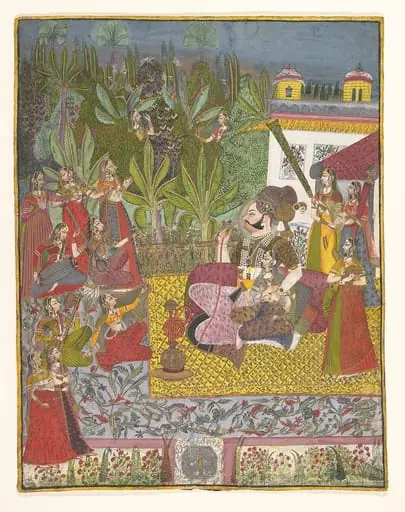
A closely related composition, depicting Maharajah Sri Prabh Singh ji, was recorded in a 1959 Sotheby’s sale and is now held in the S. C. Welch collection at Harvard. While the provenance of this specific painting of Ratan Singh remains undocumented, its stylistic and compositional parallels suggest shared workshop origins or regional artistic exchange. Both works reflect the continuity of courtly portraiture in mid-18th-century North India.
Context
During the mid-1700s, regional courts in North India, though politically fragmented, sustained vibrant artistic traditions. Miniature painting flourished as a medium for documenting court life, often commissioned by rulers to assert cultural legitimacy. Gardens, music, and dance were favored themes, symbolizing refinement and divine favor. This painting fits within a broader network of visual culture linking Rajput, Mughal, and Pahari styles.
Legacy
Though unsigned and unattributed, the painting contributes to the understanding of regional artistic practices in 18th-century India. Its survival and recognition among institutional collections, such as the Victoria and Albert Museum, underscore its value as a document of courtly aesthetics. It remains a reference point for scholars studying the evolution of Indian miniature painting beyond Mughal centers, highlighting the diversity of regional expression.
Artist & collection

 Domestic Scene
 Giacomo and Cardinal Marco, investing Andrea, Abbot of San Zeno, with his Benefice
 The Nymph of Fontainebleau
 Portrait of a Woman
 Madonna and Child with Saints in the Enclosed Garden
 Venus and Minerva
 Family Group of Four on Sofa
 Wall painting from Room H of the Villa of P. Fannius Synistor at Boscoreale
 A Heroine and Her Paramour: Malavi Ragini, from a Ragamala
 Untitled
 A Heroine and Her Paramour: Malavi Ragini, from a Ragamala
 Radha and Krishna
 Vishnu
 Prince and Lady in Palace Scene with Musicians
 Raja Ajit Singh of Bundi
 Dipak ragini
 Radha and Krishna
 Taking of the Toll, Dana-Lila
 Patamanjari Ragini
 Maharaja Raj Singh