Artwork
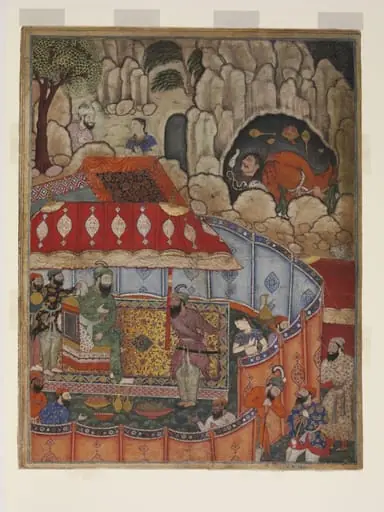
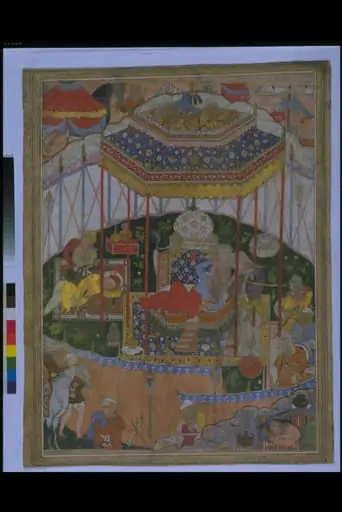
Rustam and Mihrafroz prepare for their wedding
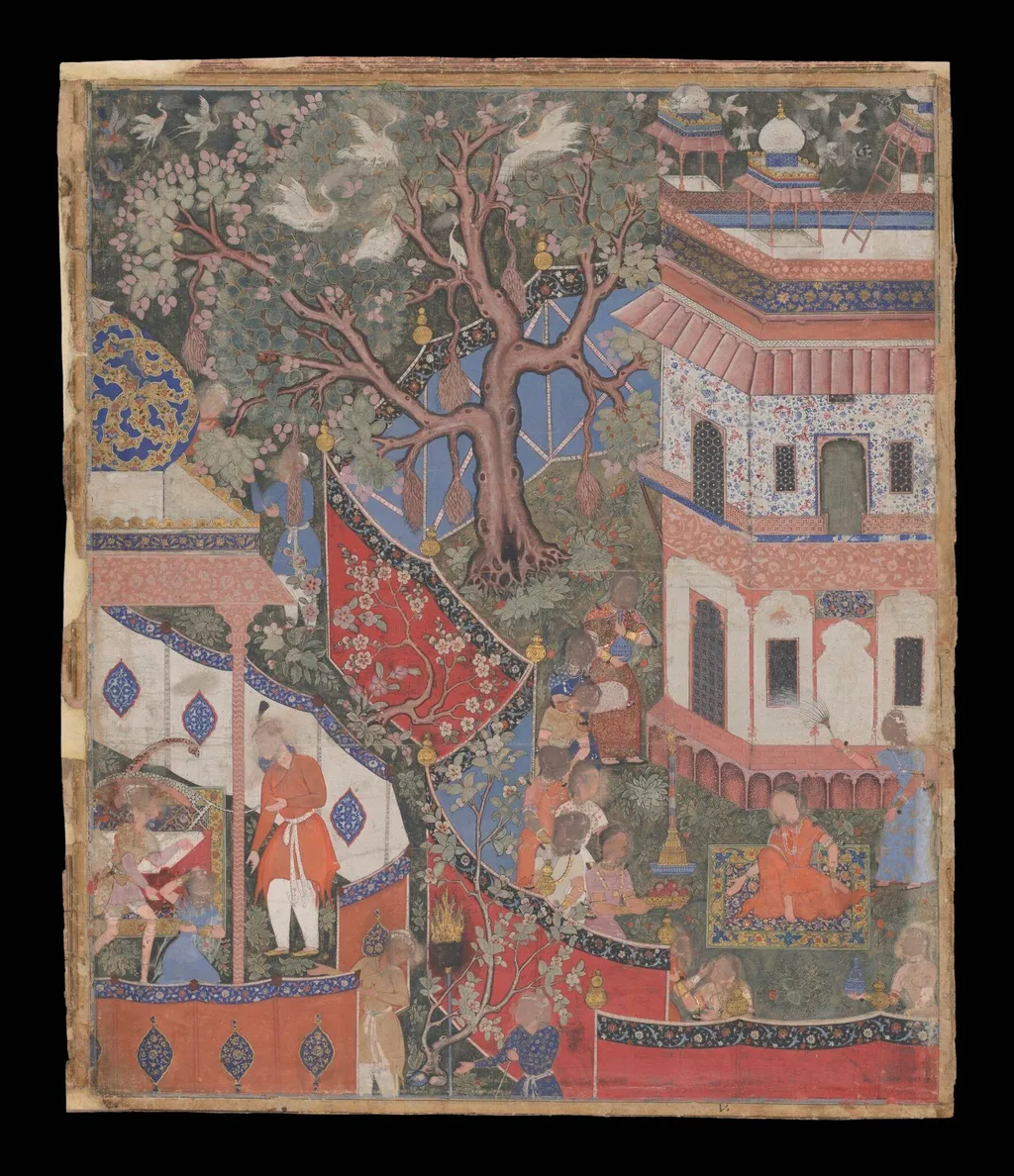
Rustam and Mihrafroz prepare for their wedding is a paint painting by the Mughal Painting artist Unknown. It dates from 1570 and is held in the collection of the Victoria and Albert Museum.
About this work
Overview
This scene captures a quiet moment from the narrative, set apart from the usual battles and quests.
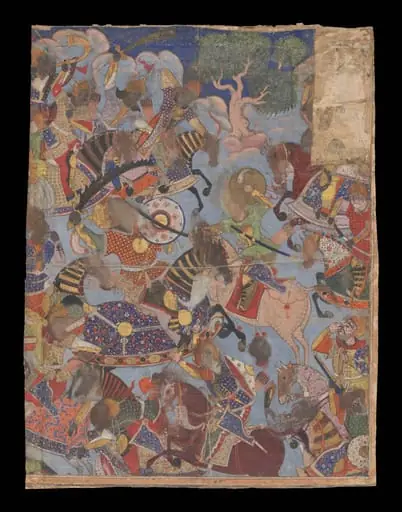
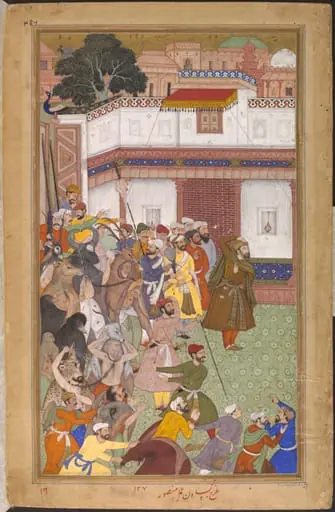
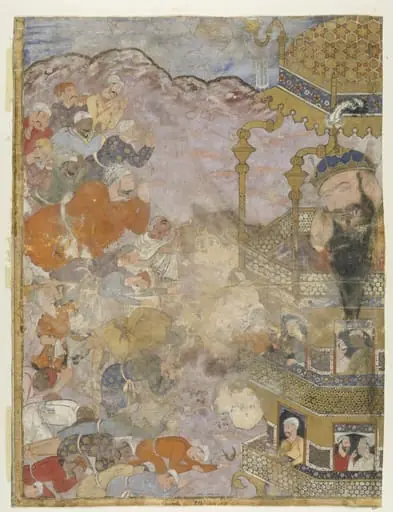
This painting is one of approximately 200 surviving illustrations from the Hamzanama, a vast illustrated epic commissioned by the Mughal emperor Akbar around 1562. Created over fifteen years by a team of artists, it depicted the legendary exploits of Hamza, an uncle of the Prophet Muhammad, drawn from Persian oral traditions. The work was produced in Persian, the imperial language, and originally comprised 1,400 folios. This scene captures a quiet moment from the narrative, set apart from the usual battles and quests.
Subject & Meaning
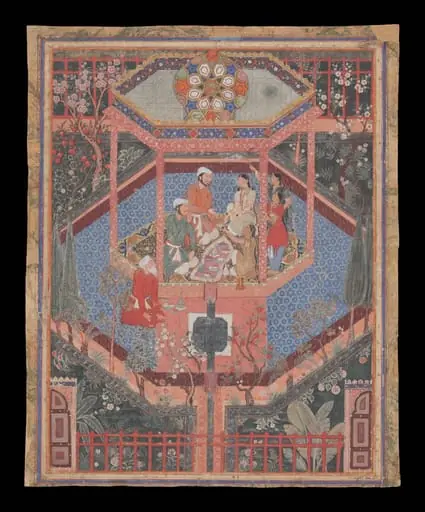
The scene portrays Rustam and Mihr Afruz preparing for their wedding within a garden pavilion enclosed by tent-like walls. Though part of a larger cycle of heroic adventures, this moment focuses on intimacy and ritual rather than combat. The figures, dressed in elaborate robes, are engaged in personal gestures—Rustam adjusting his turban, Mihr Afruz seated in stillness—suggesting a pause in the epic’s momentum. The absence of violent action underscores a cultural emphasis on ceremonial grace within royal narratives.
Technique & Style
The painting blends Persian miniature traditions with Indian artistic sensibilities, characteristic of Akbar’s atelier. Fine brushwork defines the intricate patterns of garments and the delicate rendering of foliage. The landscape is softly modeled with gentle hills and sparse trees, creating a serene backdrop. Notably, all human and avian faces have been deliberately obliterated, likely in the 19th century, altering the original visual narrative and leaving the figures anonymized.
History & Provenance
The Hamzanama project began around 1562 and concluded roughly 15 years later, involving multiple artists working collaboratively. Most of the original 1,400 illustrations have been lost; the surviving fragments are often the only physical records of the text, as the narrative was written on their reverses. This painting’s current condition, with erased faces, reflects later interventions, possibly due to religious or aesthetic shifts in the 1800s, complicating scholarly reconstruction of the full sequence.
Context
Akbar’s patronage of the Hamzanama reflected his interest in synthesizing diverse cultural traditions under Mughal rule. The epic’s Persian roots were adapted through Indian artistic practices, creating a hybrid visual language. While the stories celebrated Islamic heroism, their depiction in courtly settings mirrored Mughal ideals of refined power. This painting’s tranquil tone contrasts with the epic’s usual themes, revealing how court artists could emphasize quiet dignity amid grand narratives.
Legacy
The surviving Hamzanama illustrations remain vital for understanding early Mughal painting and cross-cultural synthesis in South Asia. Their fragmented state—due to loss, dispersal, and later alterations—highlights the vulnerability of manuscript culture. This particular scene, with its erased faces, serves as a silent testament to changing attitudes toward figural representation over centuries, offering insight into both artistic intent and later reinterpretation.
Artist & collection

 Domestic Scene
 Giacomo and Cardinal Marco, investing Andrea, Abbot of San Zeno, with his Benefice
 The Nymph of Fontainebleau
 Portrait of a Woman
 Madonna and Child with Saints in the Enclosed Garden
 Venus and Minerva
 Family Group of Four on Sofa
 Wall painting from Room H of the Villa of P. Fannius Synistor at Boscoreale
 Prince Alamshah Rustam with Mihr Afruz in a garden pavilion
 Umar searches for Hamza
 Hamza receives an envoy of Qitanush Shah
 Hamzanama
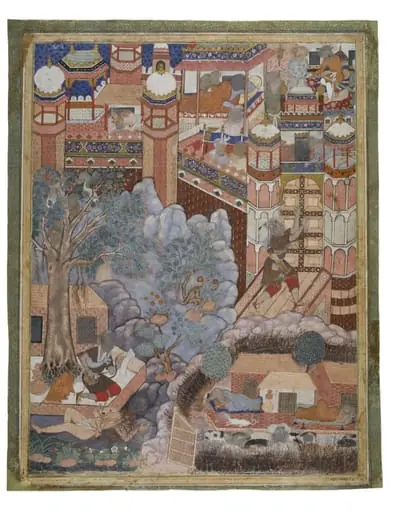 Basu beheads Namadpush and enters Acre Castle
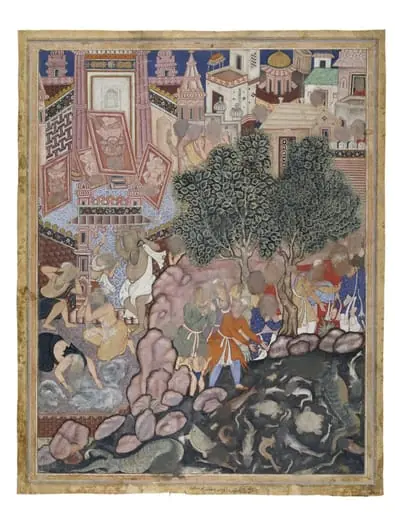 Temple idols fall and the sea dries up on the birth of the Prophet Muhammad
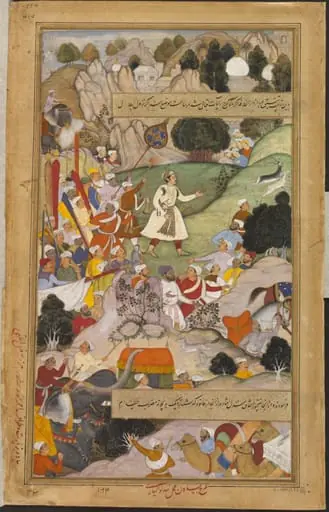 Akbar
Akbar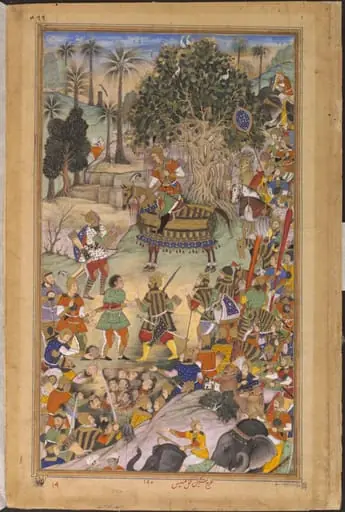 Muhammad Husain Mirza and Akbar
 Hamza's army battles Girang's men and kills a giant
 Husain Quli and Akbar
 Umar is received by the giant Zumrud Shah
 An Ayyar murders Qubad in his sleep