Artwork
Samantabhadra spinning clouds of things, folio 22 (recto) from a Gandavyuha-sutra (Scripture of the Supreme Array)

Samantabhadra spinning clouds of things, folio 22 (recto) from a Gandavyuha-sutra (Scripture of the Supreme Array) is an unspecified painting by Unknown. It dates from 1104 and is held in the collection of the Cleveland Museum of Art. The work is a narrow wooden panel painted on both sides, with dense script covering much of the surface.
About this work
Overview
The work is a narrow wooden panel painted on both sides, with dense script covering much of the surface. At its center a small figure, rendered with a red face and blue skin, sits cross‑legged and holds a fan, surrounded by clouds and a scattering of tiny figures that suggest beings or animals. The palette, though faded, retains vivid reds, blues and golds that contrast with the wood grain.
Subject & Meaning
The central figure is identified as Samantabhadra, a bodhisattva associated with practice and vows in Buddhist iconography. His posture and fan are conventional attributes, while the surrounding clouds and diminutive figures evoke the celestial realm and the flow of karmic activity, reflecting the sutra’s theme of an all‑encompassing, supreme array of phenomena.
Technique & Style
Gold accents highlight divine elements, and the dense script on the reverse demonstrates the panel’s dual function as both visual and textual object.
Executed in pigment on wood, the painting employs a limited but striking color scheme typical of Nepalese religious art. The figure is outlined with fine brushwork, while the background clouds are rendered in broader washes, creating a sense of movement. Gold accents highlight divine elements, and the dense script on the reverse demonstrates the panel’s dual function as both visual and textual object.
History & Provenance
The panel forms folio 22 (recto) of a Gandavyuha‑sutra manuscript, a text that circulated widely in the Himalayan Buddhist tradition. Its creation dates to a period when Nepalese workshops produced illustrated sutras for monastic and lay patrons. The piece has remained attached to the manuscript, preserving its original context as a devotional and instructional object.
Context
In Nepalese Buddhist art, painted sutra folios often combined narrative illustration with extensive marginal script, reflecting a holistic approach to teaching. The depiction of Samantabhadra aligns with the Mahayana emphasis on bodhisattva practice, while the cloud motif resonates with local artistic conventions that blend Indian and Tibetan visual vocabularies.
Artist & collection

 Domestic Scene
 Giacomo and Cardinal Marco, investing Andrea, Abbot of San Zeno, with his Benefice
 The Nymph of Fontainebleau
 Portrait of a Woman
 Madonna and Child with Saints in the Enclosed Garden
 Venus and Minerva
 Family Group of Four on Sofa
 Wall painting from Room H of the Villa of P. Fannius Synistor at Boscoreale
 Samantabhadra spinning clouds of things, folio 22 (recto) from a Gandavyuha-sutra (Scripture of the Supreme Array)
 Folio 22 from a Gandavyuha-sutra (Scripture of the Supreme Array): Samantabhadra spinning clouds of things (recto); Text (verso)
 Folio 348 from a Gandavyuha-sutra (Scripture of the Supreme Array): Bodhisattva Manjushri with two forms of Avalokiteshvara (recto); Bodhisattva Samantabhadra purifies the path to enlightenment, with Manjushri (verso)
 Sudhana and an antelope, folio 73 (recto) from a Gandavyuha-sutra (Scripture of the Supreme Array)
 Bodhisattva Manjushri with two forms of Avalokiteshvara, folio 348 (recto) from a Gandavyuha-sutra (Scripture of the Supreme Array)
 Folio 37 from a Gandavyuha-sutra (Scripture of the Supreme Array): Sudhana and a pair of antelopes (recto); text (verso)
 Folio 73 from a Gandavyuha-sutra (Scripture of the Supreme Array): Sudhana and an antelope (recto); text (verso)
 Sudhana and a parrot, folio 20 (recto) from a Gandavyuha-sutra (Scripture of the Supreme Array)
 Sudhana and a pair of antelopes, folio 37 (recto) from a Gandavyuha-sutra (Scripture of the Supreme Array)
 Folio 20 from a Gandavyuha-sutra (Scripture of the Supreme Array): Sudhana and a parrot (recto); Text (verso)
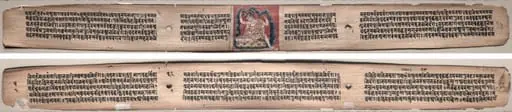 Folio 22 from a Gandavyuha-sutra (Scripture of the Supreme Array): Samantabhadra spinning clouds of things (recto); Text (verso)
 Sudhana and a pair of antelopes, folio 37 (recto) from a Gandavyuha-sutra (Scripture of the Supreme Array)