Artwork
Schimbarea la Față
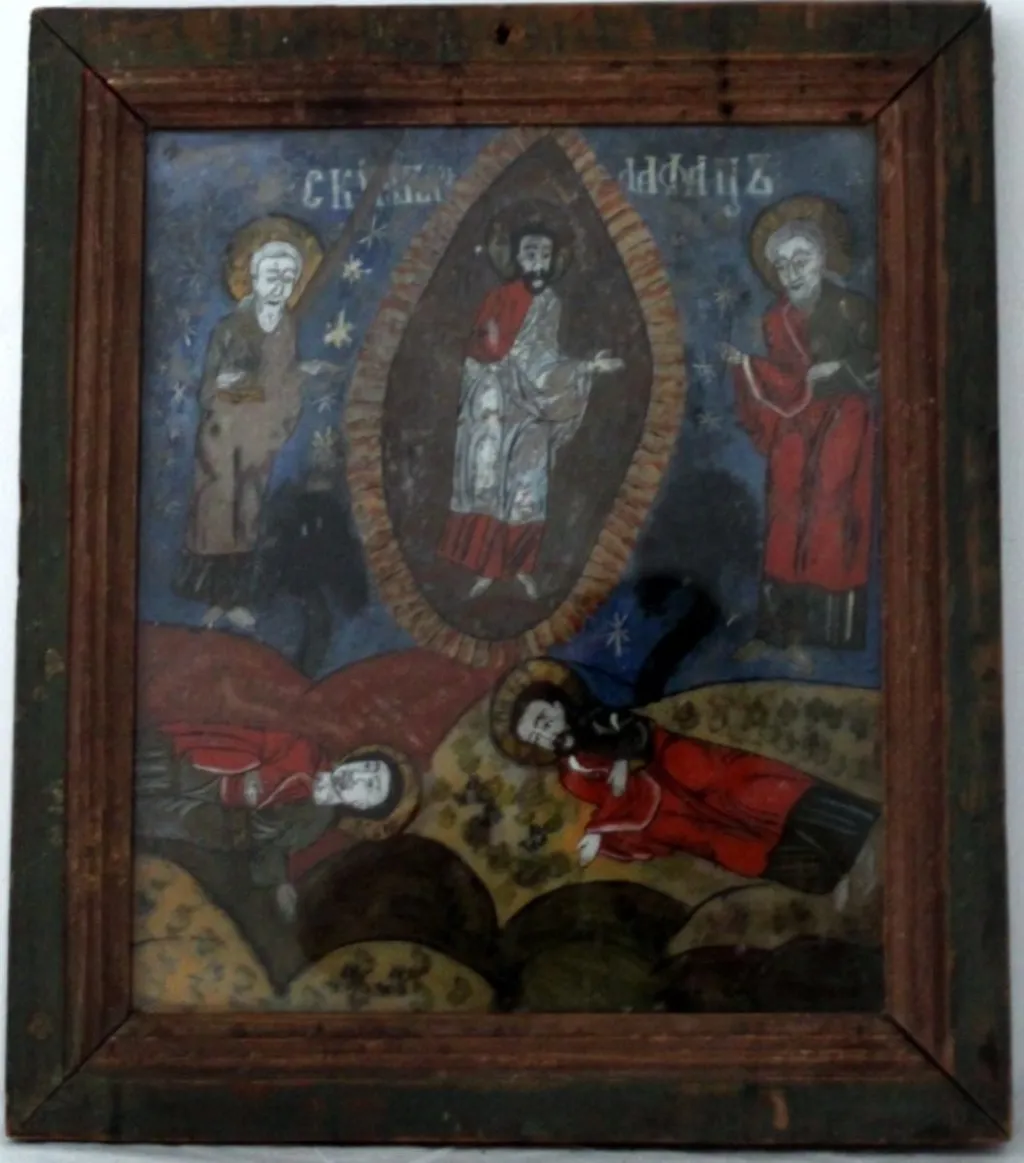
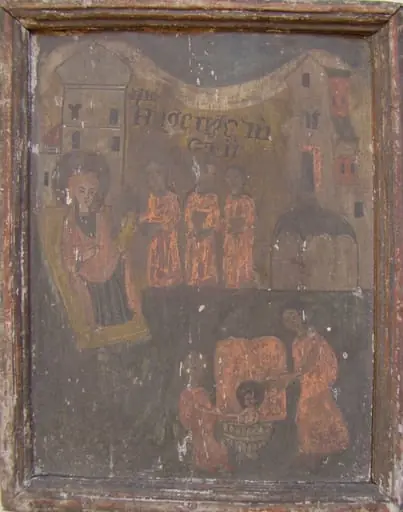
Schimbarea la Față is a drawing by Unknown. It dates from 1850 and is held in the collection of the "Dimitrie Gusti" National Village Museum. This image depicts a hierarchical religious scene with five figures arranged vertically.
About this work
Overview
Two additional figures lie prostrate below, draped in red and dark fabric, suggesting a contrast between divine presence and earthly submission.
This image depicts a hierarchical religious scene with five figures arranged vertically. Three central figures stand in a row beneath a dark blue sky, each crowned with a golden halo. The central figure is enclosed in a luminous oval and elevated slightly, distinguishing it from the others. Two additional figures lie prostrate below, draped in red and dark fabric, suggesting a contrast between divine presence and earthly submission.
Subject & Meaning
The composition likely illustrates a moment of divine revelation or transfiguration, with the central figure surrounded by a radiant oval—possibly representing spiritual transformation. The raised position and halos indicate sanctity, while the figures at lower levels, bowed or recumbent, may symbolize human reverence or awe. The use of simplified forms and symbolic color reinforces a liturgical or devotional intent rather than naturalistic narrative.
Technique & Style
The painting employs flat, unmodulated colors against a deep blue background, minimizing depth and emphasizing symbolic presence over spatial realism. Figures are rendered with minimal detail, their forms outlined clearly to enhance legibility. The glowing oval surrounding the central figure acts as a visual anchor, drawing attention through contrast and luminosity rather than perspective or shading.
History & Provenance
The work’s stylistic elements align with traditional religious iconography, possibly from a regional or liturgical context where standardized forms were preserved across generations. While its exact origin and maker are undocumented, its visual language suggests a connection to Eastern Orthodox or similar devotional traditions, where such compositions served as aids to prayer and theological instruction.
Context
In religious art of this tradition, figures are not portrayed as individuals but as embodiments of spiritual roles. The arrangement—elevated saints, kneeling supplicants, radiant symbols—follows established iconographic conventions meant to convey hierarchy, sanctity, and divine intervention. Such images were often displayed in places of worship to reinforce doctrinal narratives for congregations.
Legacy
This image reflects a sustained artistic practice rooted in symbolic representation rather than individual expression. Its preservation and display in institutions like the Museum of Ethnography highlight its role as a cultural artifact, offering insight into how spiritual beliefs were visually codified and transmitted across communities through consistent, repetitive forms.
Artist & collection
Museum
"Dimitrie Gusti" National Village Museum
Continue through works from the same source collection.
 Domestic Scene
 Giacomo and Cardinal Marco, investing Andrea, Abbot of San Zeno, with his Benefice
 The Nymph of Fontainebleau
 Portrait of a Woman
 Madonna and Child with Saints in the Enclosed Garden
 Venus and Minerva
 Family Group of Four on Sofa
 Wall painting from Room H of the Villa of P. Fannius Synistor at Boscoreale