Artwork
Icoa lem
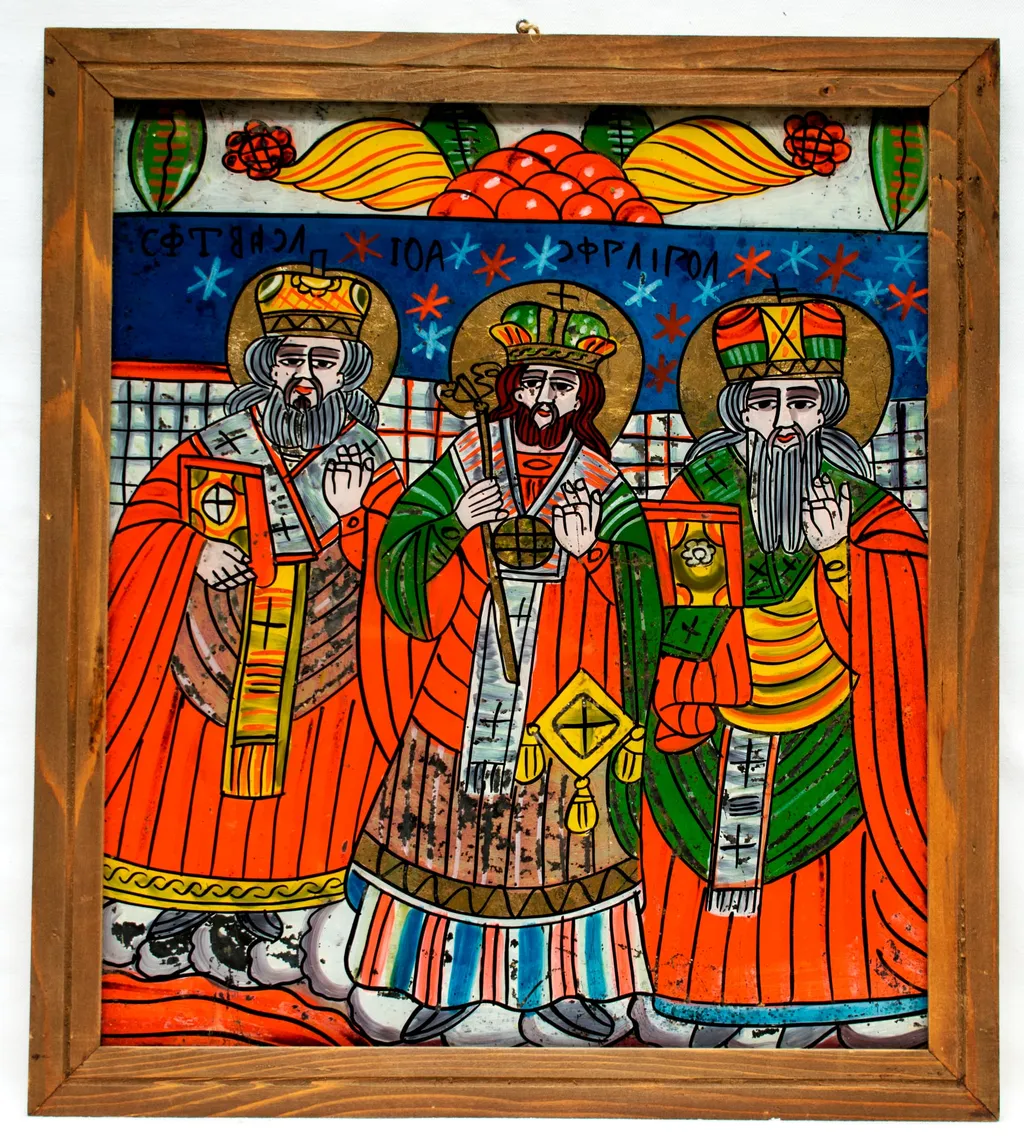
Icoa lem is a drawing by Unknown. It dates from 1850 and is held in the collection of the "Dimitrie Gusti" National Village Museum. This artwork depicts three robed figures arranged in a formal, frontal composition.
About this work
Overview
The background features a star-strewn blue field above which abstract red and yellow forms appear, possibly symbolizing celestial or divine elements.
This artwork depicts three robed figures arranged in a formal, frontal composition. Each wears a crown and carries a staff topped with a cross, suggesting sacred authority. The background features a star-strewn blue field above which abstract red and yellow forms appear, possibly symbolizing celestial or divine elements. The figures' garments display bold striped patterns, and their facial features are rendered in a flattened, non-naturalistic style, characteristic of early symbolic representation.
Subject & Meaning
The three figures, distinguished by crowns and cross-topped staffs, likely represent religious or royal personages, possibly saints, kings, or divine beings. Their uniform posture and identical attributes imply a shared spiritual role. The celestial elements above—stars, red circles, and stylized forms—may denote heavenly realms or divine approval, reinforcing their sacred status within a symbolic, rather than narrative, framework.
Technique & Style
The figures are rendered with flat, stylized faces and rigid postures, avoiding perspective or anatomical realism. Robes are defined by strong, repeating stripes and geometric patterns, emphasizing ornament over naturalism. The use of cross-hatching suggests an attempt to model texture and volume through line, though the overall effect remains decorative. Colors, once vivid, now show signs of pigment degradation, contributing to an aged, weathered appearance.
History & Provenance
The work’s materials and stylistic traits point to a pre-modern origin, possibly from a liturgical or devotional context. Its faded pigments and worn surface indicate prolonged exposure or use, though its exact place of creation and early ownership remain undocumented. The presence of crowns and crosses suggests a connection to ecclesiastical or imperial traditions, but no definitive archival trail has been established.
Context
This image aligns with traditions of early religious iconography, where symbolic representation superseded naturalism to convey spiritual authority. Similar compositions appear in Byzantine, Coptic, or early medieval art, where figures are arranged hieratically to reflect divine order. The abstract celestial elements echo contemporary motifs used to signify the heavens, reinforcing the figures’ transcendent role within a ritual or devotional setting.
Legacy
Though not widely known, the work exemplifies a broader tendency in pre-Renaissance art to prioritize symbolic clarity over illusionistic depth. Its stylistic choices reflect a visual language designed for contemplation rather than realism, influencing later devotional imagery. The persistence of its faded colors and worn surface underscores its endurance as an object of reverence, even as its original context has faded.
Artist & collection
Museum
"Dimitrie Gusti" National Village Museum
Continue through works from the same source collection.
 Domestic Scene
 Giacomo and Cardinal Marco, investing Andrea, Abbot of San Zeno, with his Benefice
 The Nymph of Fontainebleau
 Portrait of a Woman
 Madonna and Child with Saints in the Enclosed Garden
 Venus and Minerva
 Family Group of Four on Sofa
 Wall painting from Room H of the Villa of P. Fannius Synistor at Boscoreale
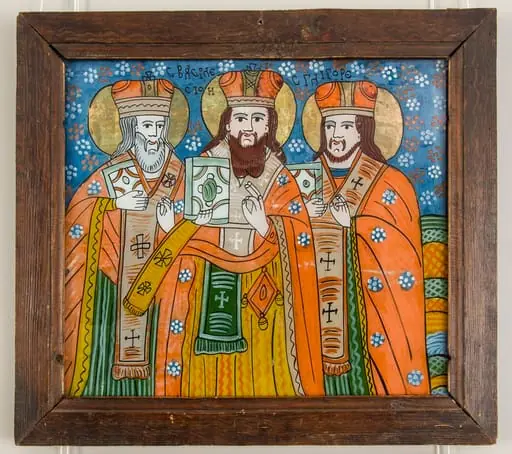 Sf. Trei Ierarhi
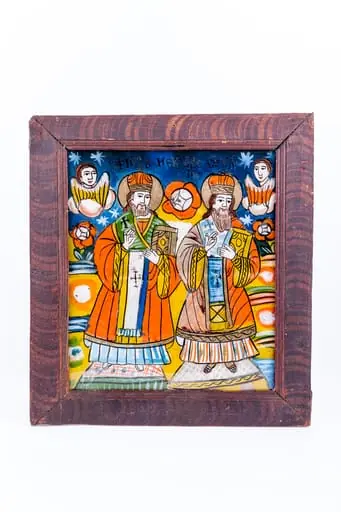 Sfinții Ierarhi Nicolae făcătorul de minuni și Vasile cel Mare sunt reprezentați împreună, binecuvântând cu mâna dreaptă și ținând în mâna stângă Sfânta Evanghelie. Sunt îmbrăcați în veșmânt-sacos și cu felon roșu vermillon și epitrahil albastru, verde, galben-ocru. Împreună slujesc și săvârșesc Sfânta Liturghie. În registrul îndepărtat superior, este pictat cerul albastru cu stele albe și ruje mari roșii. În registrul superior, în colțurile din stânga și din dreapta, este câte un înger pe o mandorlă. Cromatica este armonioasă: roșu vermillon, verde, albastru, galben-ocru, alb. Sfinții arhierei poartă și mithră arhierească. Amândoi Sfinții Ierarhi au aureole aurii. Rama este pictată cu tușe negre pe maro-roșcat, alternanță de brunuri. Este o icoană specifică picturii de Țara Oltului, din centrul Șcheii Brașovului. Din inscripția româno-chirilică se traduce Sf Nicolae Sf Vasile. În registrul inferior, fondul este format din câmpuri alternative de galben, albastru și verde.
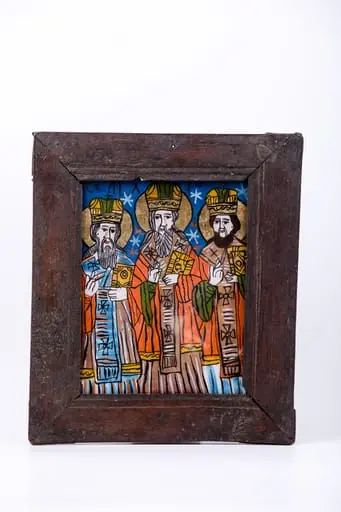 Cei Trei Sfinți Ierarhi Vasile cel Mare, Grigorie de Dumnezeu Cuvântătorul și Ioan Gură-de-Aur slujesc și săvârșesc Sfânta Liturghie împreună. Sunt înveșmântați în veșminte liturgice: sacos crem-albastru-alb-crem, felon roșu vermillon, epitrahil albastru-verde cu câte patru cruci negre. Sfântul Vasile cel Mare are Sfânta Evanghelie în mâna dreaptă. Sfântul Ierarh Grigorie de Dumnezeu Cuvântătorul Binecuvântează. Fondul registrului superior este cerul albastru-regal, bogat ornamentat cu elemente astrale - stele roșii și albe. Cromatica este luminoasă și armonioasă: verde văratic, alb, roșu vermillon, galben-ocru, bej, crem, albastru regal și bleu-ciel, negru. Este o icoană specifică picturii de Țara Oltului, cu un desen fin cu conturul negru și cromatica pastelată. Inscripția din româno-chirilică se traduce Vasile Grigorie Ioan.
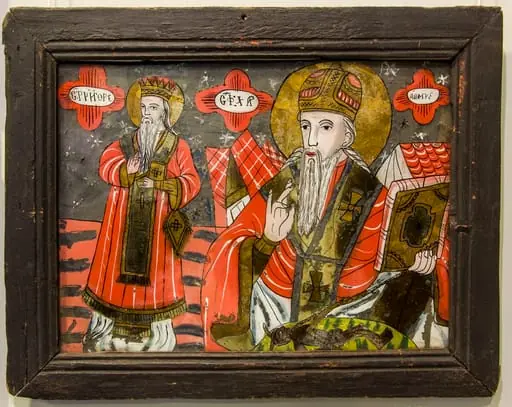 Sf. Grigore și Haralambie
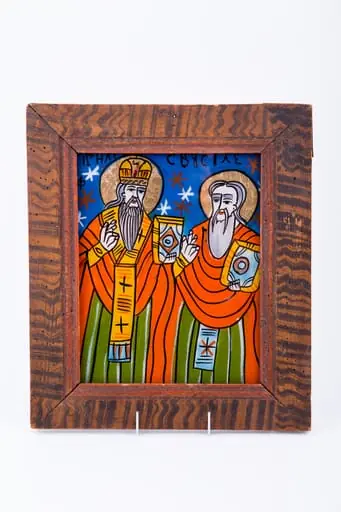 Sfinții Ierarhi Ioan Gură-de-Aur și Vasile cel Mare sunt reprezentați împreună, binecuvântând cu mâna dreaptă și ținând în mâna stângă Sfânta Evanghelie. Sunt îmbrăcați în veșmânt-sacos verde, cu felon roșu vermillon și epitrahil galben-ocru. Împreună slujesc și săvârșesc Sfânta Liturghie. În registrul îndepărtat superior, este pictat cerul albastru cu stele albe și roșii. Cromatica este armonioasă: roșu vermillon, verde, albastru, galben-ocru, alb. Sfântul Ierarh Ioan Gură-de-Aur poartă și mithră arhierească. Amândoi Sfinții Ierarhi au aureole aurii. Rama este pictată cu tușe negre pe maro-roșcat, alternanță de brunuri. Este o icoană specifică picturii de Țara Oltului, din centrul Șcheii Brașovului. Tematica este rară.
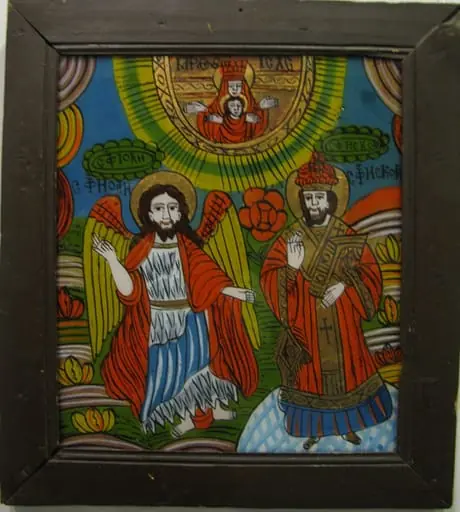 Sf. Ioan Botezătorul și Sf.Nicolae