Artwork
Sf. Ilie
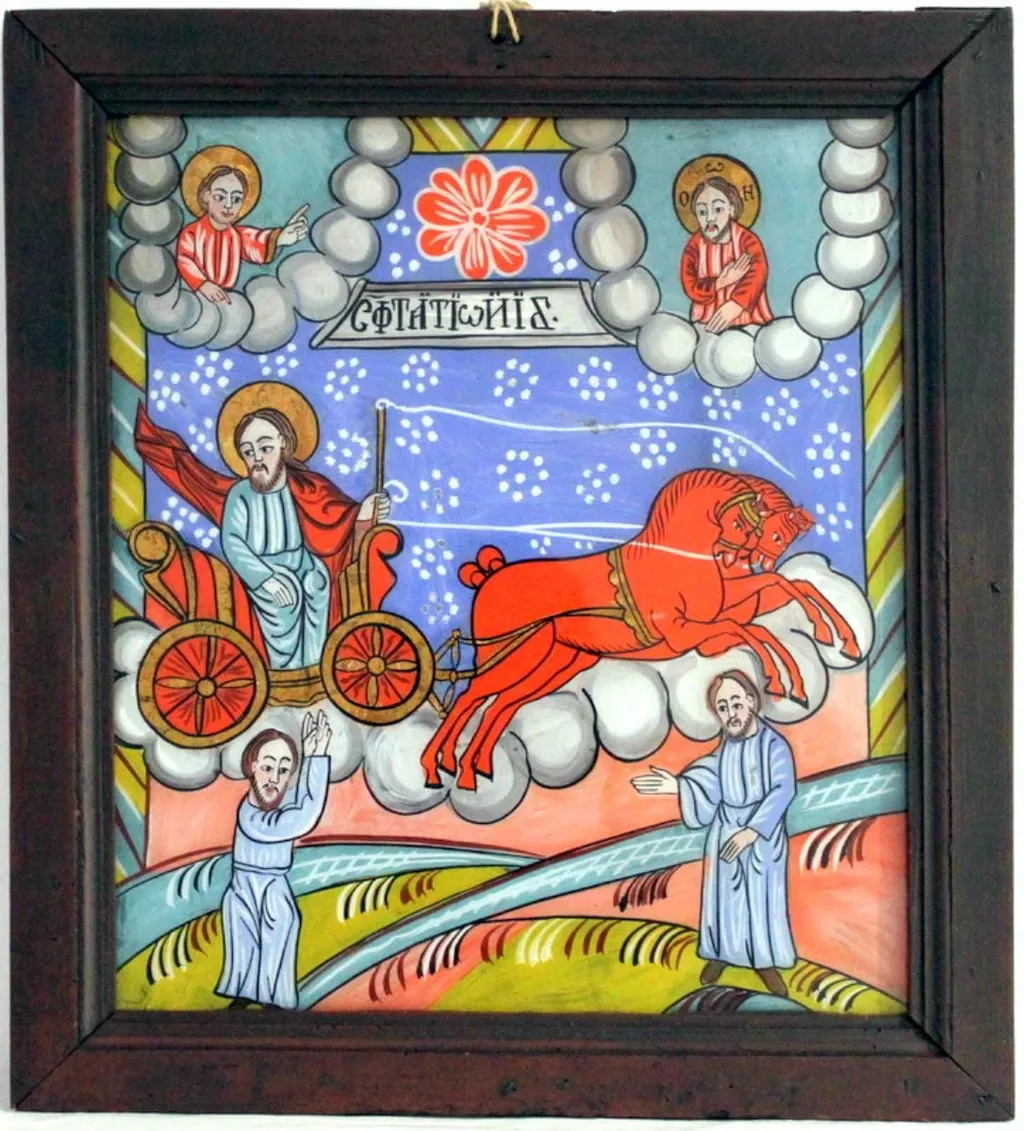
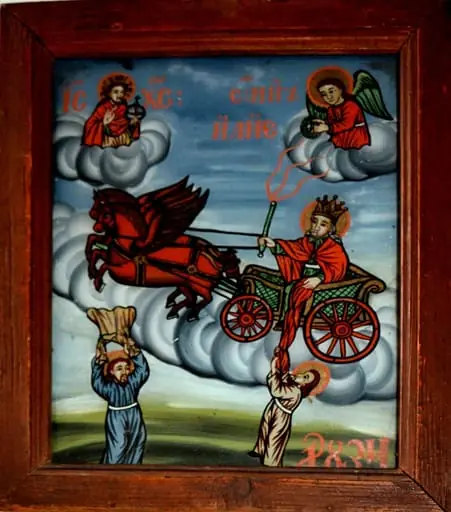
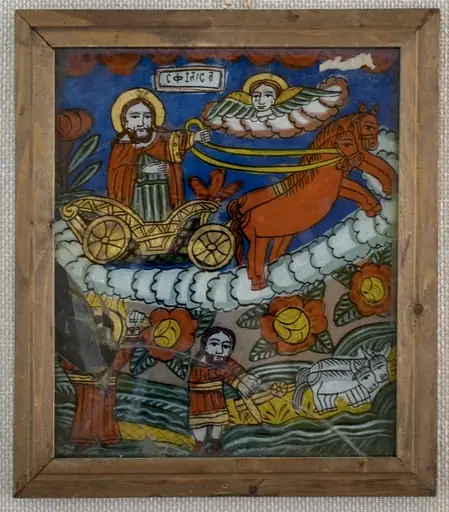
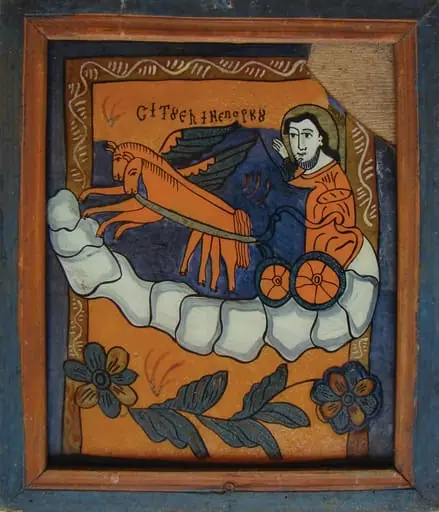
Sf. Ilie is a drawing by Unknown. It dates from 1850 and is held in the collection of the "Dimitrie Gusti" National Village Museum. The work titled “Sf.
About this work
Overview
The central rider, crowned with a halo and grasping a whip, is surrounded by four additional haloed figures in long robes, their hands raised in reverence.
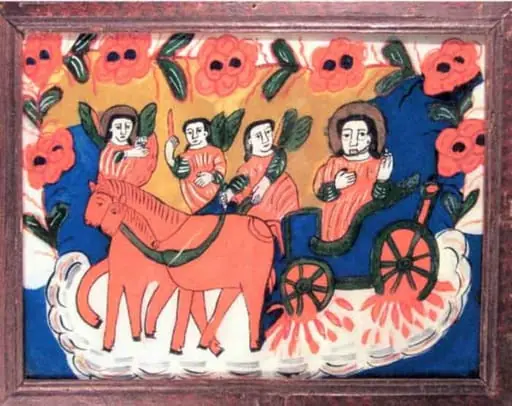
The work titled “Sf. Ilie” depicts a figure in a red robe seated in a chariot drawn by a red horse that appears to gallop across a sky of blue dotted with white specks. The central rider, crowned with a halo and grasping a whip, is surrounded by four additional haloed figures in long robes, their hands raised in reverence. A banner bearing text runs across the composition, though the inscription is illegible.
Subject & Meaning
The central character is identified as Saint Elijah, a prophet traditionally associated with fire and divine ascent, suggested by his elevated position and the celestial setting. The surrounding figures likely represent attendant angels or disciples, their uplifted gestures emphasizing veneration. The chariot and horse, both rendered in vivid red, reinforce themes of divine power and heavenly movement.
Technique & Style
Executed in a richly colored palette, the painting combines flat areas of hue with intricate detailing, particularly in the patterned robes and the cloudscape. The background’s blue field dotted with white points creates a stylized atmospheric effect, while the halo motifs and banner introduce ornamental elements typical of religious iconography. The overall composition balances narrative clarity with decorative exuberance.
History & Provenance
The piece is part of the collection of the Museum of Ethnography, where it is displayed as an example of regional religious art. Its acquisition details are not specified, but its presence in an ethnographic context suggests it was collected as a cultural artifact reflecting local devotional practices.
Context
Within the tradition of Eastern Orthodox visual culture, saints are often portrayed in dynamic, celestial scenes that convey their spiritual authority. The depiction of Saint Elijah in a chariot aligns with medieval motifs of heavenly transport, while the use of vivid reds and gold‑like halos reflects the liturgical emphasis on sanctity and divine illumination.
Artist & collection
Museum
"Dimitrie Gusti" National Village Museum
Continue through works from the same source collection.
 Domestic Scene
 Giacomo and Cardinal Marco, investing Andrea, Abbot of San Zeno, with his Benefice
 The Nymph of Fontainebleau
 Portrait of a Woman
 Madonna and Child with Saints in the Enclosed Garden
 Venus and Minerva
 Family Group of Four on Sofa
 Wall painting from Room H of the Villa of P. Fannius Synistor at Boscoreale