Artwork
Sf. Mucenic Gheorghe, ucigând balaurul
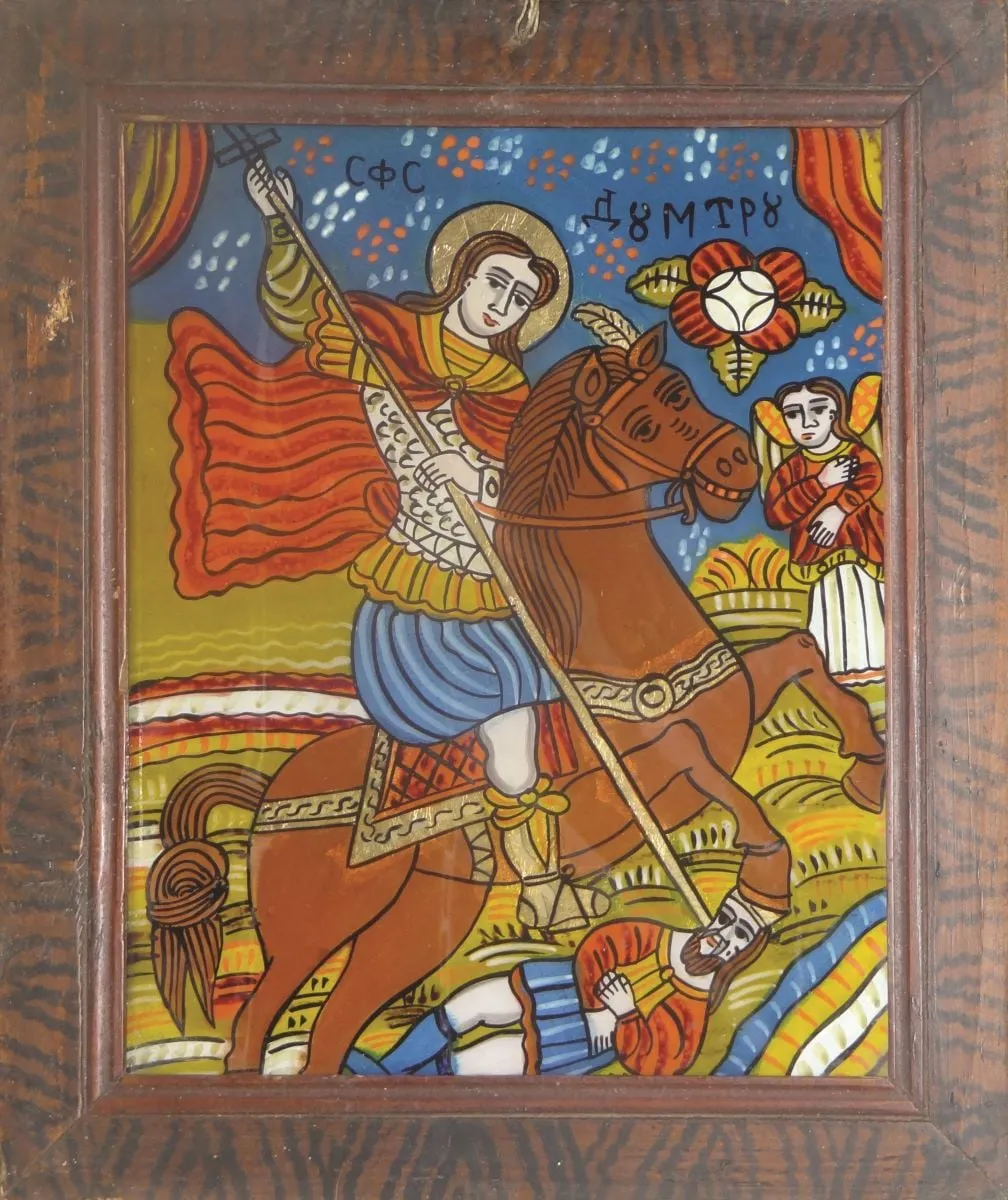
Sf. Mucenic Gheorghe, ucigând balaurul is an unspecified painting by Unknown. It dates from 1850 and is held in the collection of the Alba Iulia Unification National Museum. This painted image depicts Saint George slaying a dragon, rendered in vivid hues of red, blue, gold, and yellow.
About this work
Overview
The presence of a cross-topped staff and the inscription 'Dumitru' point to a localized religious or cultural interpretation of the saintly warrior.
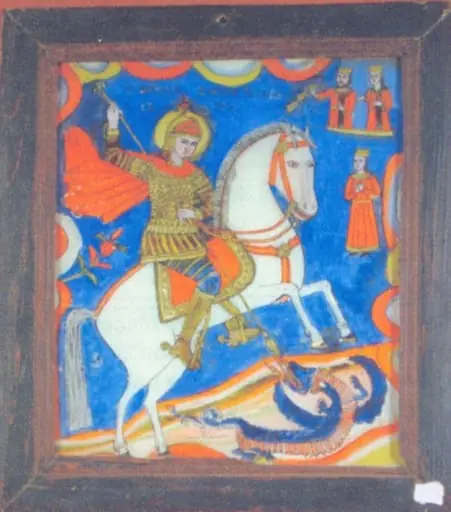
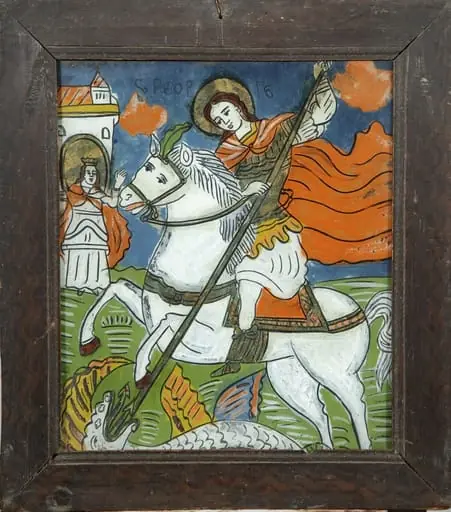
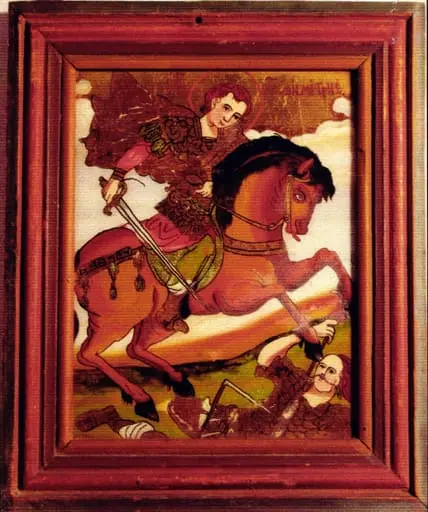
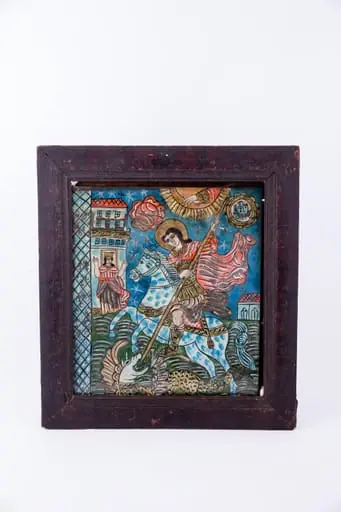
This painted image depicts Saint George slaying a dragon, rendered in vivid hues of red, blue, gold, and yellow. The composition emphasizes dynamic movement, with the horse mid-stride and the dragon’s body coiled in motion. Bold outlines and flat color planes define the figures, suggesting a folk or devotional tradition. The presence of a cross-topped staff and the inscription 'Dumitru' point to a localized religious or cultural interpretation of the saintly warrior.
Subject & Meaning
The scene illustrates the traditional legend of Saint George defeating a dragon, symbolizing the triumph of faith over evil. The knight’s armor and blue robe align with saintly iconography, while the cross-topped staff reinforces his divine mission. The small figure watching behind him may represent a witness or supplicant, underscoring the spiritual significance of the act. The name 'Dumitru' possibly identifies the donor, patron, or a regional variant of the saint’s name.
Technique & Style
The painting employs flat, unmodulated areas of color with strong, clean outlines, characteristic of folk or ecclesiastical art traditions. Bright, saturated tones create visual intensity without shading or perspective. The horse’s motion and the dragon’s twisted form convey energy through simplified, stylized forms. The lack of depth and spatial realism suggests a focus on symbolic narrative over naturalism, typical of devotional imagery in certain regional contexts.
History & Provenance
The inscription 'Dumitru' in the upper right corner likely indicates a local patron or artist, possibly linking the work to a specific community or workshop in Eastern Europe. Its stylistic features align with 18th- or 19th-century religious paintings from regions such as Moldavia or Wallachia, where saintly warrior imagery was commonly commissioned for churches or private devotion. Exact origins remain undocumented, but the work reflects a broader tradition of Orthodox iconography adapted into folk forms.
Context
Saint George’s legend was widely venerated across Orthodox Christian communities, often adapted into local artistic languages. This painting fits within a regional tradition where biblical and hagiographic stories were rendered with bold, decorative aesthetics rather than Renaissance naturalism. The emphasis on color, movement, and symbolic clarity served both devotional and didactic purposes, making sacred narratives accessible to lay audiences in rural or less literate communities.
Legacy
The painting preserves a vernacular interpretation of a widely shared religious motif, reflecting how canonical stories were localized through artistic practice. Its stylistic choices—flat planes, vivid color, and stylized motion—continue to inform contemporary understandings of folk religious art in Eastern Europe. Though not part of major institutional collections, such works remain important as cultural artifacts of popular piety and regional identity.
Artist & collection
Museum
Alba Iulia Unification National Museum
Continue through works from the same source collection.
 Domestic Scene
 Giacomo and Cardinal Marco, investing Andrea, Abbot of San Zeno, with his Benefice
 The Nymph of Fontainebleau
 Portrait of a Woman
 Madonna and Child with Saints in the Enclosed Garden
 Venus and Minerva
 Family Group of Four on Sofa
 Wall painting from Room H of the Villa of P. Fannius Synistor at Boscoreale
 Sfântul Mare Mucenic Gheorghe Purtător de Biruință
 Sfântul Mare Mucenic Gheorghe
 Sfântul Mare Mucenic Gheorghe
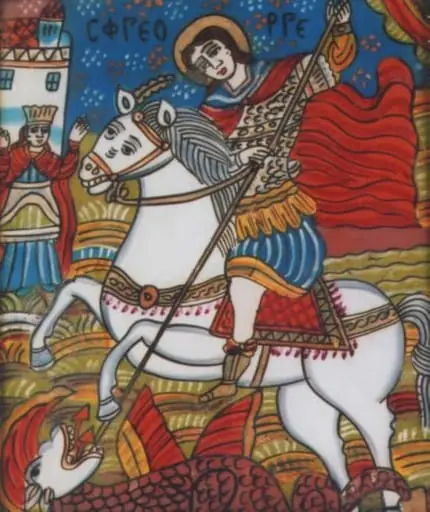 Sfântul Gheorghe
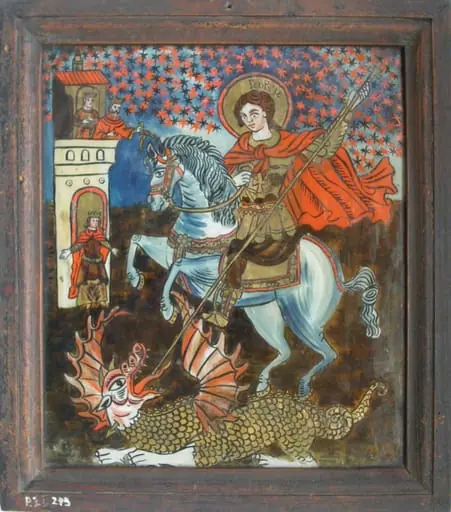 Sf. Gheorghe, ucigând balaurul
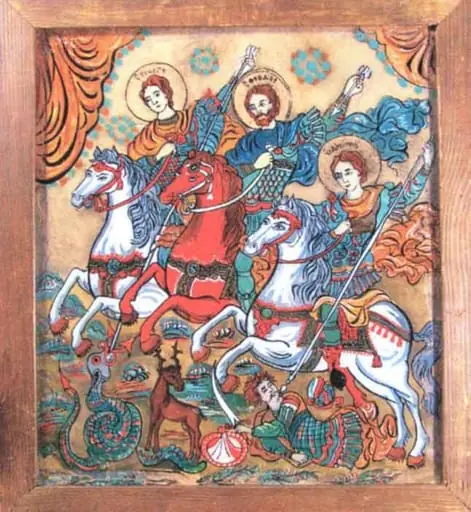 Sfinții Militari Gheorghe, Theodor - Tiron și Dimitrie
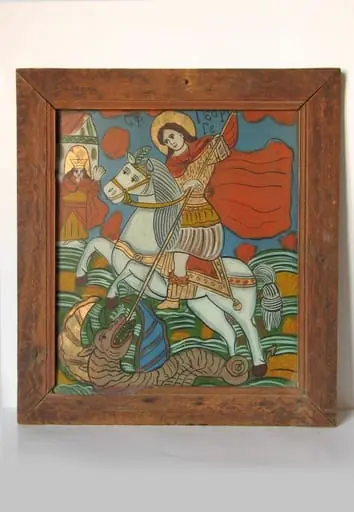
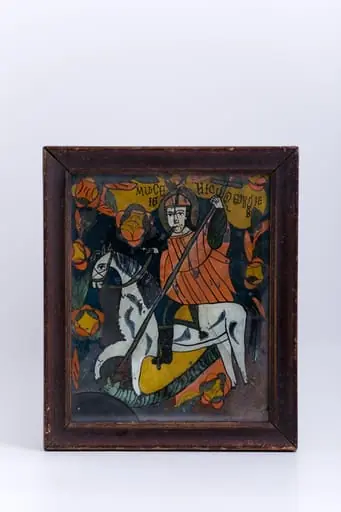 Sfântul Mare Mucenic Gheorghe este așezat călare pe un cal alb acoperit cu elemente de harnașament galbene și verzi și omorând balaurul cu lancea bronzie, pe care o ține în mâna stângă. Balaurul este pictat cu verde smarald-gri și kaki și gri cenușiu-antracit verzui și având corp de reptilă, cu coadă de diavol. Fondul icoanei este cerul albastru ultramarin-bleumarin și galben-chihlimbar în exterior și în cel inferior, în centrul icoanei ușor întrepătrundu-se toate culorile. Tunica Sfântului Mucenic Purtător de Biruință este roșie-vermillon-orange, având pantalonii albaștri-ultramarin. În registrul superior, icoana este încadrată de un chenar decorativ, format dintr-o ghirlandă de 8 ruje orang-galben. Cromatica este armonioasă: roșu vermillon, orange, albastru-regal, cobalt și ceruleum, ocru, galben chihlimbar, verde kaki și smarald, gri antracit, alb și negru. Inscripția din româno-chirilică se traduce Mucenicu Gheorghe. Icoana este din Nordul Transilvaniei, Nicula.
 Sfântul Mare Mucenic Gheorghe
 Sf. Mare Mucenic Gheorghe
 Sfântul Dumitru
 Sfân
Sfân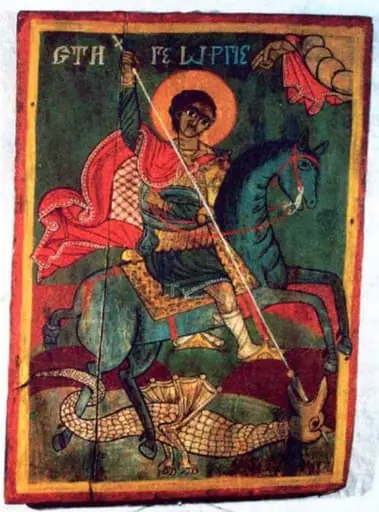 Sfântul Gheorghe