Artwork
Sfântul Gheorghe e reprezentat pe un cal alb cu multe pete gri. Înveșmântat cu tunică roșie, mantie verde și pantaloni albaștri, sfântul poartă pe cap un coif roșu și ține în mâna dreaptă sulița cu care ucide balaurul. Aici, iconarul a pictat balaurul sub formă de șarpe ce stă încolăcit printre și pe sub picioarele calului. Scena e încadrată de un brâu ocru decorat cu motivul torsadei. Ca elemente decorative iconarul a folosit frunzele simple, esențializate. Cromatica icoanei se compune din tonuri de roșu, ocru galben, alb, verde, maro, gri și negru. Rama icoanei e profilată, bicromă (latura interioară roșie, iar cea exterioară maronie) și e formată din îmbinarea a patru baghete de lemn.
Sfântul Gheorghe e reprezentat pe un cal alb cu multe pete gri. Înveșmântat cu tunică roșie, mantie verde și pantaloni albaștri, sfântul poartă pe cap un coif roșu și ține în mâna dreaptă sulița cu care ucide balaurul. Aici, iconarul a pictat balaurul sub formă de șarpe ce stă încolăcit printre și pe sub picioarele calului. Scena e încadrată de un brâu ocru decorat cu motivul torsadei. Ca elemente decorative iconarul a folosit frunzele simple, esențializate. Cromatica icoanei se compune din tonuri de roșu, ocru galben, alb, verde, maro, gri și negru. Rama icoanei e profilată, bicromă (latura interioară roșie, iar cea exterioară maronie) și e formată din îmbinarea a patru baghete de lemn. is a print by Unknown. It dates from 1850 and is held in the collection of the Ethnographical Museum of Transylvania. This medieval icon depicts Saint George on a white horse with grey spots, battling a serpent.
About this work
The colors are bold—red, green, and blue stand out—but the wood frame is plain, with a red inner edge and a darker outer one.
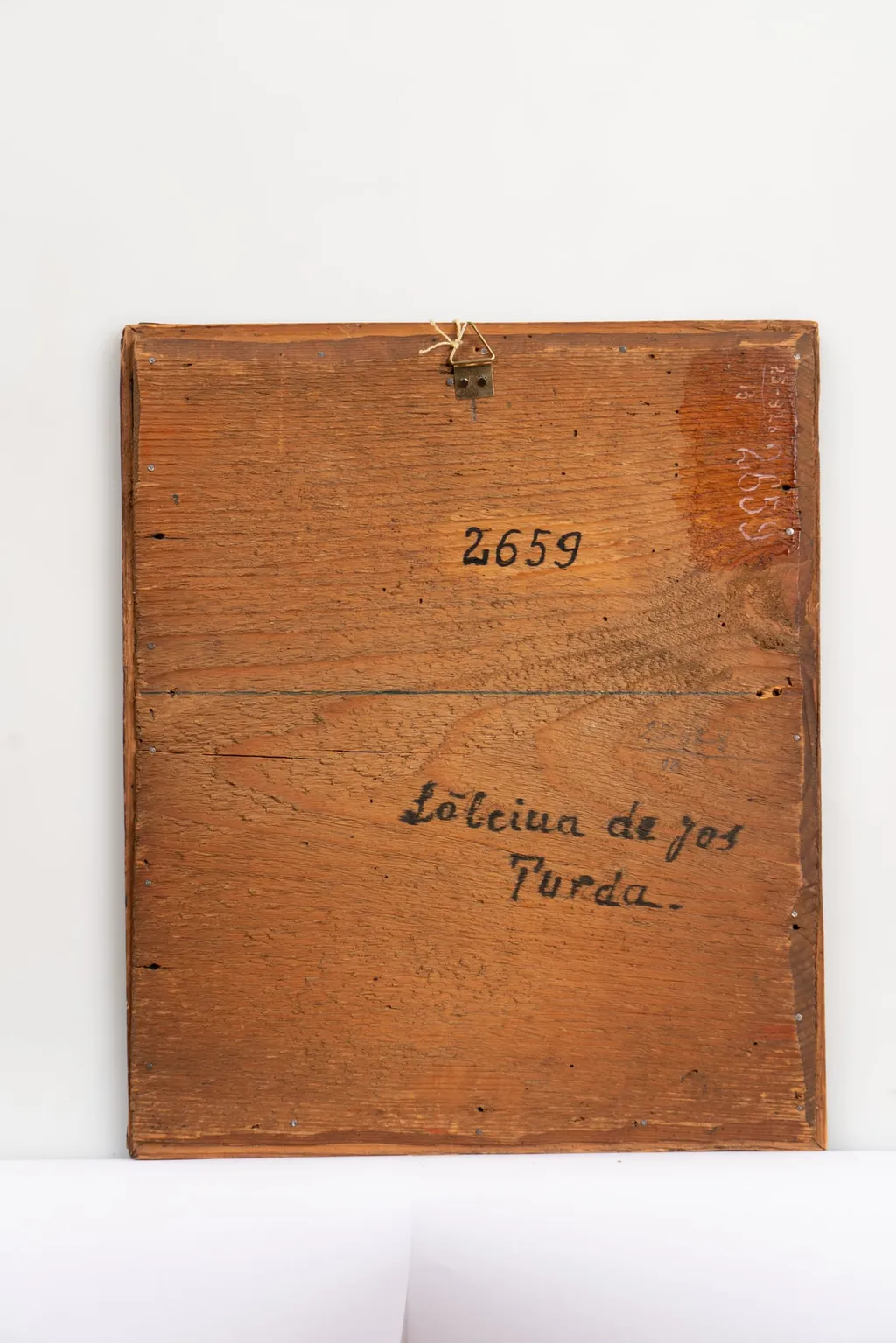
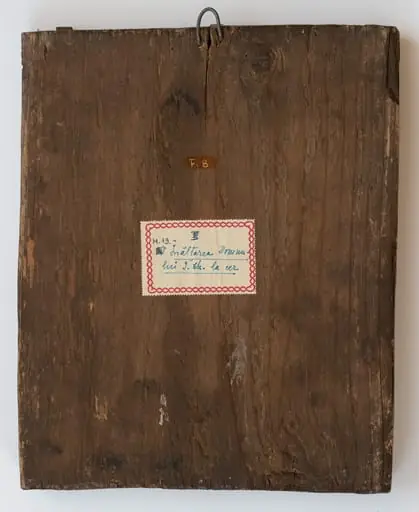
This is the back of a wooden panel with handwritten notes. The wood is light brown, worn in spots, and has a metal hinge at the top. Someone wrote "2659" near the top and "Solcia de jos Turda" below it in uneven script.
The painting itself shows a saint on a spotted white horse, fighting a snake. The colors are bold—red, green, and blue stand out—but the wood frame is plain, with a red inner edge and a darker outer one.
Look up cult object to see how icons like this were used in daily life.
Overview
This medieval icon depicts Saint George on a white horse with grey spots, battling a serpent. The composition is framed by an ochre band with a twisted rope motif, set against a palette of red, ochre yellow, white, green, brown, grey, and black.
Subject & Meaning
The icon illustrates the legend of Saint George defeating a dragon, symbolized here as a snake entwined under the horse's legs. Saint George is dressed in a red tunic, green cloak, and blue pants, wearing a red helmet and holding a spear in his right hand.
Technique & Style
The icon's style is characterized by simplified, essentialized foliage motifs and a bold, restrained color scheme. The saint and horse are rendered in a formal, stylized manner, while the snake represents a more dynamic element.
History & Provenance
Handwritten notes on the back of the wooden panel indicate the number '2659' and the location 'Solcia de jos Turda', suggesting its origin or storage location. The panel's worn, light-brown wood and metal hinge at the top indicate age and potential use.
Context
As a cult object, this icon would have been used in daily religious life, possibly for veneration or as part of ritual practices. Its design and materials reflect traditional iconographic conventions.
Legacy
While specific influence or notable exhibitions are not detailed, the icon represents a preserved example of medieval religious art, offering insights into the artistic and devotional practices of its time.
Artist & collection
Museum
Ethnographical Museum of Transylvania
Continue through works from the same source collection.
 Domestic Scene
 Giacomo and Cardinal Marco, investing Andrea, Abbot of San Zeno, with his Benefice
 The Nymph of Fontainebleau
 Portrait of a Woman
 Madonna and Child with Saints in the Enclosed Garden
 Venus and Minerva
 Family Group of Four on Sofa
 Wall painting from Room H of the Villa of P. Fannius Synistor at Boscoreale
 Compoziție (Fată din Tulcea)
 Sfânta Mare Cuvioasă Parascheva de la Iași are crucea și o ramură de finic verde brad, în mâna dreaptă. Este îmbrăcată în veșmânt roșu vermillon, cu interiorul căptușit cu verde, vernil, crem și galben, cu sacosul alb ivoriu, cu dungi crem-bej. Sacosul este alb ivoriu crem-bej, cu danteluță și guleraș galben. Sfânta Cuvioasă are părul negru lung, ondulat, lăsat pe umeri, coroană roșie și aureolă. Fondul icoanei este cerul albastru-negru întunecat, în registrul superior și un câmp înalt luminos de grâu galben-copt, în registrul mediu și inferior, de culoare ocru-muștar. Întreaga compoziție iconografică este încadrată de un chenar decorativ geometrizant alb și unul paralel, fitomorf, format dintr-o ghirlandă de 6 ruje - margarete, cu petale roșii. Ghirlanda excelează prin delicatețea desenului și bogăția cromatică armonioasă. Cromatica este armonioasă: roșu vermillon, albastru-negru, verde forest, kaki, vernil-măr, olive, bej-crem, negru, galben chihlimbar, ocru, muștar, negru, alb. Icoana este din Nordul Transilvaniei, Nicula.
 Maica Domnului ține în brațe Pruncul Iisus Hristos care are în mâna stângă un hrisov înfășurat și Binecuvântează cu mâna dreaptă. Maica Domnului arată calea cu mâna dreaptă, deci este Hodighitria. Maica Domnului este înveșmântată în mantie cu maforion roșu vermillon cu interiorul verde și sacos galben, are aureolă. Pruncul Iisus Hristos este înveșmântat în galben-bronziu și alb crem-ivoriu, are aureolă. Întreaga icoană este încadrată de un chenar decorativ geometrizant vișiniu-acajou-sracojiu cu linia albă șerpuită, specifică centrului de la Nicula. Fondul icoanei este cerul albastru ultramarin bleumarin. Cromatica este armonioasă, luminoasă, bizantină și foarte picturală: roșu vermillon, verde spanac-avocado, kaki, galben chihlimbar, albastru ultramarin bleumarin, vișiniu, stacojiu-acajou, bronziu, alb, negru. Icoana este de Nicula. Inscripția din româno-chirilică se traduce MP IC XC Maica Domnului Iisus Hristos.
 Înălțarea Domnului
 Maica Domnului este înveșmântată în maforiom roșu vermillon, cu interiorul verde-brad-smarald, cu aureolă aurie împodobită cu coroniță de trandafiri, din 4 ruje. Pruncul Iisus Hristos este înveșmântat în alb-nisipiu - verde brad și ocru și are, de asemenea, aureolă aurie, împodobită cu cunună de trandafiri, din 3 ruje. Pruncul Iisus Binecuvântează, arătând înspre Maica Domnului. Fondul icoanei este cerul albastru bleu-ciel senin, împodobit cu 2 elemente florale - ruje roșii cu frunze smarald. Cromatica este armonioasă: roșu vermillon, galben-ocru, crem, bej, albastru ceruleum și bleu-ciel, verde smarald, alb, negru. Icoana este de Nicula. Inscripția din româno-chirilică se traduce IC XC MP Iisus Hristos Maica Domnului.
 Scen
Scen Icoa cen