Artwork
Icoa cen
Icoa cen is a drawing by anonim. It is held in the collection of the "Dimitrie Gusti" National Village Museum. This work is a faint, aged drawing on paper, its surface marked by time and handling.
About this work
Overview
The paper shows signs of wear—torn edges, smudges, and uneven discoloration—suggesting prolonged exposure or storage.
This work is a faint, aged drawing on paper, its surface marked by time and handling. The image is rendered in muted browns and grays, with no sharp outlines or vivid contrasts. The paper shows signs of wear—torn edges, smudges, and uneven discoloration—suggesting prolonged exposure or storage. A small white label, barely legible, is affixed in one corner, hinting at prior cataloging or ownership.
Subject & Meaning
The central form is indistinct, appearing as a shadowy silhouette without clear definition. No recognizable figures or symbols emerge, leaving its intent ambiguous. The lack of detail may reflect intentional abstraction, or the degradation of an original image. Its obscurity invites contemplation rather than narrative interpretation, emphasizing material presence over representational clarity.
Technique & Style
The drawing relies on subtle tonal variations rather than defined lines. Cross-hatching or light washes may have been used to build texture, though erosion has softened these marks. The absence of bright highlights or bold strokes suggests a restrained, possibly experimental approach. The rough paper surface interacts with the medium, enhancing the work’s tactile, weathered quality.
History & Provenance
The presence of a small label indicates the work was once part of a collection or archive. Its condition—faded pigments, torn edges, and surface soiling—implies decades of storage under non-ideal conditions. No documented origin or artist is known, and its creation date remains uncertain, placing it within a broader category of anonymous or lost works from the 19th or early 20th century.
Context
This piece aligns with practices in which artists used inexpensive materials for sketches, studies, or personal records. Its fragility and lack of formal presentation suggest it was not intended for public display. Similar works from the period often served as preparatory notes or private experiments, later preserved more by accident than design.
Legacy
Though unsigned and unremarkable in appearance, the work survives as a physical trace of an unseen hand. Its deterioration underscores the vulnerability of ephemeral media and the fragility of artistic memory. It stands as a quiet testament to the countless undocumented gestures that once filled sketchbooks and drawers, now surviving only in fragments.
Artist & collection
Artist
This anonymous painter made small religious scenes with bold, flat colors and shaky lines, following old church traditions.
Museum
"Dimitrie Gusti" National Village Museum
Continue through works from the same source collection.
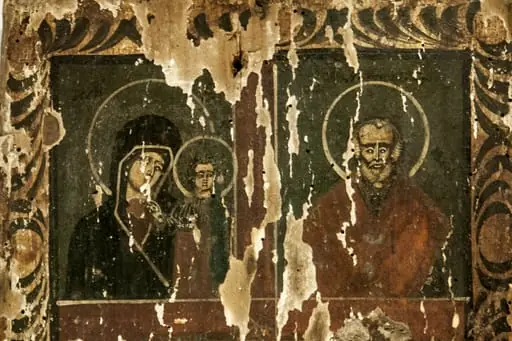 Un câmp central sub formă de cruce, împarte spațiul pictural în patru casete dreptunghiulare care conțin următoarele scene: Stânga sus Maica Domnului cu Pruncul tipul Kazanskaia. Este reprezentată până la piept, nu se văd mâinile, înveșmântată cu maforion negru cu galon alb. Are chipul îndurerat, privirea tristă, capul ușor înclinat spre Prunc. Iisus – Emanuel, binecuvintează cu dreapta, privirea îndreptată lateral, către sfântul Nicolae..Chiton brun deschis, himation verde. Dreapta sus - Sf. Nicolae în veșminte simple, capul descoperit, cărunt, cu barba rotundă și scurtă, privind la rândul său către pruncul Iisus. Înveșmântat cu sacos verde și omofor mare orange, care îi acoperă umerii. În casetele de jos sunt redați doi sfinți în vârstă, în picioare, în veșminte preoțești, întorși unul către altul, cu privirea îndreptată către scenele din registrul superior. Inscripția ce denominează primul dintre ei a fost ștearsă, cel de al doilea posibil sfântul Savatie?. Icoana are un vădit caracter popular, naiv. Spațiul cruciform pictat cu roșu, fondul scenelor verde închis, 2/3 din fondul scenelor de jos galben-orange. Nimburi trasate cu alb, inscripții caligrafice, litere cursive, cu negru. Compoziția este încadrată de un chenar cu decor vegetal, motive ample de factură populară, specifice spațiului slav.
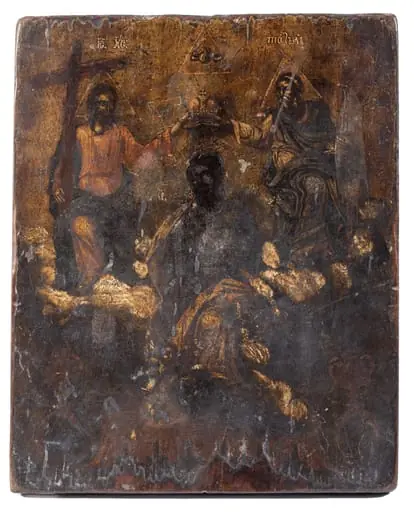 Încoronarea Fecioarei - reprezintă în centrul compoziției pe Fecioara Maria, în planul al doilea pe Iisus Hristos și Dumnezeu Tatăl ținând o coroană în mâini.
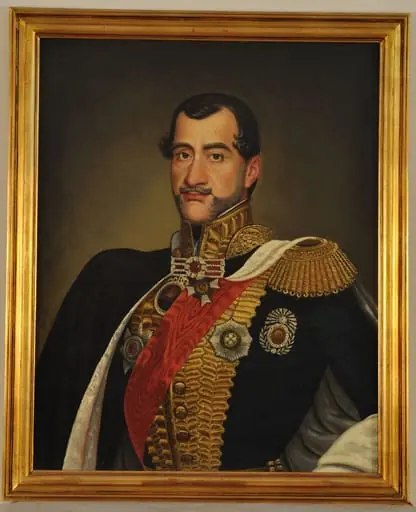 Alexandru Dimitrie Ghica
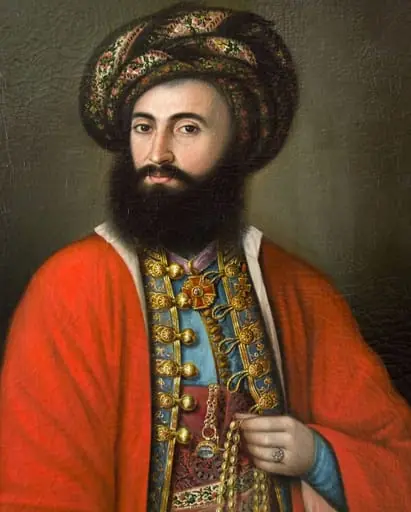 Constantin G. Cantacuzino cu turban (1793 - 1877)
 Icoana este pictată pe dosul unei bucăți de glajă de formă dreptunghiulară în ax vertical. Sfântul Nicolae este redat în prim plan, așezat pe un tron, ținînd Evanghelia închisă în mâna stângă în timp ce cu dreapta binecuvintează. Sfântul Nicolae este înveșmântat ca Mare Arhiereu, cu mitră înaltă, bipartită, omofor mare, verde, decorat cu cruci "patee", sacos roșu cărămiziu cu galon auriu cu motiv spiralat, stihar roșu. De mâna dreaptă îi atârnă bedernița, percepută ca decor al veșmântului. Chipul este sobru, barba albă,scurtă,la fel părul scurt, ondulat. Ochii sunt negri, bine definiți, arcadele evidențiate. Nimb auriu. Tronul, cu spătarul înalt, are marginea aurită realizată în trepte(surmontatea de câte o cruce) și decorată cu motiv spiralat. Spătarul este alb, decorat cu o rețea de linii negre dublate cu bleu, întretăiate. În colțurile de sus câte un serafim pe nori. Câmpul verde intens în partea de jos, până la nivelul jilțului, albastru de Prusia în registrul superior. Desenul este îngrijit, compoziția aglomerată, paleta cromatică variată, culorile tari, Inscripția cu negru în partea de sus, greu vizibilă. Rama, din lemn de brad băițuit, este alcătuită din patru șipci profilate pe o porțiune mică spre interior, îmbinate oblic la colțuri, decorată cu un motiv ușor ondulat, imitînd fibra lemnului, dispus oblic. Dos din scândurele subțiri de brad, dispuse orizonal și fixate în cuie.
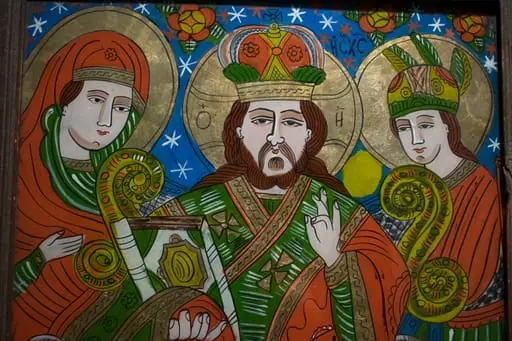 Icoacrip
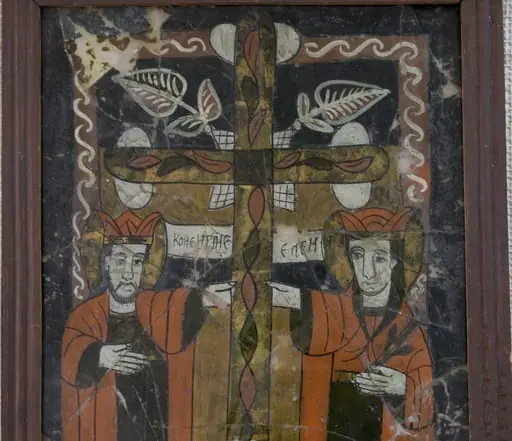 Pictură în oglindă, pe spatele unei bucăți de glajă, ax vertical.Sfinții Împărați Constantin și Elena, 3/4 , în picioare, semiprofil, sub brațele crucii pe care a fost răstignit Isus( găsită de Împărăteasa Elena la Ierusalim) Amândoi au plete castanii, lăsate pe umeri, coroane înalte, veșminte identice, simple, lungi, cămăși verzi și mantii roșii. Plasarea personajelor sub brațele crucii, în jumătatea inferioară, pe fond ocru sugerează complementaritatea celor două planuri(terestru și ceresc). Împărăteasa ține în mână o ramură verde, element ce o însoțește în majoritatea reprezentărilor populare. Fețele sunt ușor diforme, ochii negri. Crucea dreaptă, plasată în centrul compoziției, decorată cu frunze și o spirală în partea de jos, creează simetrie. La întretăierea brațelor crucii elemente vegetale cu contur alb. Chenarul specific icoanelor de Nicula, linia albă(zăluțe, funie) pe fond roșcat. Icoana este caracteristică perioadei de înflorire a picturi pe sticlă de la Nicula. Rama profilată, din lemn de brad, pictată cu o culoare roșcată. Dosul subțire. Sticla spartă în mai multe fragmente.
 Icoana este pictată "în oglindă", pe un suport de sticlă de formă dreptunghiulară în ax vertical. Cuvioasa Parascheva, 3/4, redată din ușor semiprofil, ține în mâna dreaptă o ramura verde, sinuoasă, în stânga o cruce. Fața butucănoasă, ochii căprui, sprâncenele arcuite, gura marcată cu roșu, bărbia pătrată, părul castaniu, lung, revărsat pe umeri. Pe cap poartă o tocă înaltă tripartită. Este înveșmîntată cu o mantie roșie și cămașă albastră. În jurul capului, aureolă realizată cu bronz auriu. Câmp bicolor(1/2 superior -bleu, 1/2 inferior ocru) două ramuri de trandafiri dispuși pe laturile verticale, întâlnindu-se deasupra capului sfintei. Desenul stângaci, dar destul de îngrijit, corola de flori, predominanța culorii roșii, abundența detaliului, fondul bicolor, utilizarea bronzului auriu, sunt caracteristici ale fazei târzie a picturii din centrele Nicula și Gherla. Rama subțire din lemn de brad, de culoare închisă, este completată cu un "dos" nou din scândură de brad.. Țăranii considerau că sfânta Parascheva păzește de grindină și de dureri de cap.
 Sfântul Mare Mucenic Gheorghe este așezat călare pe un cal alb, cu șaua și elementele de harnașament albastre, omorând balaurul albastru-gri cu lancea, pe care o ține cu amândouă mâinile. Balaurul este pictat cu albastru-gri, având corpul de reptilă. Fondul este albastru bleu-ciel, în registrul superior și roșu-galben-albastru, în cel inferior, în centrul icoanei ușor întrepătrundu-se toate culorile. Se remarcă un câmp deosebit galben, cu tușe subțiri albastre paralel-oblice. Tunica Sfântului Mucenic Purtător de Biruință este roșie cu verde, având pantalonii albaștri și cămașă de cavaler roșie. Mantia fluturândă a Sfântului Mucenic este albastră-regal. În registrul superior, pe cer, sunt 9 elemente florale roșii cu frunze lungi verzi, echilibrând întreaga compoziție. Rujele din ghirlanda decorativ-ancadratoare au motivul zăluței albe în interior. Fiind o icoană de Nicula, imaginea picturală este armonioasă, cu un desen simplu, curat. Cromatica este armonioasă; roșu vermillon-roz, albastru bleu-ciel și cobalt, verde brad, ocru, brun, gri, alb și negru. Inscripția din româno-chirilică se traduce Sf Gheorghe. Icoana este de Nicula-Gherla.
 Icoan mâ
 Răstignirea lui Iisus Hristos plasată pe un câmp central sub formă de cruce, împarte spațiul pictural în patru casete dreptunghiulare, Iisus Hristos răstignit pe crucea cu 6 brațe (specifică ortodoxiei ruse), cu un veșmânt alb în jurul mijlocului, ochii închișiNimbul cu inscripțiile consacrate. La baza crucii, sugerat dealul Golgota și craniul lui Adam. Pe latura de sus un nor cu inscripția XC Cele 4 casete conțin următoarele scene: Stânga sus Maica Domnului cu Pruncul tipul Kazanskaia. Este reprezentată până la piept, nu se văd mâinile. Capul ușor înclinat spre Prunc. Maforion roșu, pe frunte și pe umeri stelele Fecioriei, albe, discrete.Iisus – Emanuel, binecuvintează cu dreapta, nimbul cruciger. Chiton albastru și himationgalben. Dreapta sus - Sf. Nicolae în veșminte de arhiereu, cărunt, cu barba rotundă capul descoperit. Nu se văd mâinile.. Înveșmântat cu sacos roșu cu drapaj galben, omofor lat, închis la culoare. Stânga jos - Sf. Gheorghe, oștean, călare pe un cal alb în poziție cambrată.Înfige, cu ambele mâini, sulița în gura balaurului, redat aici ca un șarpe negru, subțire. În oglindă, sfântul mucenic Dimitrie, în veșminte identice, călare pe un cal negru, cu o suliță în mâini. Fondul: brun pentru scena centrală, scenele de sus: brun roșcat, cu o bandă îngustă, aurită sus, niburile cu linie albă, scenele de jos: inferior bandă brună, pământul cu galben, cerul - verde închis, nimburile galbene cu linie discretă, albă pe margine. Chenarul marginal specific icoanelor tip krasnushka.Inscripții caligrafice cu negru. Inscripții cu llitere negre, caligrafice la scenele de sus, alb central. Caracter popular
 Icoana este pictată pe dosul unei bucăți de sticlă de formă dreptunghiulară în ax orizontal. Compoziția combină tema Răstignirii lui Isus, cu prezența sfinților, lângă cruce fiind reprezentați sfinții împărați Constantin și Elena, zugravul deplasând în timp momentul găsirii crucii, ori reprezentarea lui Isus fiind simbolică. Crucea treflată, plasată pe un postament semicircular, pictată cu ocru, chenar verde și cercuri roșii, este redată în prim plan, constituind axul de simetrie al compoziției. Isus are corpul diform, capul mare, supradimensionat, ochii închiși, brațele scurte, mâinile diforme, trăsăturile anatomice schițate. În jurul mijlocului - veșmânt cafeniu. Cei doi împărați sunt redați 3/4, cu câte o mână diformă susținând crucea, în cealaltă mână o ramură verde(Constantin și o cruce). Au chipurile diforme, părul negru, lung, lăsat pe umeri. Împărăteasa are o coroană deschisă pe cap, împăratul o tocă rotundă închisă. Veșminte lungi, în culorile roșu și verde. În jurul capului au aureole. Câmpul alb, decorat cu două tulpini cu flori roșii globulare,(ruje) unite pe brațul vertical al crucii. Desenul este simplu, primitiv, compoziția echilibrată, paleta cromatică sobră, culorile intense:alb, ocru, negru, roșu, verde. Stratul pictural este exfoliat în mai multe locuri. Rama este alcătuită din patru stinghii profilate îmbinate oblic, culoare brună.
 Icoaori
 Prăz6.
 Scen
Scen Icoasia,
 Tema icoanei face parte din ciclul Pascal și înfățișează Învierea Domnului. În plan central apare reprezentat Iisus Hristos biruitor, deasupra unor nori stilizați, ținând în mâna dreaptă un steag cu cruce, iar cu stânga binecuvintează. În partea stângă a compoziției e pictat un paznic, iar în dreapta apare un înger cu un filacter deschis în mână. Cromatica icoanei se compune din tonuri de roșu vermillon, alb, ocru galben, verde, albastru, negru și gri. Rama icoanei e simplă, băițuită și e formată din îmbinarea a patru baghete de lemn. Sticla este spartă în partea dreaptă.