Artwork
Sfântul Prooroc Ilie
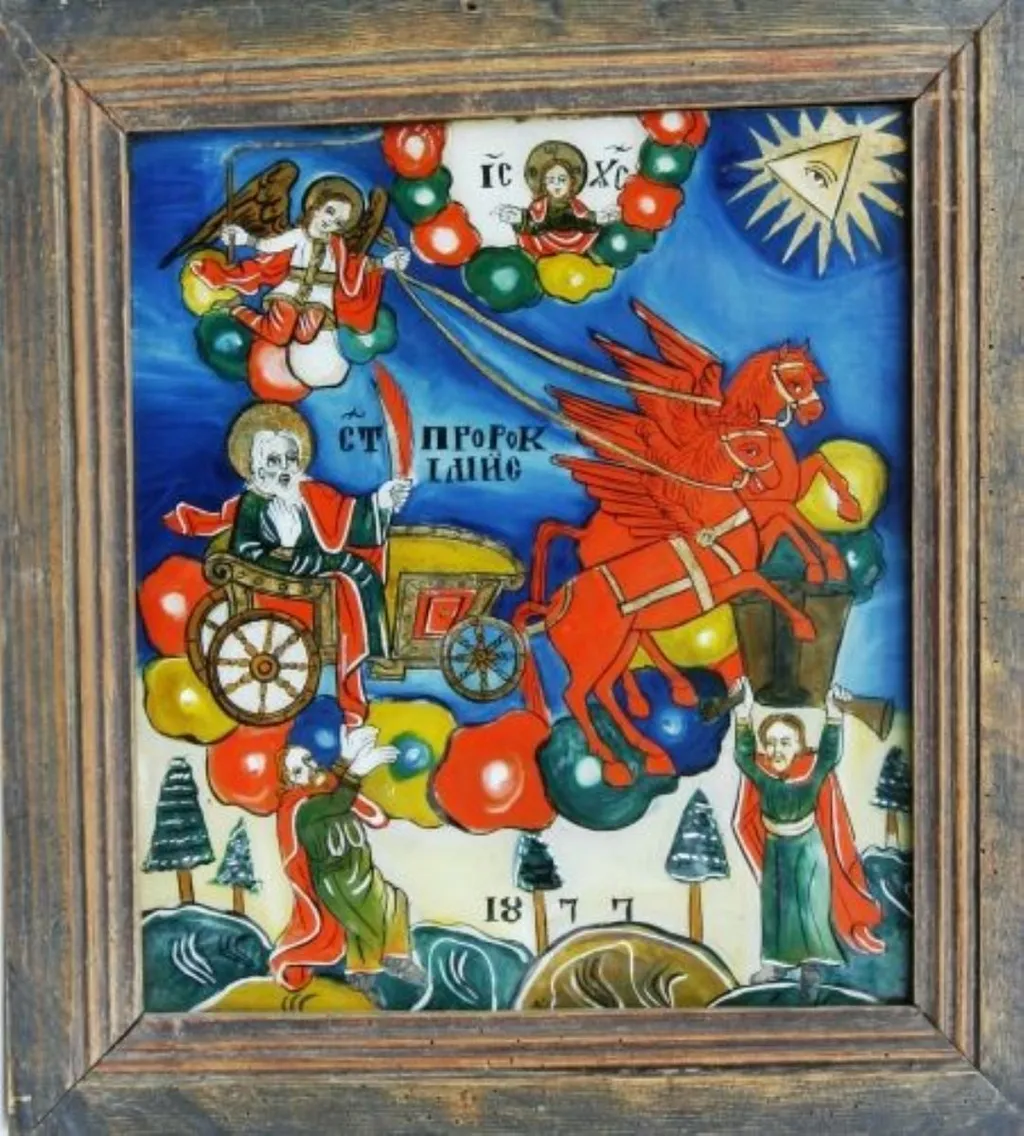
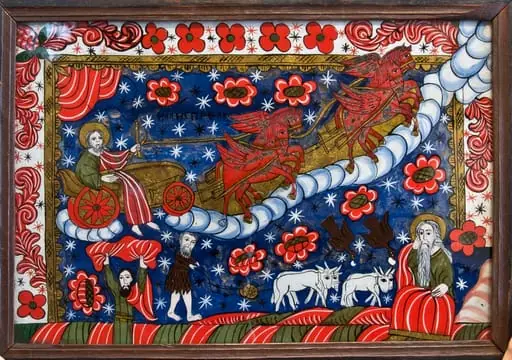
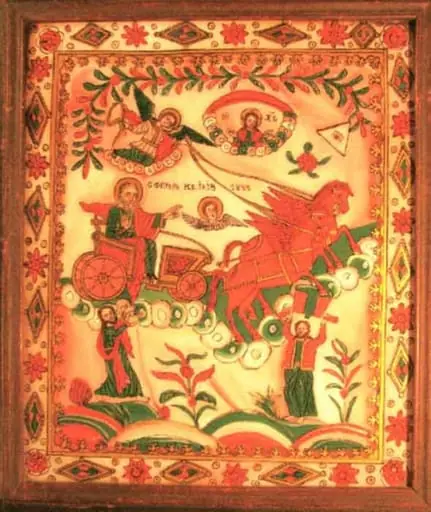
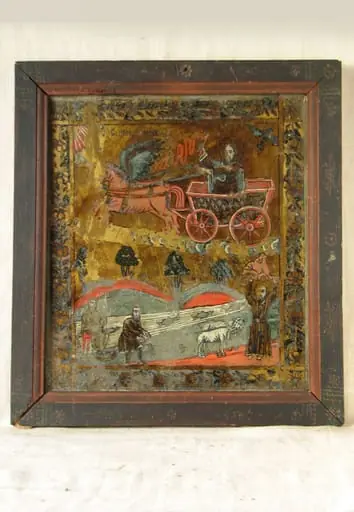
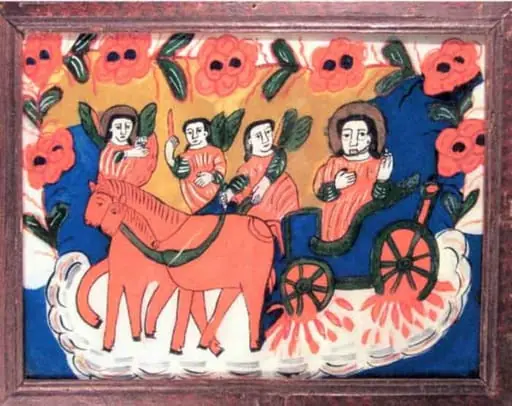
Sfântul Prooroc Ilie is a drawing by the Impressionist artist Unknown. It dates from 1877 and is held in the collection of the Romanian Peasant Museum. Painted in 1877, this work depicts a celestial scene centered on a winged, fiery chariot ascending through a vividly colored sky.
About this work
The figures and symbols suggest a story about faith or prophecy, but the exact meaning isn’t clear just from looking.
This painting shows a bright, busy scene with bold colors. At the top, two winged figures float above a chariot pulled by a fiery red horse with wings. One figure holds a wheel, and the other points upward. Below, two people stand on the ground, one in green and one in red robes, looking up. The sky is packed with floating shapes in red, yellow, and green, and a sun shines on the right side.
The year "1877" is written in the corner, matching the date on the painting. The figures and symbols suggest a story about faith or prophecy, but the exact meaning isn’t clear just from looking.
If you like this style, look up Impressionism next.
Overview
Painted in 1877, this work depicts a celestial scene centered on a winged, fiery chariot ascending through a vividly colored sky. Two angelic figures hover above it—one holding a wheel, the other gesturing upward—while two figures on the ground gaze skyward. The composition is dense with symbolic forms and saturated hues, suggesting a narrative rooted in religious or prophetic tradition, though its precise meaning remains ambiguous.
Subject & Meaning
The imagery evokes themes of divine revelation, possibly referencing the biblical prophet Elijah’s ascension in a chariot of fire. The wheel may allude to Ezekiel’s vision, and the upward gesture reinforces a spiritual ascent. The earthly figures, dressed in contrasting robes, appear as witnesses, grounding the supernatural event in human experience. The lack of clear textual sources leaves interpretation open, inviting contemplation rather than definitive reading.
Technique & Style
The painting employs bold, unmodulated colors and flattened spatial depth, creating a luminous, almost decorative surface. Forms are outlined with clarity, and the sky is filled with abstracted shapes in red, yellow, and green, suggesting movement and divine energy. While not strictly Impressionist, its emphasis on color over detail and its dynamic composition show affinities with emerging modern approaches to visual expression.
History & Provenance
Signed and dated 1877, the work originates from a period of intense religious and cultural reflection in Eastern Europe. Its creator remains unidentified in available records, and its early ownership is undocumented. The painting has been preserved in regional collections, likely within the cultural sphere of the Romanian Orthodox tradition, though its full journey from creation to present is not fully traced.
Context
Created during a time of national awakening in Romanian cultural life, the painting reflects a broader interest in spiritual and historical themes. While Western academic styles dominated official art institutions, this work suggests a more folk-influenced or local devotional tradition. Its symbolic language aligns with Orthodox iconography but diverges in its expressive color and compositional energy.
Legacy
Though not widely exhibited beyond regional contexts, the painting contributes to a lesser-known strand of 19th-century religious art that prioritized emotional resonance over doctrinal precision. Its use of vivid color and symbolic abstraction anticipates later modernist explorations of spiritual themes, offering a quiet counterpoint to dominant Western artistic trends of the era.
Artist & collection

 Domestic Scene
 Giacomo and Cardinal Marco, investing Andrea, Abbot of San Zeno, with his Benefice
 The Nymph of Fontainebleau
 Portrait of a Woman
 Madonna and Child with Saints in the Enclosed Garden
 Venus and Minerva
 Family Group of Four on Sofa
 Wall painting from Room H of the Villa of P. Fannius Synistor at Boscoreale