Artwork
Sf. Prooroc Ilie
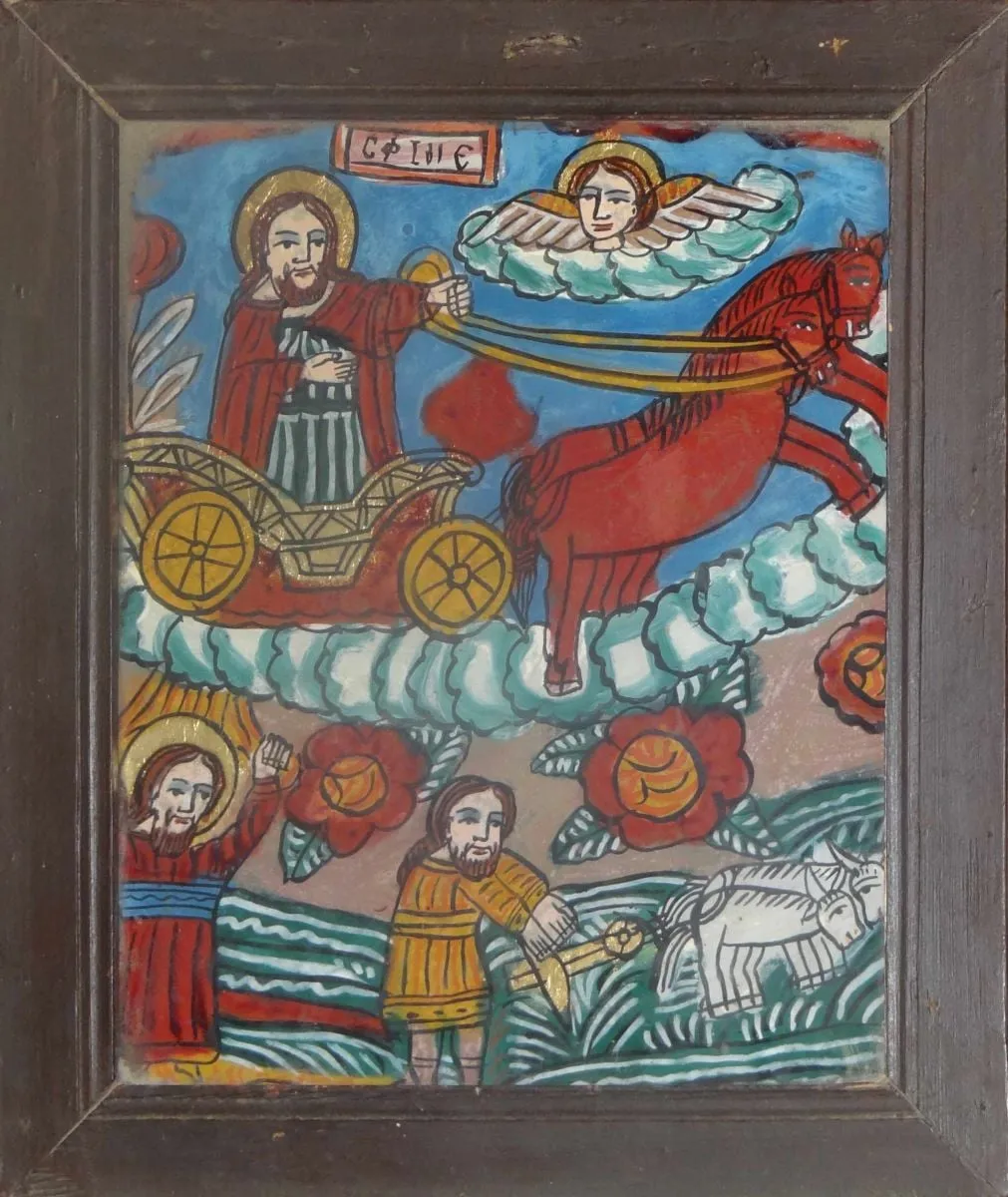
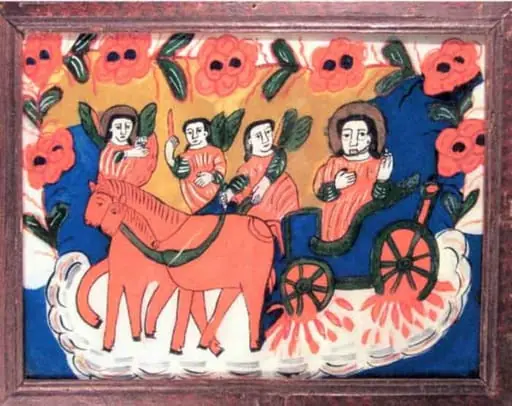
Sf. Prooroc Ilie is a drawing by Unknown. It dates from 1850 and is held in the collection of the Alba Iulia Unification National Museum. This painting portrays a religious figure in a chariot, drawn by a single red horse, ascending above a group of onlookers.
About this work
Overview
This painting portrays a religious figure in a chariot, drawn by a single red horse, ascending above a group of onlookers.
This painting portrays a religious figure in a chariot, drawn by a single red horse, ascending above a group of onlookers. Rendered in a folk-art idiom, it features flat planes of vivid color, strong outlines, and minimal spatial depth. The figure, identified by a halo and red robe, is central to the composition, while the blue background with white clouds and red blossoms suggests a celestial setting. The style reflects regional Eastern European devotional traditions.
Subject & Meaning
The central figure, likely the Prophet Elijah, is depicted in a moment of divine ascent, drawing from biblical accounts of his departure in a chariot of fire. Below, the group gazes upward in quiet reverence, emphasizing spiritual awe. The chariot and horse symbolize divine transport, while the halo affirms his sanctity. The scene functions as a visual hymn, reinforcing faith in heavenly intervention and prophetic authority within a local devotional context.
Technique & Style
Executed with bold, unmodulated colors and simplified forms, the painting avoids naturalistic perspective, favoring symbolic clarity. Lines are crisp and deliberate, defining figures and elements without shading or texture. The composition is frontal and hierarchical, with the prophet elevated both physically and visually. This approach aligns with folk religious art traditions, where emotional resonance and doctrinal clarity outweigh realism.
History & Provenance
The work’s origin is tied to rural Eastern European communities where religious imagery was often produced by local artisans for home or church use. Exact dates and creators are undocumented, but its stylistic traits suggest late 19th or early 20th-century production. It likely served as a devotional object, passed through generations within a family or parish, preserving sacred narratives outside formal ecclesiastical channels.
Context
In regions with strong Orthodox Christian traditions, images of prophets like Elijah were common in domestic altars and village churches. These works filled a need for accessible sacred imagery where trained iconographers were scarce. The bold palette and simplified forms reflect both limited materials and a cultural preference for direct, emotionally resonant representations of divine figures.
Legacy
This painting exemplifies how religious narratives were sustained in folk traditions, independent of academic or institutional art systems. Its survival offers insight into the visual piety of rural communities, preserving a mode of expression that valued symbolic power over technical refinement. It remains a testament to the enduring role of art in everyday spiritual life.
Artist & collection
Museum
Alba Iulia Unification National Museum
Continue through works from the same source collection.
 Domestic Scene
 Giacomo and Cardinal Marco, investing Andrea, Abbot of San Zeno, with his Benefice
 The Nymph of Fontainebleau
 Portrait of a Woman
 Madonna and Child with Saints in the Enclosed Garden
 Venus and Minerva
 Family Group of Four on Sofa
 Wall painting from Room H of the Villa of P. Fannius Synistor at Boscoreale
 Icoascri
 Sf. Prooroc Ilie
 Icoauite
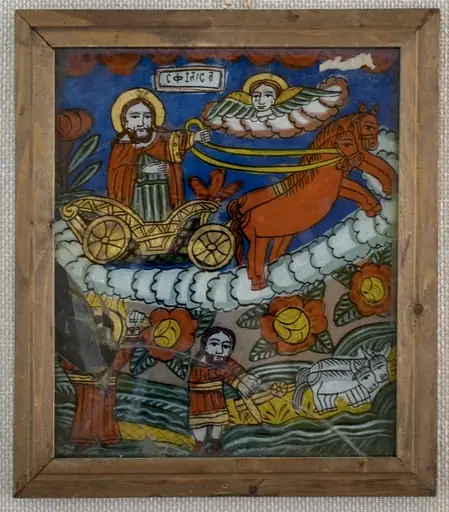
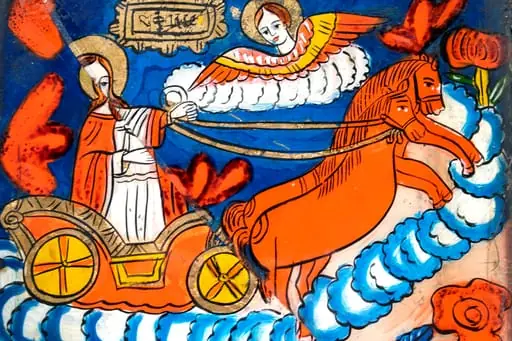 Icoana este pictată pe un suport de glajă formă dreptunghiulară în ax vertical. Scena ridicării la cer a Sfântului Ilie(Răpirea la cer)este redată într-o viziune populară. Sfântul Ilie, ca stăpân al tunetelor, fulgerelor și al ploii, purtat de un car de foc pe cer, este redat în registrul superior, în cel inferior fiind reprezantat proorocul Elisei în două ipostaze. Pe un registru în lanț de nori pastelați alb-albaștri, trăsura de culoare roșu cărămiziu, cu marginile și cercurile roților poleite, trasă de doi cai de aceeași culoare îl poartă pe sfântul Ilie înveșmântat cu tunică albă cu faldurile marcate cu negru, o mantie roșie. În slavă, pe nori, un heruvim. În registrul inferior, colțul stâng, proorocul Elisei(tunică albastră, brâul și manșetele galbene, în jurul capului, nimb aurit) cu mâinile ridicate primește haina sf. Ilie, ca semn al investiturii cu puterile acestuia.În colțul drept apare arând pământul cu un plug poleit tras de doi boi albi. Înveșmântat aici cu o tunică de culoare roșie cu poalele și încălțămintea albastră. Chipurile expresive, ochii negri, proporțiile corpului sunt reduse. Câmpul icoanei este împărțit în mai multe registre: partea superioară, în spatele carului, este albastră cu flori cu câte trei petale dispuse în poziții diferite; În cea de jos - benzi hașurate divers pe fond verde, sugerând relieful ; Registrul terestru este separat de cel celest printr-o zonă gri roz decorată cu trei flori roșii cu frunze verzi. Inscripția - în partea de sus, într-un chenar alb cu marginile dantelate. Suportul pictural deteriorat(oblic și colțul din stânga jos). Rama - patru șipci din lemn de brad, băițuite, îmbinate oblic la colțuri și întărite cu pene ascunse la colțuri. Capacul este realizat din două scânduri de lemn de brad.
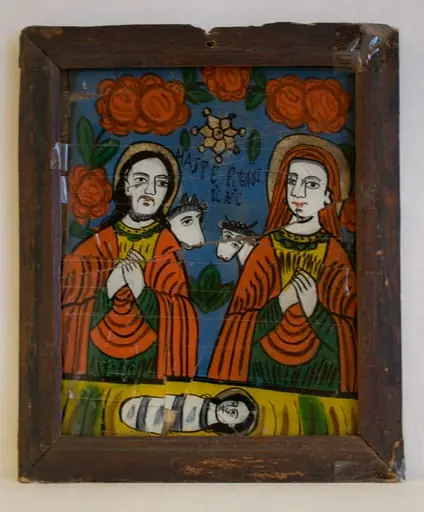 Naștiu s
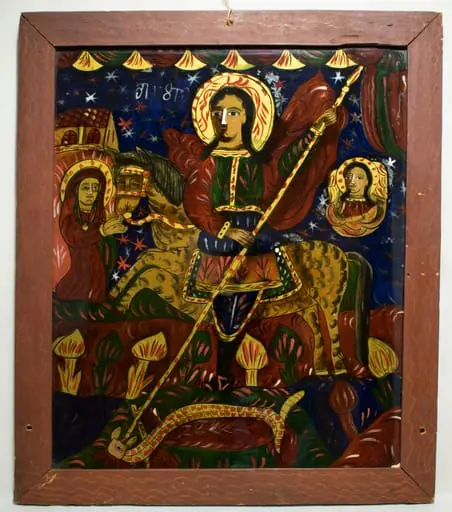
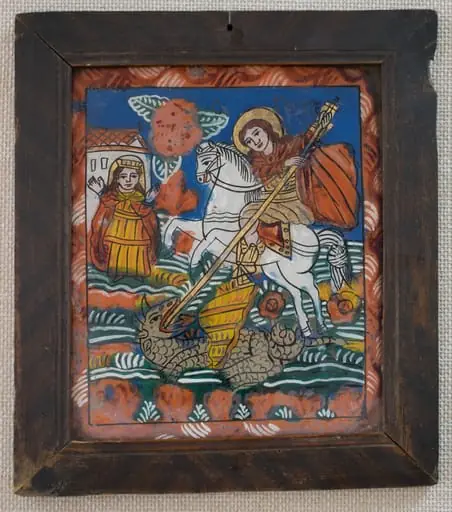 Icoana îl reprezintă pe sfântul Gheorghe omorând balaurul. Sfântul, călare pe cal alb, plasat central. Veșmintele sunt asemănătoare celor ale soldaților chezaro-crăiești, cizme înalte, tunică scurtă, zale, mantie roșie fluturând în vânt. Are capul descoperit, plete lungi, castanii, ochi mari, gura roșie, trăsăturile bine definite, expresive. În mână ține o suliță lungă, cruciformormă,aurită, cu care omoară balaurul înaripat, căzut la pământ, scoțînd limbi ascuțite. Calul este alb, capul mic, coada înnodată. Relieful este realizat prin linii albe) și vrâste de culoare(verde, galben,roșu), marcate cu motive fitomorfe. Câmp albastru închis, înviorat de o floare roșie cu frunze delimitate de nervuri albe. În partea stângă, în plan îndepărtat, în fața palatului sugerat printr-o clădire simplă,albă, înaltă, cu acoperiș de olane roșii, se află fata de împărat pe care o salvează sfântul conform legendei. Întreaga compoziție este încadrată de un chenar rectangular de culoare roșie, traversat longitudinal de o linie spiralată ale cărei meandre sunt însoțite de blicuri albe și verzui. Desenul complicat, tușa groasă, culorile intense, asemănător vitraliilor. Umplerea cu culoare neglijentă indică o producție de serie. Rama din lemn de brad este vopsită în cafeniu închis și decorată cu u motiv în formă de V Dosul este realizat din două scândurele de brad dispuse orizontal.
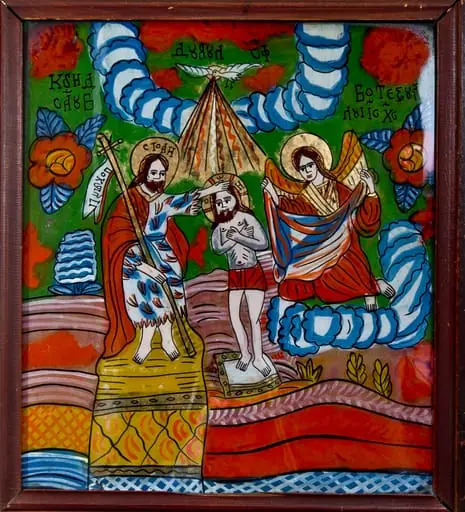 Botezul lui IS HS
 Icoaată
 Sfântul Ilie