Artwork
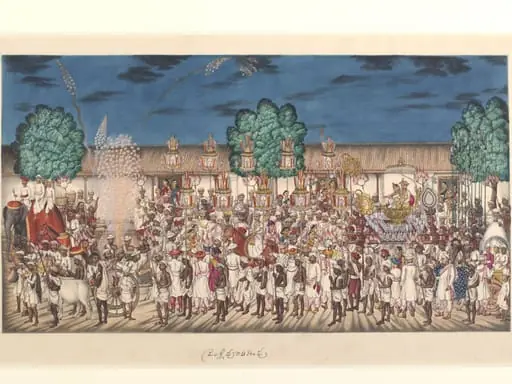
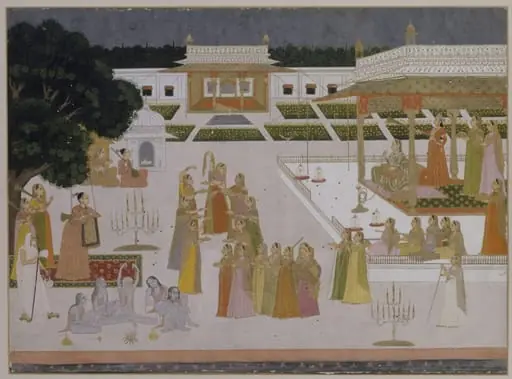
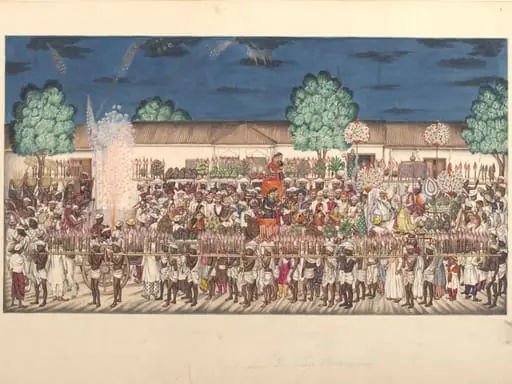
Shaivite procession at night
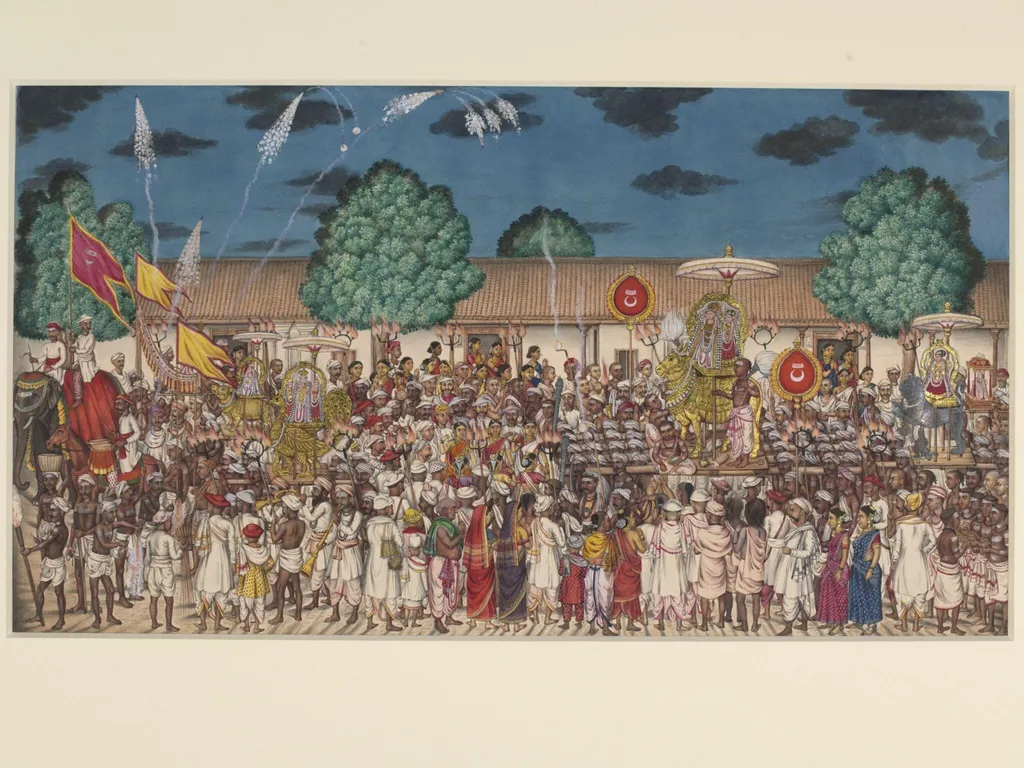
Shaivite procession at night is a paint painting by the Patna School of Painting artist Unknown. It dates from 1830 and is held in the collection of the Victoria and Albert Museum.
About this work
Overview
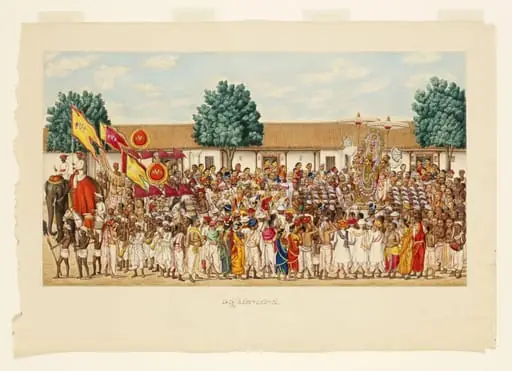
This painting is one of thirty folios created by Indian artists for British patrons during the colonial period, classified as Company painting. It captures a nocturnal Shaivite religious procession, emphasizing ritual movement through darkness. The work belongs to a broader series documenting Indian social and religious life, commissioned to satisfy European curiosity about local customs.
Subject & Meaning
Torchlight illuminates the path, suggesting sacred movement through the night.
The scene depicts a nighttime procession honoring Shiva, with devotees carrying a decorated idol on a platform, accompanied by musicians and followers dressed in white. Torchlight illuminates the path, suggesting sacred movement through the night. The imagery reflects devotional practice, where ritual processions serve as public expressions of faith, blending spiritual symbolism with communal participation.
Technique & Style
The artist employs vivid pigments and crisp linear outlines, characteristic of Company painting’s hybrid aesthetic. While the subject is indigenous, the composition reflects European conventions of clarity and detail, with careful attention to figures and lighting. The use of artificial light from torches adds dramatic contrast, enhancing the nocturnal atmosphere without naturalistic shading.
History & Provenance
Created in early 19th-century India, likely in a studio catering to British officials, this painting was part of a commissioned album documenting regional customs. It entered the Victoria and Albert Museum’s collection through colonial-era acquisitions, preserving a record of cross-cultural artistic exchange during the East India Company’s influence.
Context
Company paintings emerged as a commercial genre where Indian artists adapted traditional techniques to meet European tastes. This work reflects a period when local religious practices were observed, recorded, and often exoticized by colonial viewers. The procession format, familiar in South Asian culture, was selected for its visual richness and ceremonial clarity.
Legacy
As a preserved artifact of colonial-era collaboration, the painting offers insight into how Indian artistic traditions were documented and reshaped for foreign audiences. It remains a key example of cross-cultural visual exchange, informing contemporary understanding of how indigenous rituals were represented—and sometimes reinterpreted—within colonial frameworks.
Artist & collection

 Domestic Scene
 Giacomo and Cardinal Marco, investing Andrea, Abbot of San Zeno, with his Benefice
 The Nymph of Fontainebleau
 Portrait of a Woman
 Madonna and Child with Saints in the Enclosed Garden
 Venus and Minerva
 Family Group of Four on Sofa
 Wall painting from Room H of the Villa of P. Fannius Synistor at Boscoreale