Artwork
Shiva and Andhaka
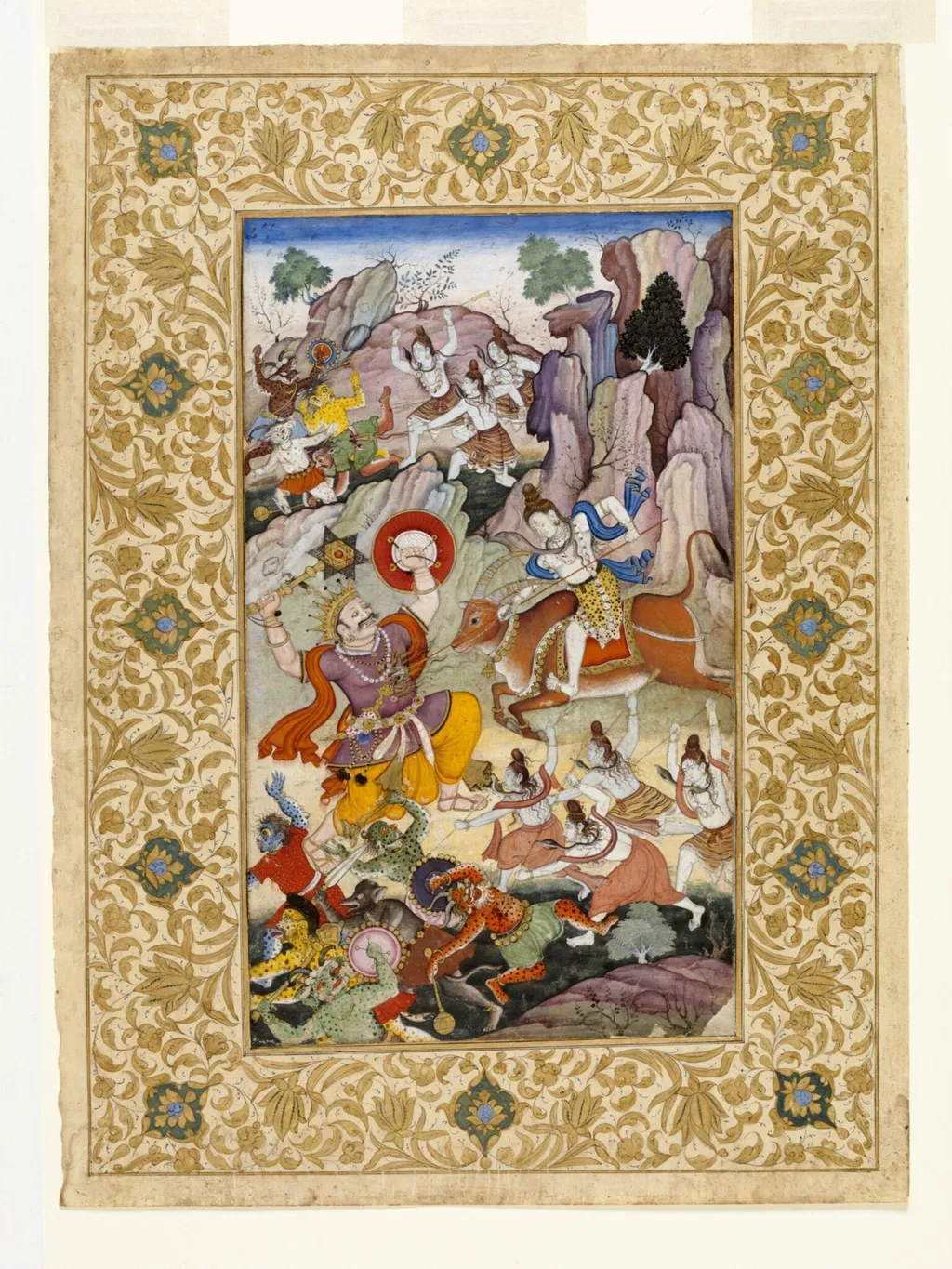
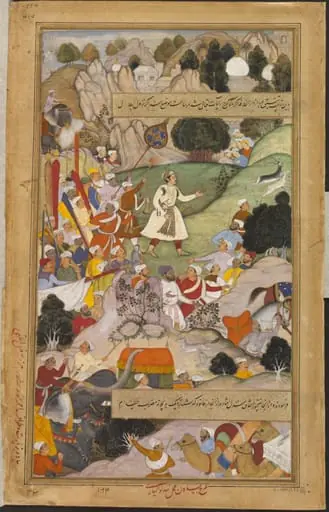
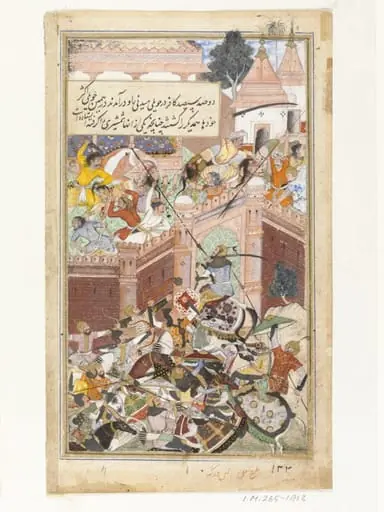
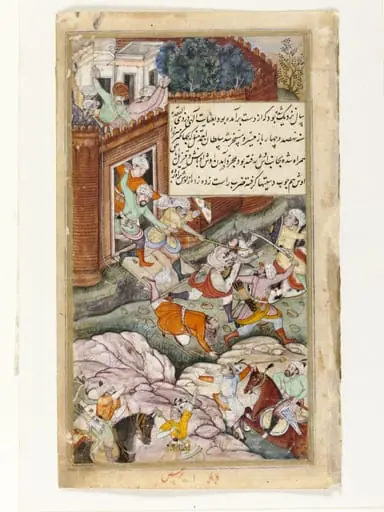
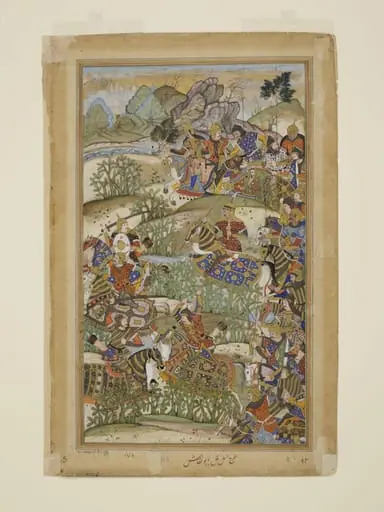
Shiva and Andhaka is a paint painting by the Mughal Painting artist Unknown. It dates from 1590 and is held in the collection of the Victoria and Albert Museum.
About this work
Overview
This painting originates from a Persian-language manuscript commissioned by the Mughal emperor Akbar, which translated Sanskrit narratives about Hindu deities.
This painting originates from a Persian-language manuscript commissioned by the Mughal emperor Akbar, which translated Sanskrit narratives about Hindu deities. Though the text focused on Krishna, this particular scene illustrates a story from Shiva’s mythology. Created around 1590, the page was later detached from its original manuscript and re-mounted in an 18th-century album, likely in Lucknow, with elaborate decorative borders.
Subject & Meaning
The scene depicts Shiva confronting Andhaka, a demon born from his own sweat, who stole a sacred flowering vine. Andhaka’s strength grows with each drop of his blood, making his defeat a symbolic act of divine control over chaos. Shiva, identified by his blue skin and third eye, severs the demon’s head, asserting cosmic order. The narrative reflects themes of self-confrontation and the subjugation of destructive impulses.
Technique & Style
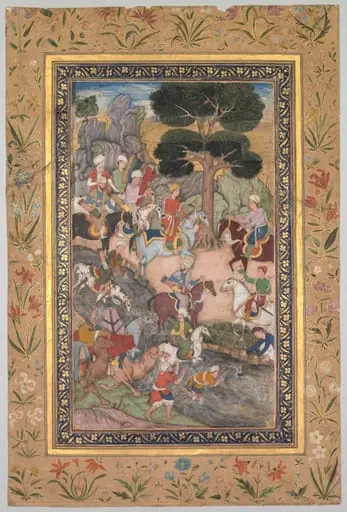
Executed in opaque watercolor and gold on paper, the painting employs fine brushwork and rich, layered pigments typical of Mughal atelier traditions. Figures are rendered with precise anatomical detail, while the background remains minimal, focusing attention on the central confrontation. The ornate borders added later in Lucknow feature floral motifs and intricate calligraphy, contrasting with the earlier, more narrative-focused composition.
History & Provenance
The painting was part of a manuscript produced under Akbar’s patronage in the 1590s, translating Hindu epics into Persian for imperial consumption. After the manuscript’s disassembly, its folios were collected and framed in the 18th century, possibly in Lucknow, as standalone album pages. It entered the Victoria and Albert Museum’s collection as part of this later album, its original context fragmented but its artistic value preserved.
Context
Akbar’s court actively promoted cross-cultural exchange, commissioning translations of Hindu texts to foster religious understanding. Artists from diverse backgrounds collaborated in imperial workshops, blending Persian aesthetics with Indian iconography. This painting reflects that synthesis: a Hindu myth rendered in a Persianate style for a Muslim ruler, later repurposed within an elite South Asian album culture.
Legacy
The painting survives as a material testament to Mughal-era cultural synthesis and the fluid boundaries between religious traditions in early modern India. Its recontextualization into an album highlights changing modes of collecting and display. Today, it remains a key example of how imperial patronage reshaped religious narratives through visual art.
Artist & collection

 Domestic Scene
 Giacomo and Cardinal Marco, investing Andrea, Abbot of San Zeno, with his Benefice
 The Nymph of Fontainebleau
 Portrait of a Woman
 Madonna and Child with Saints in the Enclosed Garden
 Venus and Minerva
 Family Group of Four on Sofa
 Wall painting from Room H of the Villa of P. Fannius Synistor at Boscoreale