Artwork
Text, Folio 75 (verso), from a Kalpa-sutra
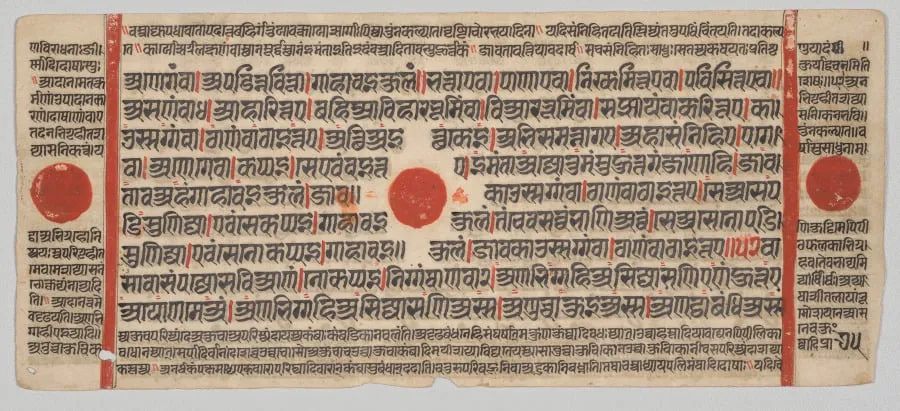
Text, Folio 75 (verso), from a Kalpa-sutra is an unspecified painting by the Mughal Painting artist Unknown. It dates from 1488 and is held in the collection of the Cleveland Museum of Art. This folio is a handwritten manuscript page featuring dense script in black ink, accented with red markings.
About this work
Overview
Though visually reminiscent of Renaissance manuscripts, its script and linguistic origin remain unidentified, indicating a non-European scribal tradition.
This folio is a handwritten manuscript page featuring dense script in black ink, accented with red markings. The text is arranged in tightly spaced lines across a rectangular format, bounded by a red border. Variations in font size suggest hierarchical emphasis within the content. Though visually reminiscent of Renaissance manuscripts, its script and linguistic origin remain unidentified, indicating a non-European scribal tradition.
Subject & Meaning
The content appears to be liturgical or doctrinal, likely drawn from a religious or philosophical corpus given the structured use of red for emphasis. The absence of imagery and the focus on textual precision imply a devotional or scholarly function. Red markings may indicate annotations, rubrics, or liturgical cues, guiding recitation or interpretation by trained readers.
Technique & Style
The script is executed with fine brushwork, demonstrating control over ink flow and line consistency. Red accents, applied with precision, serve both decorative and functional roles, highlighting key passages without disrupting the textual flow. The lack of illumination or figural elements distinguishes it from contemporary illustrated manuscripts, favoring textual clarity over visual ornamentation.
History & Provenance
The folio originates from a Kalpa-sutra manuscript, a Jain textual tradition dating from the 14th to 16th centuries in western India. Its production likely occurred in a monastic scriptorium, where scribes copied sacred texts with ritual care. The red ink and script style align with regional Jain manuscript practices, though the specific provenance of this folio remains undocumented.
Context
Jain manuscripts like this were created for ritual use, often carried by monks or displayed in temples during recitations. The emphasis on textual fidelity over illustration reflects Jain ascetic values, prioritizing the sacred word over visual representation. Similar folios survive in collections across India and Europe, preserved as artifacts of religious literacy and scribal discipline.
Legacy
This folio contributes to the understanding of pre-modern South Asian scribal culture, illustrating how religious texts were physically and visually organized for transmission. Its preservation highlights the endurance of Jain textual traditions and the meticulous craftsmanship of regional manuscript production, offering insight into non-Western systems of knowledge preservation.
Artist & collection

 Domestic Scene
 Giacomo and Cardinal Marco, investing Andrea, Abbot of San Zeno, with his Benefice
 The Nymph of Fontainebleau
 Portrait of a Woman
 Madonna and Child with Saints in the Enclosed Garden
 Venus and Minerva
 Family Group of Four on Sofa
 Wall painting from Room H of the Villa of P. Fannius Synistor at Boscoreale
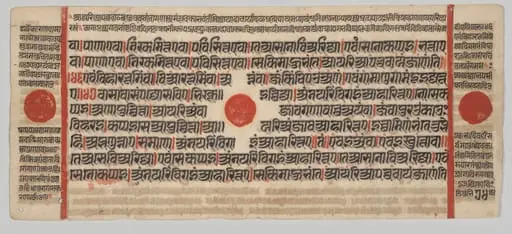 Text, Folio 74 (verso), from a Kalpa-sutra
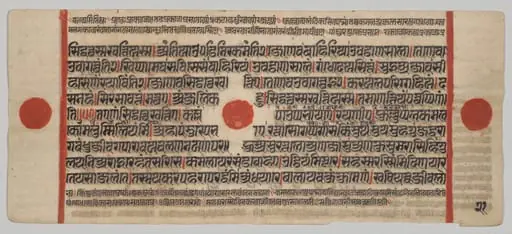 Text, Folio 21 (verso), from a Kalpa-sutra
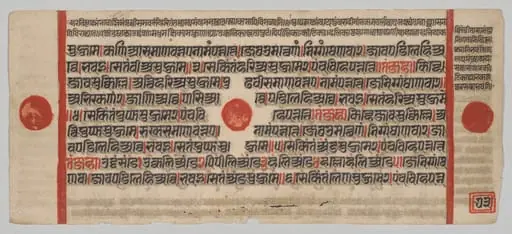 Text, Folio 73 (verso), from a Kalpa-sutra
 Text, Folio 53 (verso), from a Kalpa-sutra
 Text, Folio 68 (verso), from a Kalpa-sutra
 Text, Folio 18 (verso), from a Kalpa-sutra
 Text, Folio 4 (verso), from a Kalpa-sutra
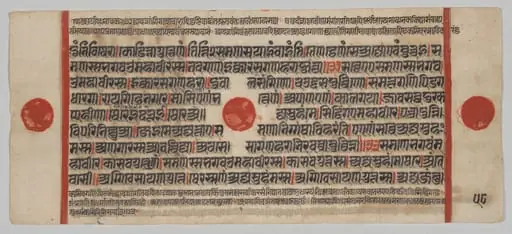 Text, Folio 58 (verso), from a Kalpa-sutra
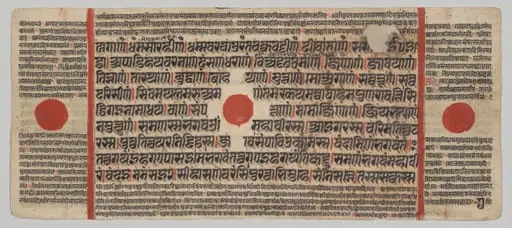 Text, Folio 7 (verso), from a Kalpa-sutra
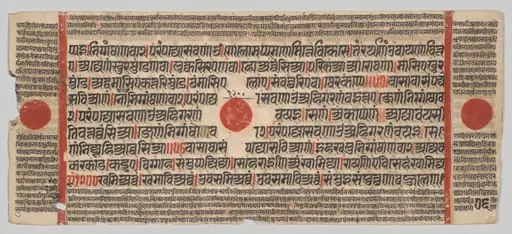 Text, Folio 76 (verso), from a Kalpa-sutra
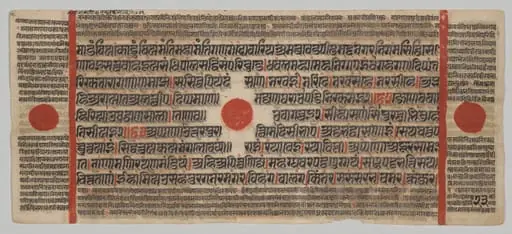 Text, Folio 23 (verso), from a Kalpa-sutra