Artwork
The giant Sar Farangi dashes Mesluq to the ground
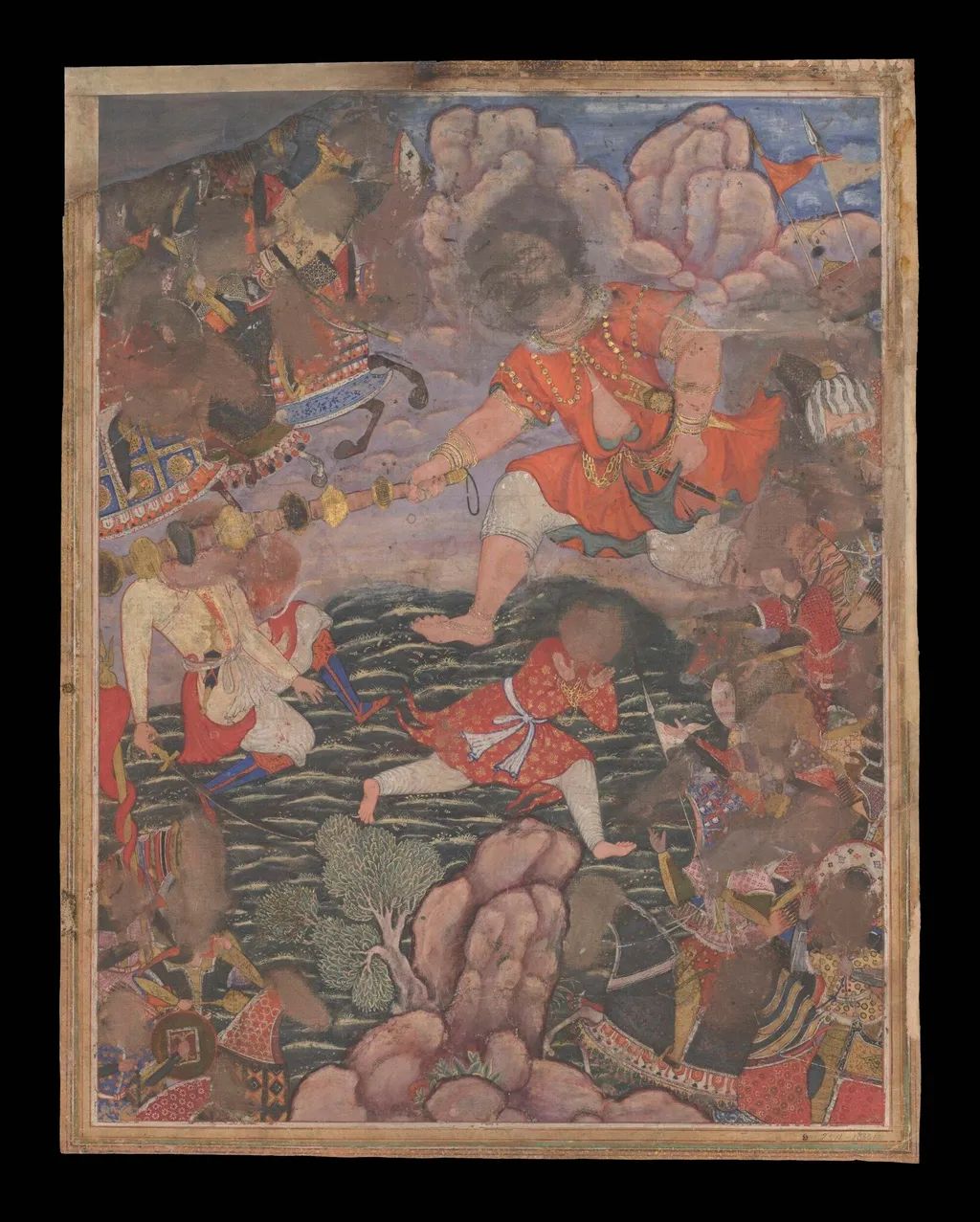
The giant Sar Farangi dashes Mesluq to the ground is a paint painting by the Mughal Painting artist Unknown. It dates from 1570 and is held in the collection of the Victoria and Albert Museum.
About this work
Overview
The work was produced over fifteen years by a team of artists in Akbar’s imperial atelier, blending Persian, Indian, and Central Asian visual traditions.
The Hamzanama was a vast illustrated manuscript commissioned by Emperor Akbar around 1562, depicting the legendary exploits of Hamza, an uncle of the Prophet Muhammad. Originally comprising approximately 1,400 paintings, fewer than 200 survive. This scene, one of many from the series, captures a moment of supernatural combat between the giant Sar Farangi and his foe Mesluq. The work was produced over fifteen years by a team of artists in Akbar’s imperial atelier, blending Persian, Indian, and Central Asian visual traditions.
Subject & Meaning
The scene illustrates a battle between Sar Farangi, a colossal warrior, and Mesluq, a smaller adversary, set against a rugged landscape. The narrative draws from Persian epic traditions, portraying Hamza’s allies as champions of divine justice. The exaggerated scale of Sar Farangi emphasizes his otherworldly strength, while Mesluq’s fall signifies the triumph of the righteous. Though rooted in Islamic legend, the story evolved through centuries of oral retelling, absorbing local motifs and moral frameworks beyond strict religious doctrine.
Technique & Style
The painting employs vivid mineral pigments and fine brushwork to render dynamic movement and textured surfaces. Musculature is exaggerated, clothing and armor detailed, and the rocky terrain rendered with meticulous attention to foliage and geology. The composition uses diagonal energy to convey the giant’s leap and the force of impact. Despite damage, the original precision in line and color reveals the high skill of the imperial workshop, where artists collaborated under strict stylistic guidelines to maintain visual coherence across the entire series.
History & Provenance
The painting’s human and equine figures were deliberately defaced in the 19th century, likely due to religious objections to figural representation. The giant’s face was later crudely repainted, indicating attempts at partial restoration. The original text, once inscribed on the reverse of each folio, is now largely lost, making narrative reconstruction difficult. Surviving folios are scattered across collections, with this example held in the Victoria and Albert Museum, where it remains a key artifact of Mughal artistic ambition.
Context
Akbar’s patronage of the Hamzanama reflected his interest in synthesizing diverse cultural traditions within his empire. The project united Persian literary heritage with Indian painting techniques and Central Asian storytelling. Unlike earlier illustrated manuscripts, the Hamzanama emphasized action, scale, and emotional intensity, breaking from static courtly scenes. Its production involved dozens of artists, calligraphers, and pigment makers, representing one of the most ambitious artistic undertakings of 16th-century South Asia.
Legacy
The Hamzanama set a precedent for large-scale narrative illustration in Mughal art, influencing later imperial manuscripts. Its survival in fragments underscores the fragility of such projects and the impact of changing religious attitudes. Scholars rely on these remnants to understand the collaborative nature of Mughal workshops and the evolution of visual storytelling. Though the full manuscript is lost, its surviving images continue to inform studies of cross-cultural aesthetics and the role of art in imperial identity.
Artist & collection

 Domestic Scene
 Giacomo and Cardinal Marco, investing Andrea, Abbot of San Zeno, with his Benefice
 The Nymph of Fontainebleau
 Portrait of a Woman
 Madonna and Child with Saints in the Enclosed Garden
 Venus and Minerva
 Family Group of Four on Sofa
 Wall painting from Room H of the Villa of P. Fannius Synistor at Boscoreale
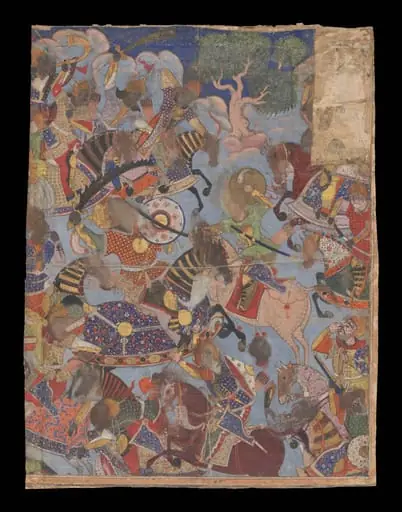 Hamza's army battles Girang's men and kills a giant
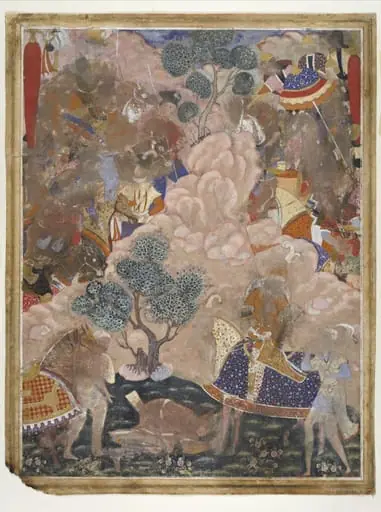 Hamza receives an envoy of Qitanush Shah
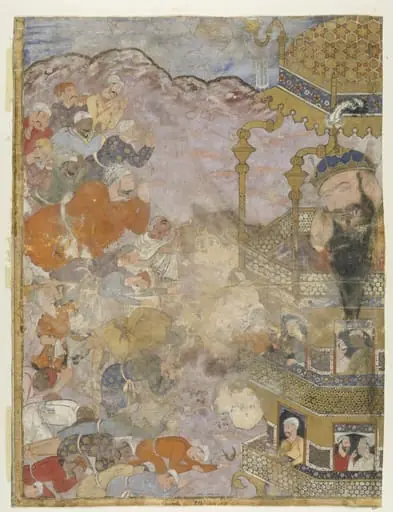 Umar is received by the giant Zumrud Shah
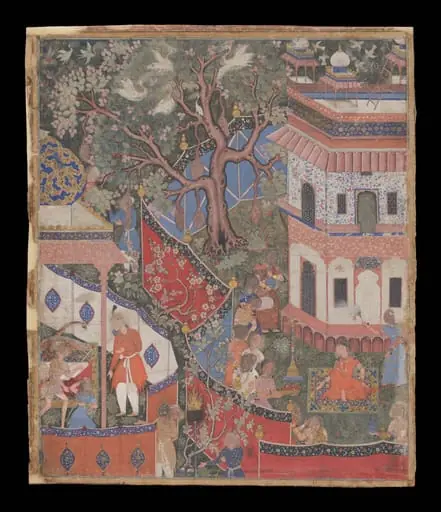 Rustam and Mihrafroz prepare for their wedding
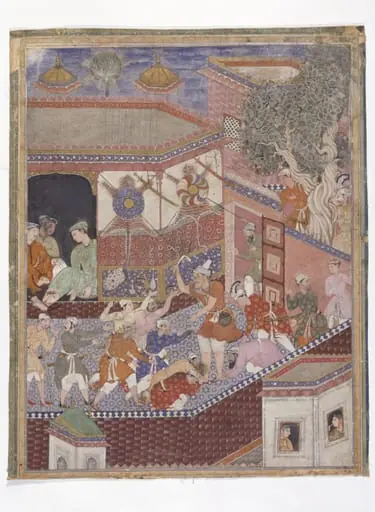 Umar searches for Hamza
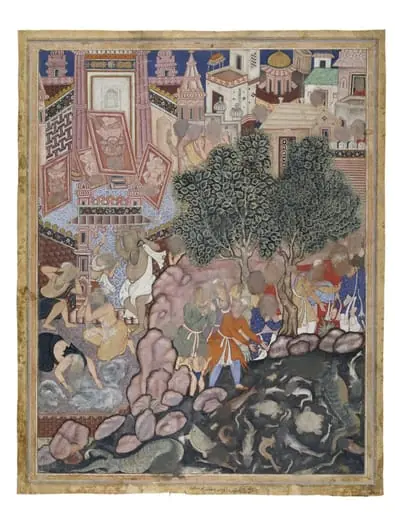 Temple idols fall and the sea dries up on the birth of the Prophet Muhammad
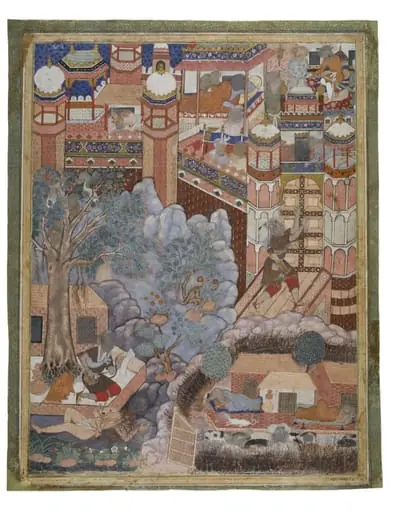 Basu beheads Namadpush and enters Acre Castle
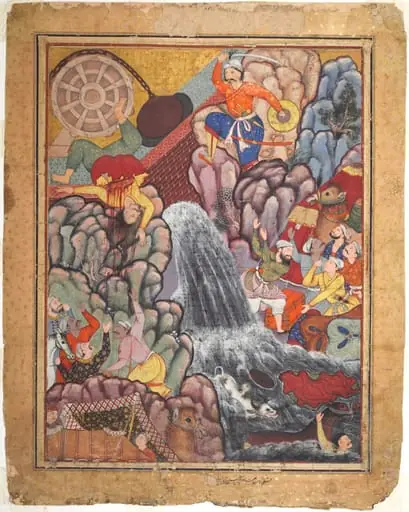 Alamshah cleaving asunder the chain of the wheel, from volume 11 of a Hamza-nama (Adventures of Hamza)
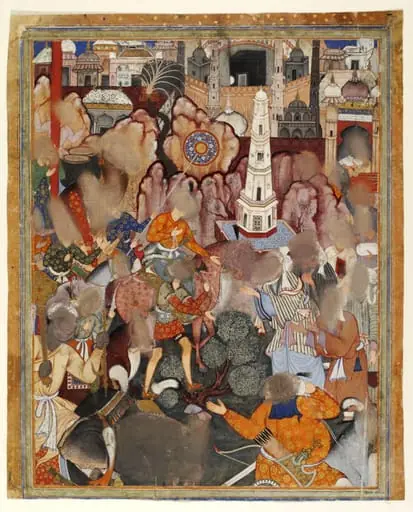 Hamza arrives in Mecca
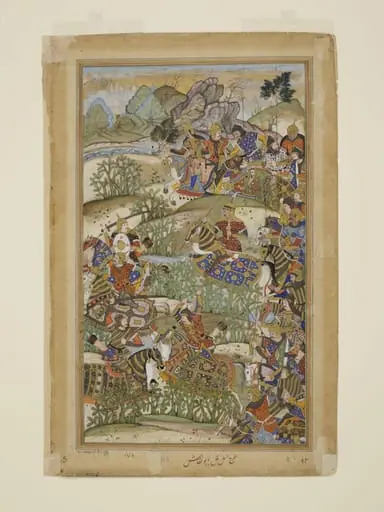 Battle of Sarnal in Gujarat