Artwork
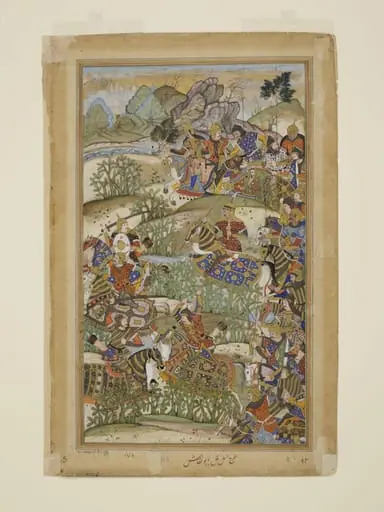
Alamshah cleaving asunder the chain of the wheel, from volume 11 of a Hamza-nama (Adventures of Hamza)
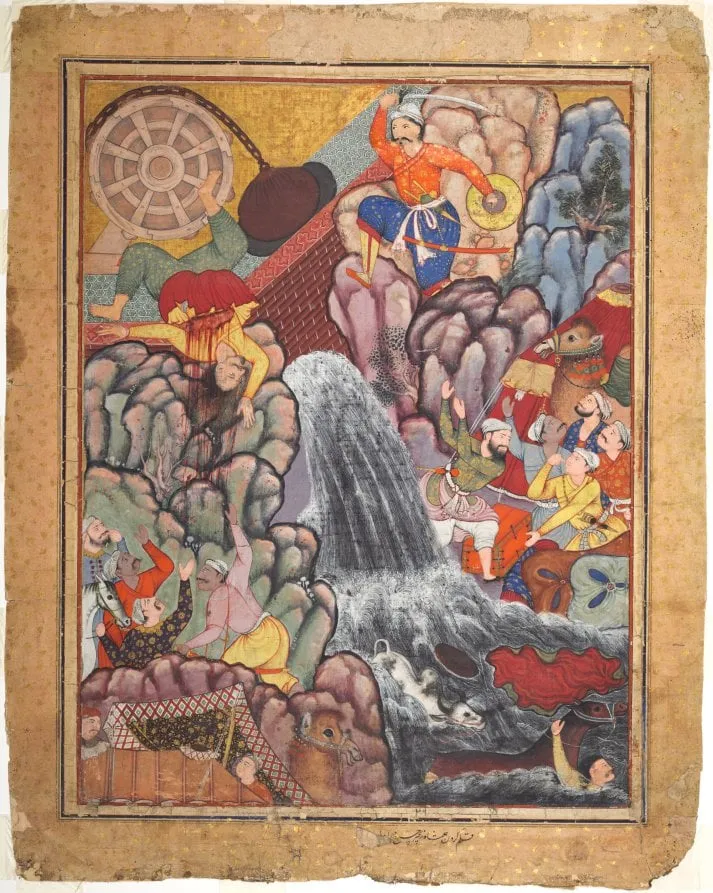
Alamshah cleaving asunder the chain of the wheel, from volume 11 of a Hamza-nama (Adventures of Hamza) is an unspecified painting by the Mughal Painting artist Unknown. It dates from 1570 and is held in the collection of the Cleveland Museum of Art.
About this work
It’s one of the first big projects from his new art workshop—1,400 pictures in all, though most are lost now.
A man in gold armor swings a sword at a giant bronze chain. Below him, water crashes through a broken dam. The hero stands on a cliff, muscles tense, while soldiers and tents wash away in the flood.
This painting comes from a huge storybook made for Emperor Akbar in the 1560s. It’s one of the first big projects from his new art workshop—1,400 pictures in all, though most are lost now.
To see more like it, look up Mughal India, court of Akbar (reigned 1556–1605).
Overview
The miniature illustrates a dramatic episode from the Hamza‑nama, a Persian‑language epic recounting the exploits of Hamza, the Prophet’s uncle. In this scene, the Greek hero Alamshah stands on a precipice, sword raised against a massive bronze chain that once held back a flood. Below, water surges through a shattered dam, sweeping away tents and soldiers.
Subject & Meaning
Alamshah is portrayed as a triumphant saviour who has just defeated the antagonist responsible for raising the bronze plug that threatened his father’s camp. The violent rupture of the dam and the ensuing torrent symbolize the hero’s liberation of his people from oppression, while the broken chain represents the severing of the enemy’s power.
Technique & Style
Executed in the Mughal miniature tradition of the 1560s, the work combines fine brushwork with vivid mineral pigments. Gold leaf accents the armor, and the composition balances dynamic diagonal lines—the sword, the chain, and the rushing water—to convey movement. The figures are rendered with a blend of Persian elegance and emerging Indian naturalism characteristic of Akbar’s workshop.
History & Provenance
Commissioned by Emperor Akbar for a deluxe illustrated manuscript of the Hamza‑nama, the painting belongs to volume 11 of a planned series of fourteen volumes, each intended to contain one hundred miniatures. The project marked the first major output of Akbar’s newly founded royal atelier. Of the original 1,400 illustrations, only about ten percent have survived, making this piece a rare example of the early Mughal court’s artistic ambition.
Context
The Hamza‑nama was adapted for Mughal audiences to celebrate heroic virtues aligned with imperial ideals. By depicting a foreign (Greek) champion allied with Islamic lineage, the narrative reinforced Akbar’s policy of cultural synthesis. The miniature reflects the workshop’s early experimentation with large‑scale narrative cycles that would later define Mughal painting.
Artist & collection

 Domestic Scene
 Giacomo and Cardinal Marco, investing Andrea, Abbot of San Zeno, with his Benefice
 The Nymph of Fontainebleau
 Portrait of a Woman
 Madonna and Child with Saints in the Enclosed Garden
 Venus and Minerva
 Family Group of Four on Sofa
 Wall painting from Room H of the Villa of P. Fannius Synistor at Boscoreale