Artwork
The Goddess Pratyangira
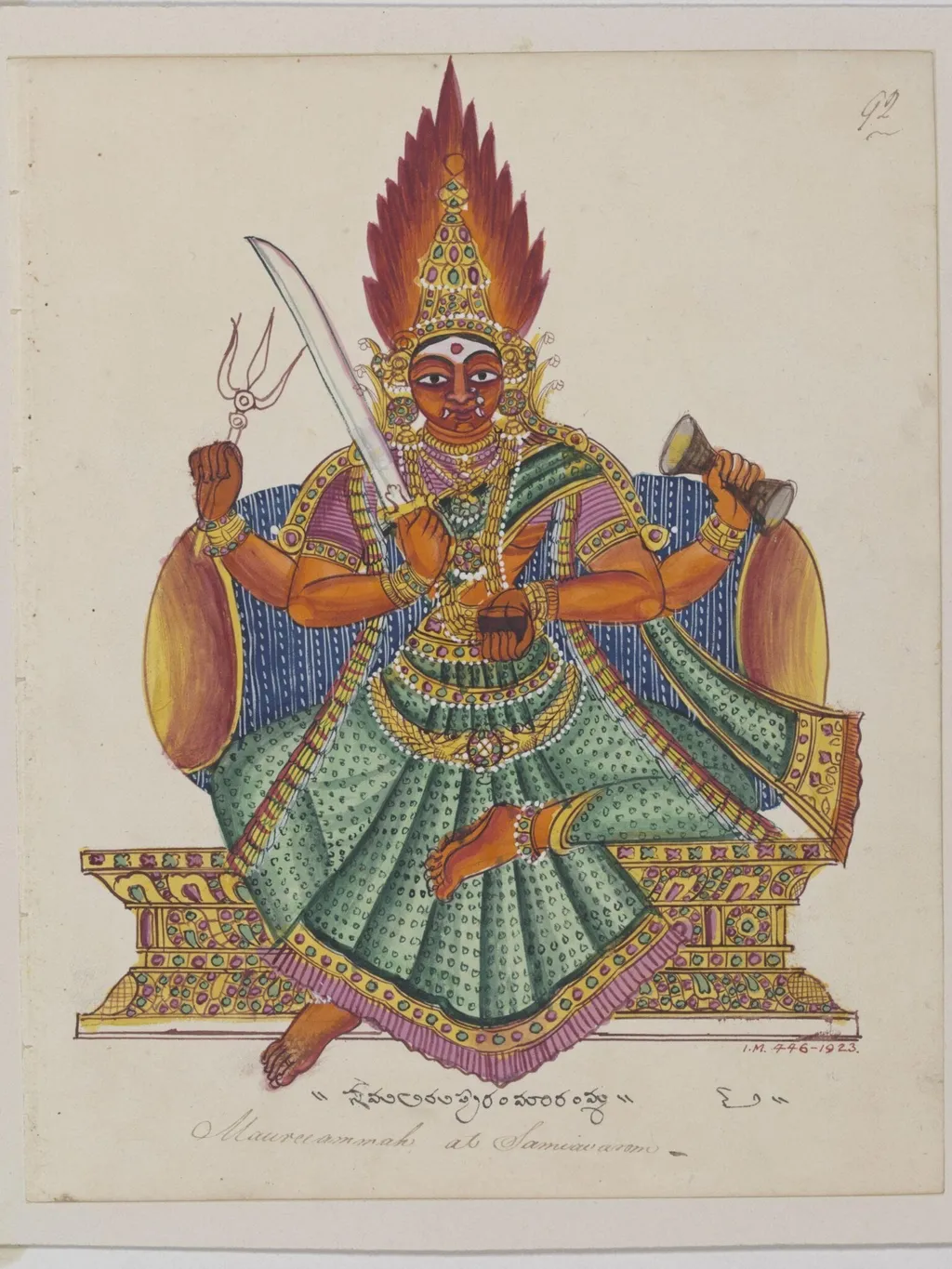
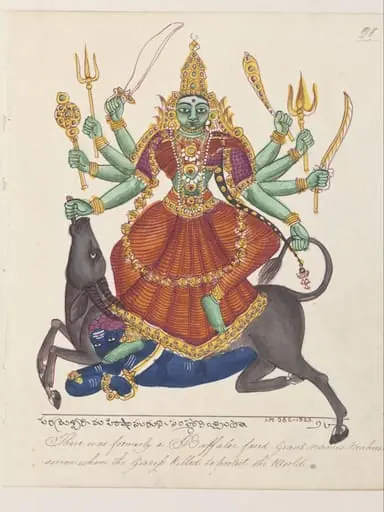
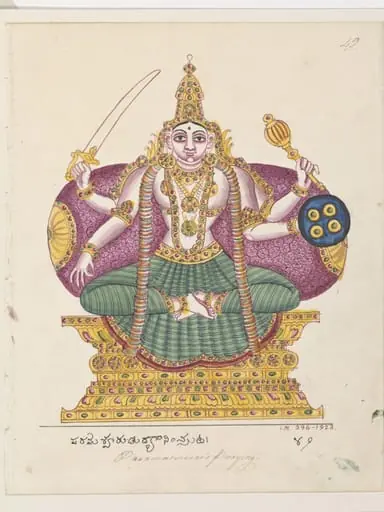
The Goddess Pratyangira is a paint painting by the Romanticist artist Unknown. It dates from 1820 and is held in the collection of the Victoria and Albert Museum. This early nineteenth‑century South Indian painting portrays the Shaivite deity Pratyangira seated upon an ornate throne.
About this work
Overview
She is rendered with vivid greens, golds and purples, her form accentuated by bold outlines and a striking flame‑shaped headdress.
This early nineteenth‑century South Indian painting portrays the Shaivite deity Pratyangira seated upon an ornate throne. She is rendered with vivid greens, golds and purples, her form accentuated by bold outlines and a striking flame‑shaped headdress. The composition includes a sword at her side, a trident in one hand, a drum (damaru) in the other, and a bowl of blood, all traditional attributes linked to Shiva.
Subject & Meaning
Pratyangira, a fierce manifestation of the goddess associated with protection and the destruction of evil, is depicted with the implements of Shiva to emphasize her martial and transformative powers. The presence of the blood bowl underscores her role in subduing malevolent forces, while the trident and damaru reinforce her connection to the cosmic rhythms and authority of the Shaivite pantheon.
Technique & Style
The work employs strong, confident line work and a saturated palette characteristic of South Indian devotional art of the period. Decorative motifs and intricate jewel details cover the figure’s garments, and the throne’s embellishments echo contemporary courtly aesthetics. The composition balances flat decorative space with a sense of three‑dimensional presence through careful shading of folds and accessories.
History & Provenance
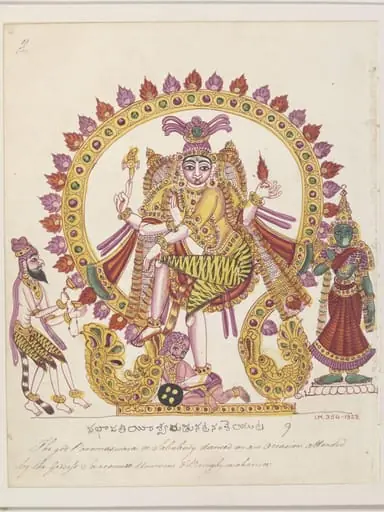
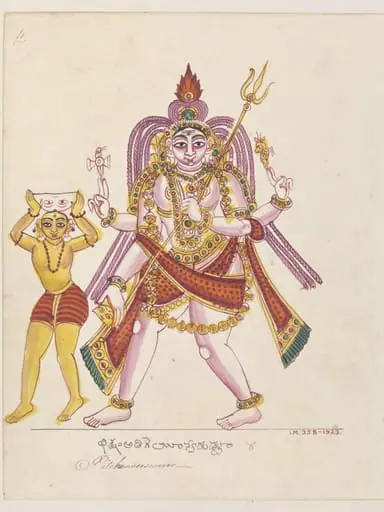
Created around 1820, the painting belongs to a larger series of one hundred drawings of Hindu deities produced in South India. The series was likely commissioned for a temple or private devotional collection, reflecting the era’s interest in systematic iconographic documentation of the pantheon.
Context
During the early nineteenth century, South Indian artists responded to both traditional religious demands and the growing influence of European print techniques. This work exemplifies the synthesis of indigenous iconography with a more graphic, linear style that facilitated reproduction and study by scholars and collectors.
Legacy
The image of Pratyangira from this series has been referenced in later scholarly catalogues of Hindu iconography and serves as a visual source for understanding regional variations in goddess representation. Its inclusion in museum collections continues to inform comparative studies of South Asian religious art.
Artist & collection

 Domestic Scene
 Giacomo and Cardinal Marco, investing Andrea, Abbot of San Zeno, with his Benefice
 The Nymph of Fontainebleau
 Portrait of a Woman
 Madonna and Child with Saints in the Enclosed Garden
 Venus and Minerva
 Family Group of Four on Sofa
 Wall painting from Room H of the Villa of P. Fannius Synistor at Boscoreale