Artwork
The magician disguised as a Brahman returns to claim his “daughter-in-law,” from a Tuti-nama (Tales of a Parrot): Thirty-fifth Night
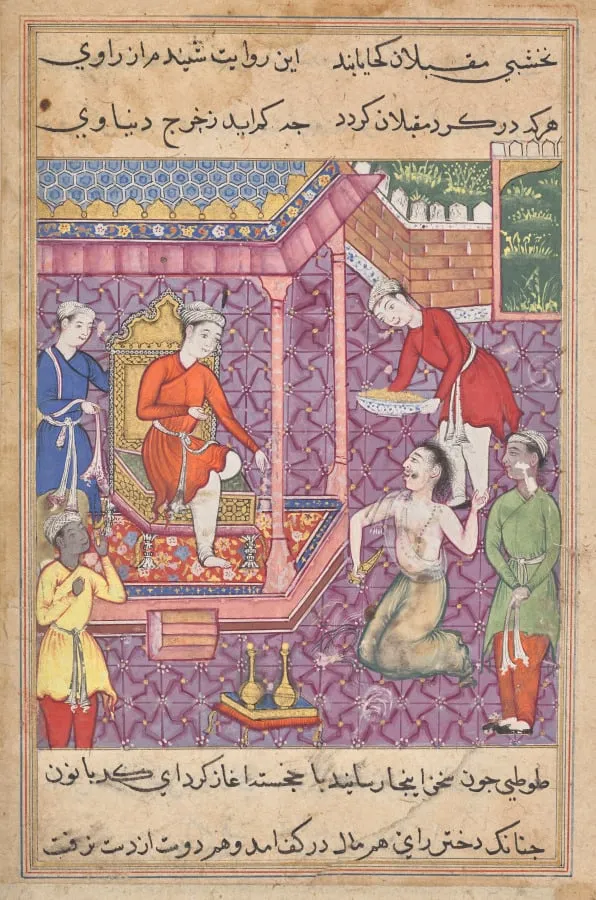
The magician disguised as a Brahman returns to claim his “daughter-in-law,” from a Tuti-nama (Tales of a Parrot): Thirty-fifth Night is an unspecified painting by the Mughal Painting artist Unknown. It dates from 1560 and is held in the collection of the Cleveland Museum of Art. This painting illustrates a scene from the Tuti-nama, a collection of parrot tales presented to Emperor Akbar's court.
About this work
You see a crowded palace scene: a man in a white robe kneels before a king, while guards and courtiers watch.
You see a crowded palace scene: a man in a white robe kneels before a king, while guards and courtiers watch. A woman in a red dress stands nearby, her face calm.
This painting comes from a book of parrot tales told to Emperor Akbar’s court. The story is a trick—what looks like a holy man is really a magician helping two lovers escape. The bright colors and flat figures make it feel like a comic strip from 1560.
To see more art like this, look up Mughal India, court of Akbar (reigned 1556–1605).
Overview
This painting illustrates a scene from the Tuti-nama, a collection of parrot tales presented to Emperor Akbar's court. It depicts a pivotal moment in a story of love and deception, showcasing the artistic style characteristic of Mughal India during Akbar's reign.
Subject & Meaning
The scene shows a magician, disguised as a Brahman, kneeling before a king, demanding compensation for a supposed 'daughter-in-law' entrusted to the royal harem. The narrative revolves around the magician's ruse to secure funds for the escape of two lovers.
Technique & Style
The painting features bright colors and flat, two-dimensional figures, creating a narrative-driven visual style. The artist's use of vibrant hues and composition emphasizes the story's unfolding drama.
History & Provenance
Created around 1560 for Emperor Akbar's court, this work is part of a larger manuscript. The artist did not reference the preceding page, indicating a distinct interpretation of the narrative.
Context
The Tuti-nama was a significant literary work in Mughal India, reflecting the cultural and artistic tastes of Akbar's court. This painting exemplifies the artistic production of that era.
Artist & collection

 Domestic Scene
 Giacomo and Cardinal Marco, investing Andrea, Abbot of San Zeno, with his Benefice
 The Nymph of Fontainebleau
 Portrait of a Woman
 Madonna and Child with Saints in the Enclosed Garden
 Venus and Minerva
 Family Group of Four on Sofa
 Wall painting from Room H of the Villa of P. Fannius Synistor at Boscoreale
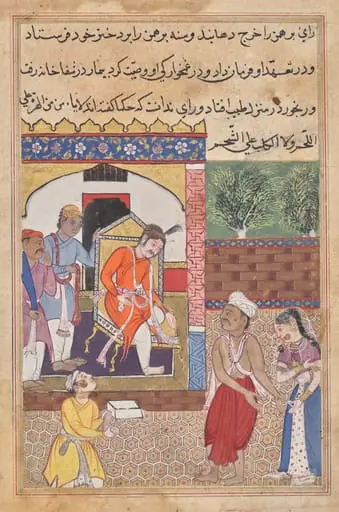 The magician, disguised as a Brahman, visits the king of Babylon, from a Tuti-nama (Tales of a Parrot): Thirty-fifth Night
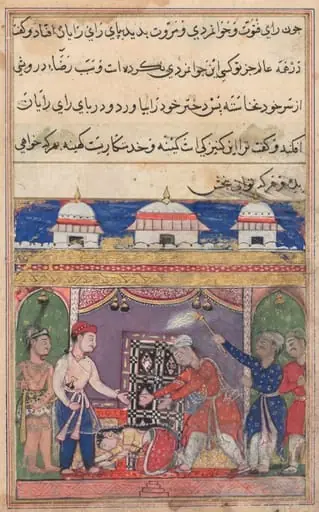 The king of Bahilistan offers his daughter to the King of Kings, from a Tuti-nama (Tales of a Parrot): Seventh Night
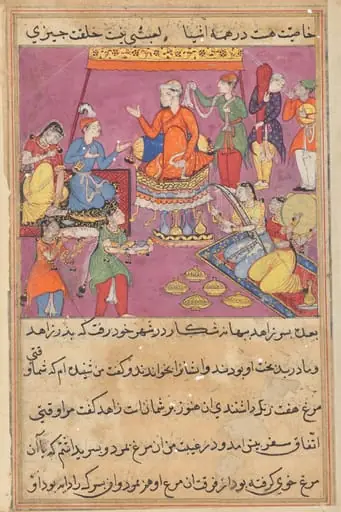 The king gives his daughter in marriage to the pious man’s son, from a Tuti-nama (Tales of a Parrot): Fifty-second Night
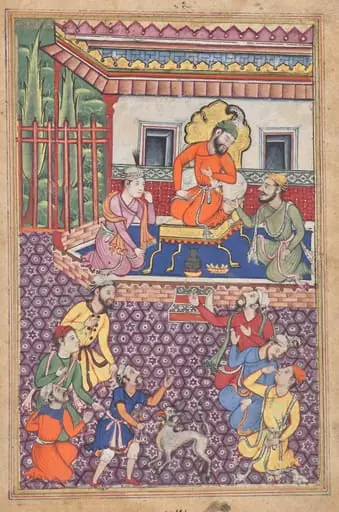 The court of the Raja of Ujjain, from a Tuti-nama (Tales of a Parrot): Forty-sixth Night
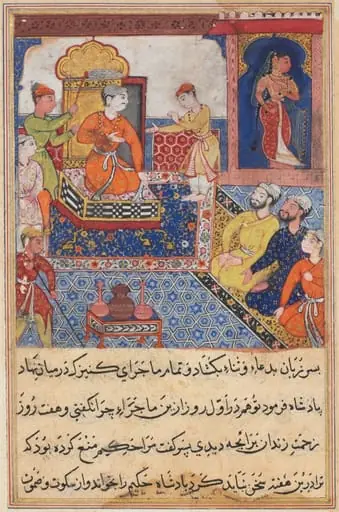 The young prince recounts his experiences to his father, the king, from a Tuti-nama (Tales of a Parrot): Eighth Night
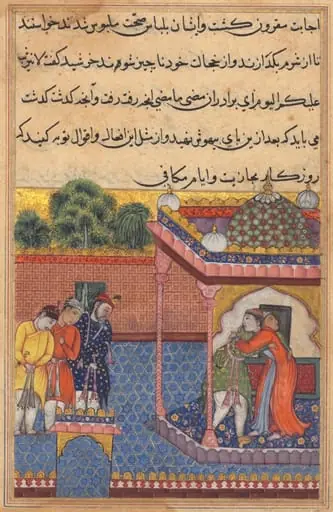 Khurshid reunited with her husband Utarid, from a Tuti-nama (Tales of a Parrot): Thirty-second Night