Artwork
The rejuvenated old man and the daughter of the king of the jinns take leave of the King of Kings, from a Tuti-nama (Tales of a Parrot): Seventh Night
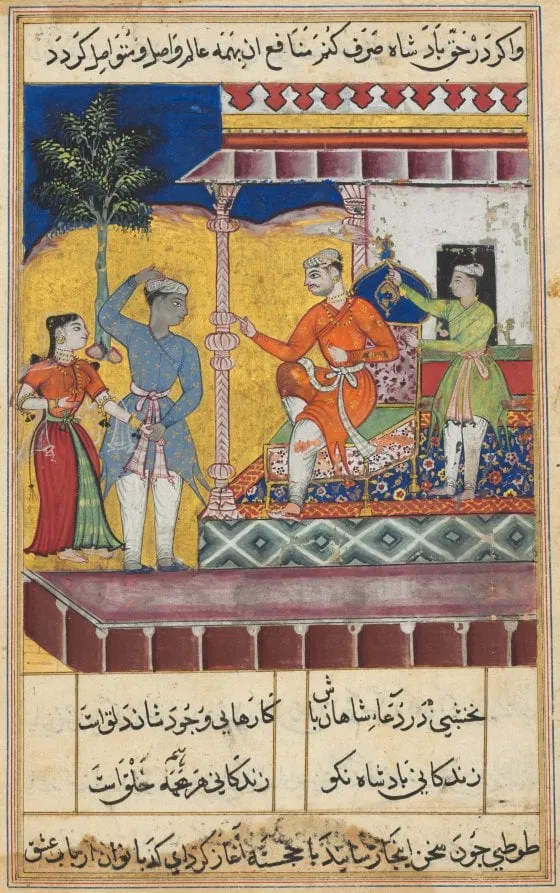
The rejuvenated old man and the daughter of the king of the jinns take leave of the King of Kings, from a Tuti-nama (Tales of a Parrot): Seventh Night is an unspecified painting by the Mughal Painting artist Unknown. It dates from 1560 and is held in the collection of the Cleveland Museum of Art. The miniature illustrates a richly attired elderly man and a golden‑skinned woman bidding farewell to a monarch seated on an ornate throne.
About this work
The story is wild—love, magic, and a 70-year wait in a pit—but the artist keeps it calm, like a royal ceremony.
You see a richly dressed old man and a woman with golden skin saying goodbye to a king on a jeweled throne. Tiny figures fill the courtyard, and the sky glows with soft colors.
This painting comes from a book of parrot tales made for Emperor Akbar’s court. The story is wild—love, magic, and a 70-year wait in a pit—but the artist keeps it calm, like a royal ceremony. Every face is different, yet no one steals the scene.
If you like this quiet drama, look up Mughal India, court of Akbar (reigned 1556–1605).
Overview
The miniature illustrates a richly attired elderly man and a golden‑skinned woman bidding farewell to a monarch seated on an ornate throne. The scene unfolds in a courtyard populated by numerous diminutive figures, while the sky above is rendered in muted, pastel tones that lend a serene atmosphere to the narrative moment.
Subject & Meaning
The composition depicts the parting of the rejuvenated old man and the daughter of the jinn king, who have just completed a perilous trial. Their departure follows the king’s provision of a protective salve that enables the man to cross a boiling cauldron, a rite that restores his youth and permits his union with the luminous jinn princess after a seventy‑year waiting period.
Technique & Style
Executed in the Mughal miniature tradition, the work features fine brushwork, intricate detailing of textiles and jewellery, and a delicate palette of soft hues. The artist employs a flattened spatial arrangement, allowing each figure to be clearly distinguished without a dominant focal point, while the ornamental border bears the painter’s inscription.
History & Provenance
The piece is part of a Tuti‑nama, a collection of parrot tales commissioned for the court of Emperor Akbar (r. 1556–1605). The margin of the third folio records the name Banavari, who later achieved prominence in Akbar’s imperial atelier. This miniature is likely the earliest extant example of his hand.
Context
Mughal courtly manuscripts often blended Persian literary themes with Indian visual conventions. The narrative of love, magical transformation, and royal patronage reflects the syncretic culture of Akbar’s empire, where Hindu, Islamic, and indigenous motifs coexisted within elite artistic production.
Artist & collection

 Domestic Scene
 Giacomo and Cardinal Marco, investing Andrea, Abbot of San Zeno, with his Benefice
 The Nymph of Fontainebleau
 Portrait of a Woman
 Madonna and Child with Saints in the Enclosed Garden
 Venus and Minerva
 Family Group of Four on Sofa
 Wall painting from Room H of the Villa of P. Fannius Synistor at Boscoreale
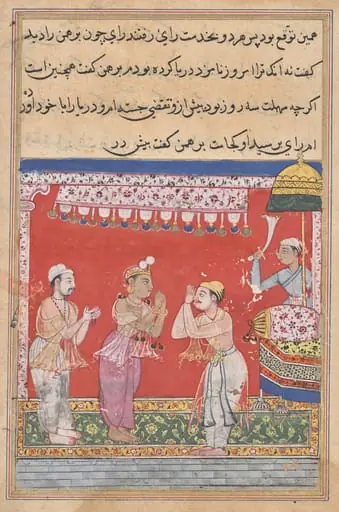 The king of the Ocean, having assumed human form, arrives at the court of the Raja, from a Tuti-nama (Tales of a Parrot): Eleventh Night
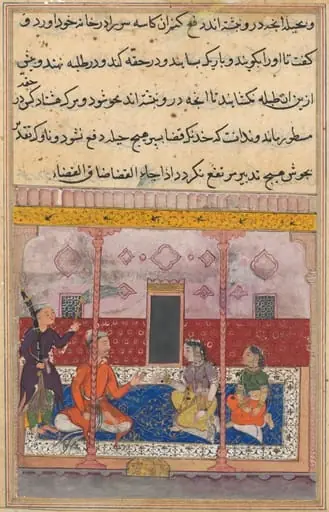 The merchant has the hateful skull ground and put into a box, from a Tuti-nama (Tales of a Parrot): Twenty-third Night
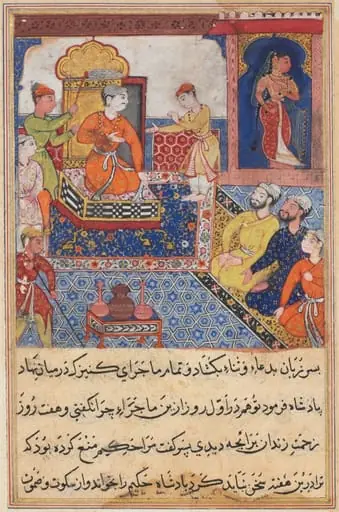 The young prince recounts his experiences to his father, the king, from a Tuti-nama (Tales of a Parrot): Eighth Night
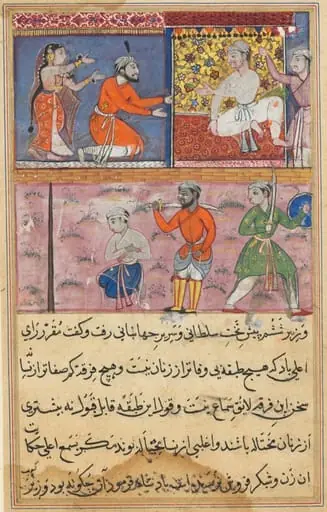 The prince sent back to the place of execution for the sixth time, from a Tuti-nama (Tales of a Parrot): Eighth Night
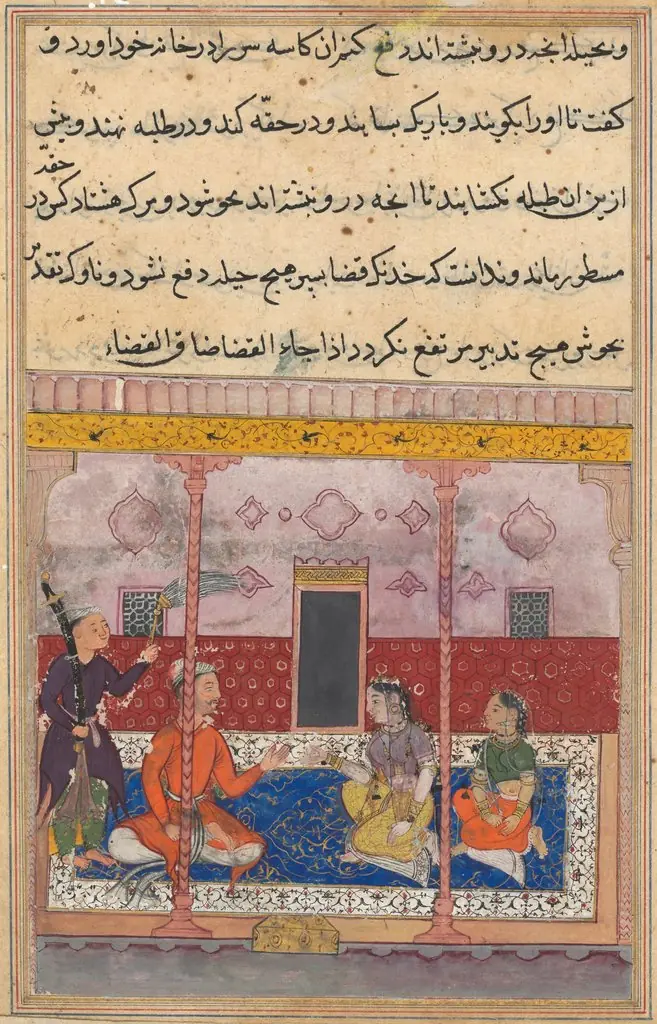 The merchant has the hateful skull ground and put into a box, from a Tuti-nama (Tales of a Parrot): Twenty-third Night
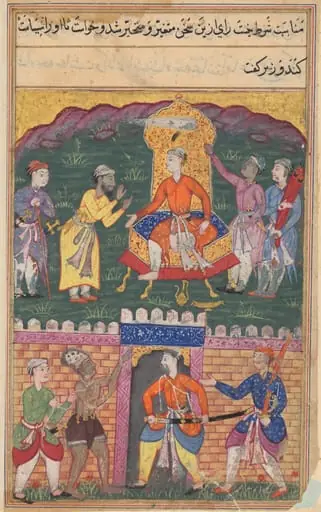 The vizier dissuades the king of Bahilistan from executing the dervish who asks for his daughter’s hand in marriage, from a Tuti-nama (Tales of a Parrot): Seventh Night