Artwork
The Mutiny of the Heroine Rani Lakshmi Bai of Jhansi
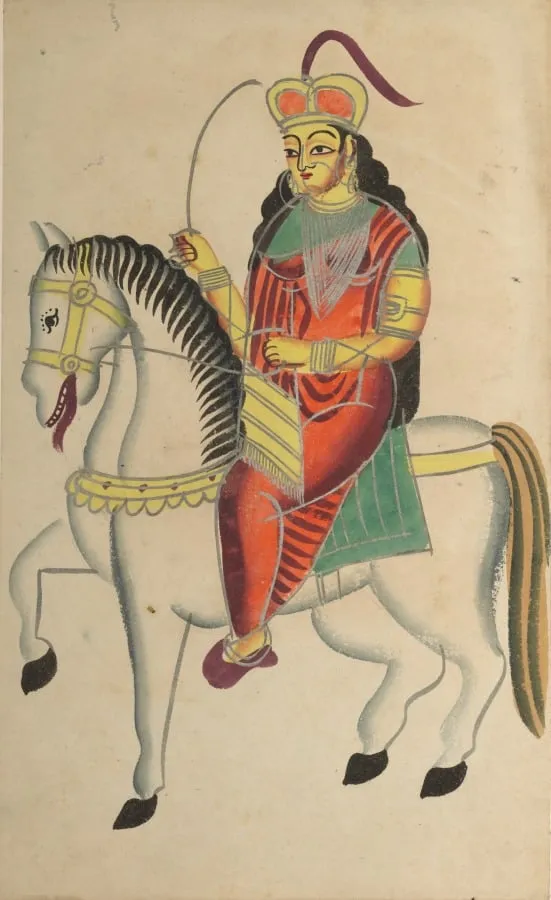
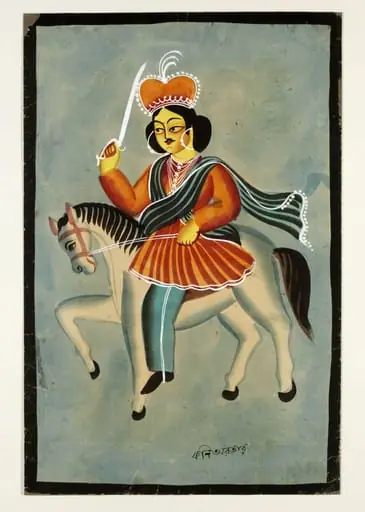
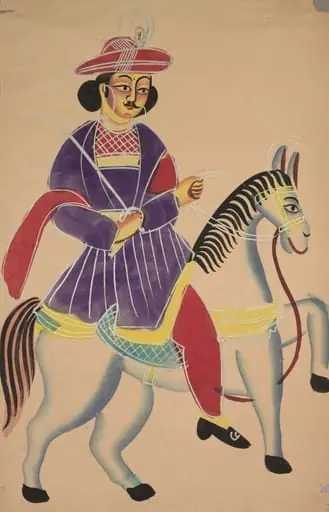
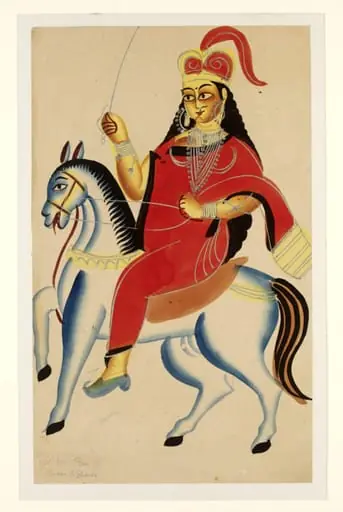
The Mutiny of the Heroine Rani Lakshmi Bai of Jhansi is an unspecified painting by the Impressionist artist Unknown. It dates from 1890 and is held in the collection of the Cleveland Museum of Art. The work depicts Rani Lakshmi Bai, the former queen of Jhansi, mounted on a white horse while brandishing a sword.
About this work
Overview
The work depicts Rani Lakshmi Bai, the former queen of Jhansi, mounted on a white horse while brandishing a sword. She is dressed in a vivid red sari and wears a British crown, her gaze directed forward as if in charge. The composition captures a moment of defiant movement, emphasizing her role as a martial figure in the 1857 uprising.
Subject & Meaning
In June 1857 she was declared ruler after a violent clash involving local troops, and she continued armed resistance until her death in 1858.
Rani Lakshmi Bai, widowed after the death of Raja Gangadhar Rao, assumed leadership of Jhansi following the British annexation of the state. In June 1857 she was declared ruler after a violent clash involving local troops, and she continued armed resistance until her death in 1858. The painting presents her as a heroic embodiment of Indian opposition to colonial rule, symbolising the larger struggle for independence.
Technique & Style
The image employs the characteristic features of the Kalighat school, a 19th‑century Bengal tradition noted for brisk, flowing lines and a flattened pictorial space. Bold outlines define the rider and horse, while the limited palette—dominant reds, whites, and gold—creates visual immediacy suited to narrative illustration. The style’s simplicity aids rapid visual storytelling.
Historical Context
Created in the aftermath of the 1857 rebellion, the painting reflects contemporary efforts to memorialise figures who challenged British authority. Rani Lakshmi Bai quickly entered popular memory as a martyr and a rallying point for later nationalist movements, her image being reproduced in prints and posters that circulated among both Indian and colonial audiences.
Provenance
The work is attributed to an anonymous artist working within the Kalighat tradition, a commercial workshop that produced affordable prints for a broad public. It likely originated in Calcutta in the late 19th century and entered museum collections through acquisition of a private print series documenting the Indian Mutiny.
Artist & collection

 Domestic Scene
 Giacomo and Cardinal Marco, investing Andrea, Abbot of San Zeno, with his Benefice
 The Nymph of Fontainebleau
 Portrait of a Woman
 Madonna and Child with Saints in the Enclosed Garden
 Venus and Minerva
 Family Group of Four on Sofa
 Wall painting from Room H of the Villa of P. Fannius Synistor at Boscoreale