Artwork
Kalki
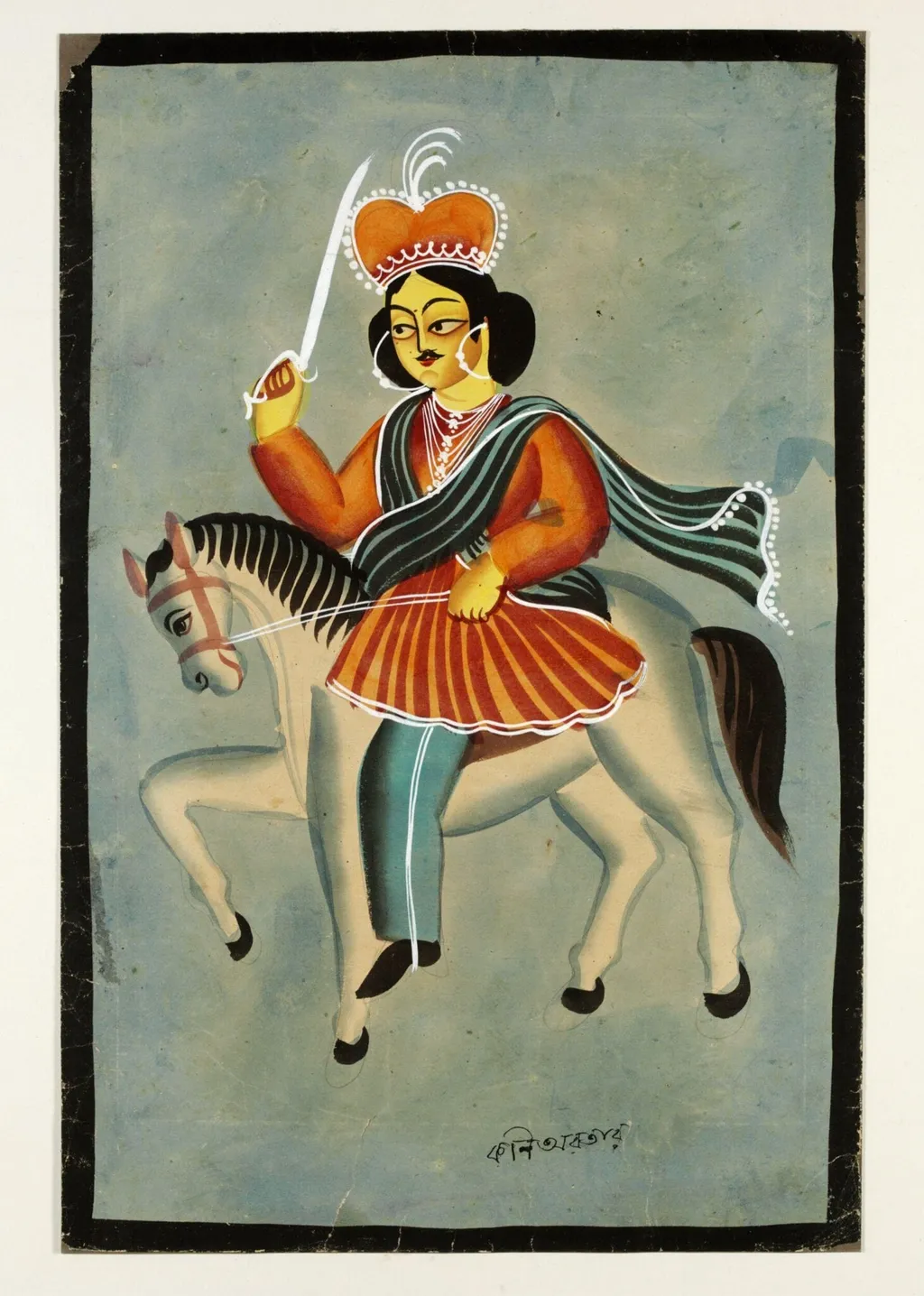
Kalki is a paint painting by the Impressionist artist Unknown. It dates from 1885 and is held in the collection of the Victoria and Albert Museum.
About this work
Overview
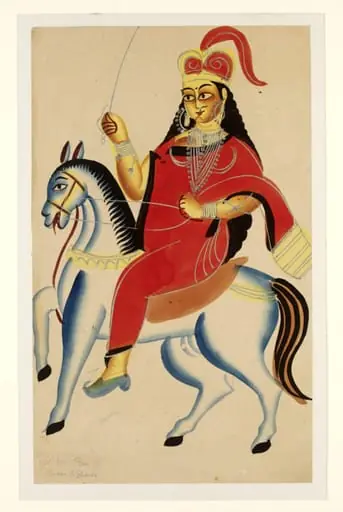
This opaque watercolor on paper portrays Kalki, the final avatar of Vishnu, riding a horse with bold black-and-white striping. Executed in a stylized manner, the image uses flat areas of color and minimal background detail to focus attention on the figure. The work was acquired by the Victoria and Albert Museum in 1894 from Miss M. Steele, who traced its origin to her grandmother’s time in India.
Subject & Meaning
The absence of narrative context invites interpretation rooted in regional or esoteric traditions rather than mainstream textual sources.
Kalki is depicted as a female figure, a rare representation in Hindu iconography, mounted on a striped horse that may symbolize the destructive force of cosmic renewal. Clad in an orange and black garment and adorned with gold jewelry, she holds a staff, signifying authority. The absence of narrative context invites interpretation rooted in regional or esoteric traditions rather than mainstream textual sources.
Technique & Style
The painting employs opaque watercolor on paper, with sharp outlines and unmodulated color fields. The horse’s stripes are simplified into high-contrast bands, contrasting with the flat blue background. The figure’s attire and jewelry are rendered with precision but without shading, emphasizing symbolic clarity over naturalism. This approach aligns with certain Indian miniature traditions that prioritize emblematic representation.
History & Provenance
The painting entered the museum’s collection in 1894 through Miss M. Steele, whose mother was a Sanskrit scholar at Cambridge. Steele suggested the image may have been collected by her grandmother during a stay in India, possibly during the 19th century. Its exact place of origin and artist remain undocumented, though its style suggests a regional workshop rather than a major court atelier.
Context
While most depictions of Kalki show a male warrior on a white horse, this version’s female form and striped steed diverge from canonical iconography. Such variations may reflect local oral traditions, colonial-era reinterpretations, or artistic experimentation in South Indian or Deccan studios. The absence of landscape or architectural elements points to a devotional or didactic function rather than a narrative scene.
Legacy
This painting stands as an unusual example of Kalki’s iconography, offering insight into the fluidity of religious imagery outside standardized texts. Its preservation in a major museum collection highlights early Western interest in non-canonical Hindu art. It continues to prompt scholarly inquiry into regional variations and gendered representations within South Asian visual traditions.
Artist & collection

 Domestic Scene
 Giacomo and Cardinal Marco, investing Andrea, Abbot of San Zeno, with his Benefice
 The Nymph of Fontainebleau
 Portrait of a Woman
 Madonna and Child with Saints in the Enclosed Garden
 Venus and Minerva
 Family Group of Four on Sofa
 Wall painting from Room H of the Villa of P. Fannius Synistor at Boscoreale