Artwork
The rakshasa Kabandha supporting Rama and Lakshmana on his arms.
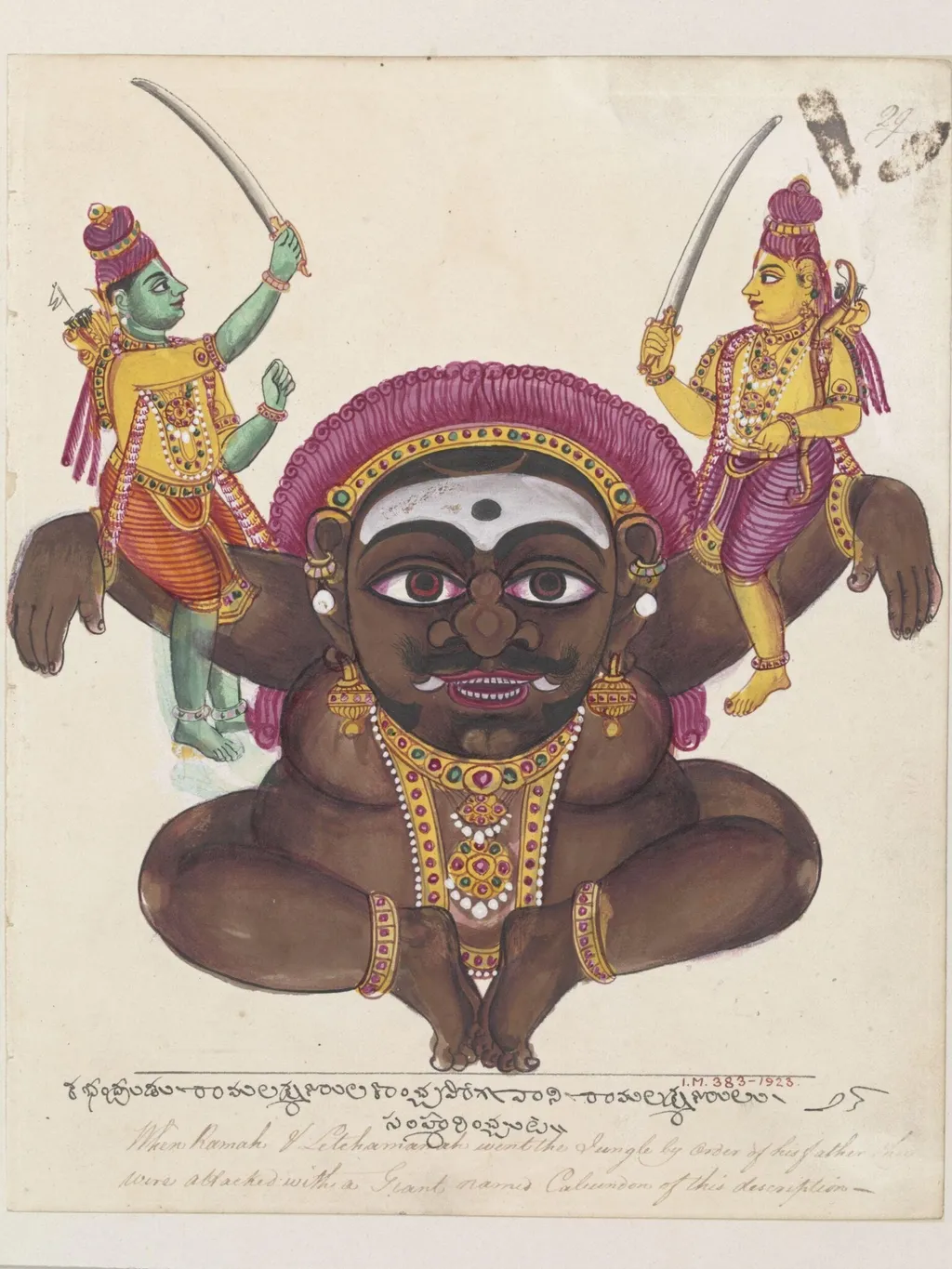
The rakshasa Kabandha supporting Rama and Lakshmana on his arms. is a paint painting by the Patna School of Painting artist Unknown. It dates from 1820 and is held in the collection of the Victoria and Albert Museum. This 19th-century Indian painting (c.
About this work
Overview
This 19th-century Indian painting (c. 1820) portrays a pivotal scene from Hindu mythology, featuring the rakshasa Kabandha supporting the brothers Rama and Lakshmana on his outstretched arms.
Subject & Meaning
The scene depicts Kabandha, a demon from the Ramayana, aiding Rama (green-skinned) and Lakshmana (golden-skinned) as they brandish swords, symbolizing an alliance or assistance in their quest.
Technique & Style
Executed in a vibrant, detailed manner, the painting showcases intricate patterns, textures, and dynamic energy. Kabandha is rendered in dark brown, contrasting with the brightly attired brothers in yellow, red, and gold adornments.
History & Provenance
Created circa 1820 by an unknown artist, the painting's origins and ownership history prior to its current location are not specified in available records.
Context
While often contextualized within Indian mythology and art, the painting's style bears some superficial resemblance to contemporaneous European Romanticism in its emphasis on expressive color and dynamic movement, though it remains rooted in traditional Indian artistic themes.
Legacy
As a representation of a specific Ramayana episode, the painting contributes to the visual heritage of Hindu mythology, though its impact on broader art historical narratives or its influence on subsequent artists is not widely documented.
Artist & collection

 Domestic Scene
 Giacomo and Cardinal Marco, investing Andrea, Abbot of San Zeno, with his Benefice
 The Nymph of Fontainebleau
 Portrait of a Woman
 Madonna and Child with Saints in the Enclosed Garden
 Venus and Minerva
 Family Group of Four on Sofa
 Wall painting from Room H of the Villa of P. Fannius Synistor at Boscoreale