Artwork
The three suitors again begin to quarrel among themselves for the hand of the devotee’s daughter, from a Tuti-nama (Tales of a Parrot): Twentieth Night
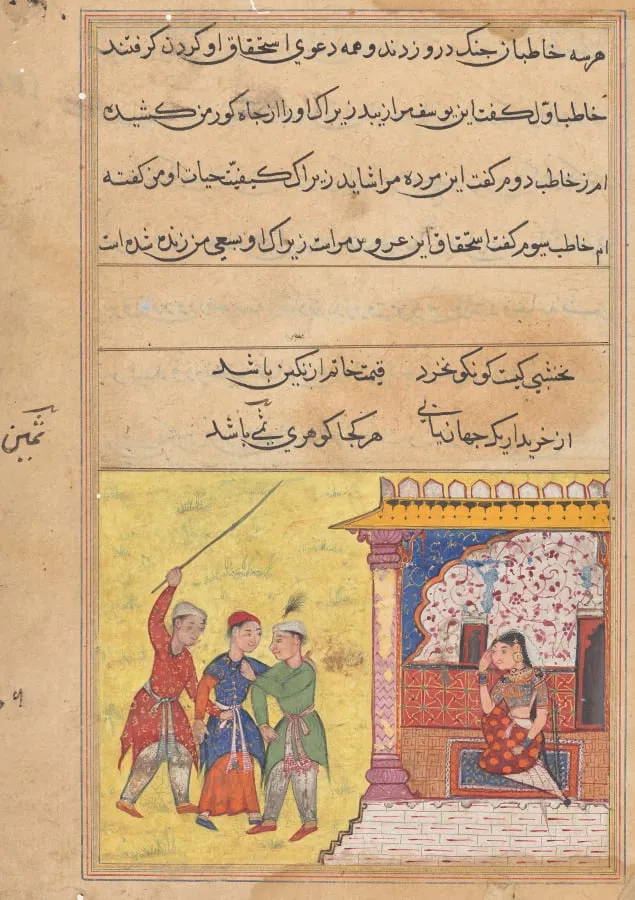
The three suitors again begin to quarrel among themselves for the hand of the devotee’s daughter, from a Tuti-nama (Tales of a Parrot): Twentieth Night is an unspecified painting by the Mughal Painting artist Unknown. It dates from 1560 and is held in the collection of the Cleveland Museum of Art.
About this work
The men are dressed in rich fabrics, and the scene is packed with tiny details—flowers, animals, and patterns on the walls.
You see three men fighting in a courtyard while a woman watches from a balcony. The men are dressed in rich fabrics, and the scene is packed with tiny details—flowers, animals, and patterns on the walls.
This painting comes from a book of stories told by a parrot to keep its owner from sneaking out at night. The woman in the story is so upset by the men’s behavior that she gives up on love and joins a temple. The artist filled the scene with bright colors and careful lines, showing off the skill of painters in Mughal India.
To see more work like this, look up Mughal India, court of Akbar (reigned 1556–1605).
Overview
This painting depicts a dramatic scene from the Twentieth Night of a Tuti-nama (Tales of a Parrot), where three suitors resume their quarrel for the hand of a devotee’s daughter after a brief collaboration.
Subject & Meaning
The scene contrasts the chaotic brawl among the richly attired suitors in the courtyard with the devotee’s daughter watching from her chamber, ultimately leading to her renunciation of worldly life for a religious devotion, highlighting her disillusionment with the suitors’ behavior.
Technique & Style
Characterized by meticulous lines, vibrant colors, and intricate details (including flora, fauna, and architectural patterns), the work exemplifies the refined artistic traditions of Mughal India during its period.
History & Provenance
Originating from a Tuti-nama manuscript, this painting is associated with the courtly patronage of Mughal India, specifically during or around the reign of Akbar (1556–1605), though direct provenance details are not provided here.
Context
Part of a narrative collection (Tuti-nama) where a parrot tells stories to distract its owner, this piece reflects the cultural and literary richness of Mughal court life, blending moral tales with exquisite visual storytelling.
Artist & collection

 Domestic Scene
 Giacomo and Cardinal Marco, investing Andrea, Abbot of San Zeno, with his Benefice
 The Nymph of Fontainebleau
 Portrait of a Woman
 Madonna and Child with Saints in the Enclosed Garden
 Venus and Minerva
 Family Group of Four on Sofa
 Wall painting from Room H of the Villa of P. Fannius Synistor at Boscoreale
 The third suitor strikes the devotee’s daughter and thus restores her to life, from a Tuti-nama (Tales of a Parrot): Twentieth Night
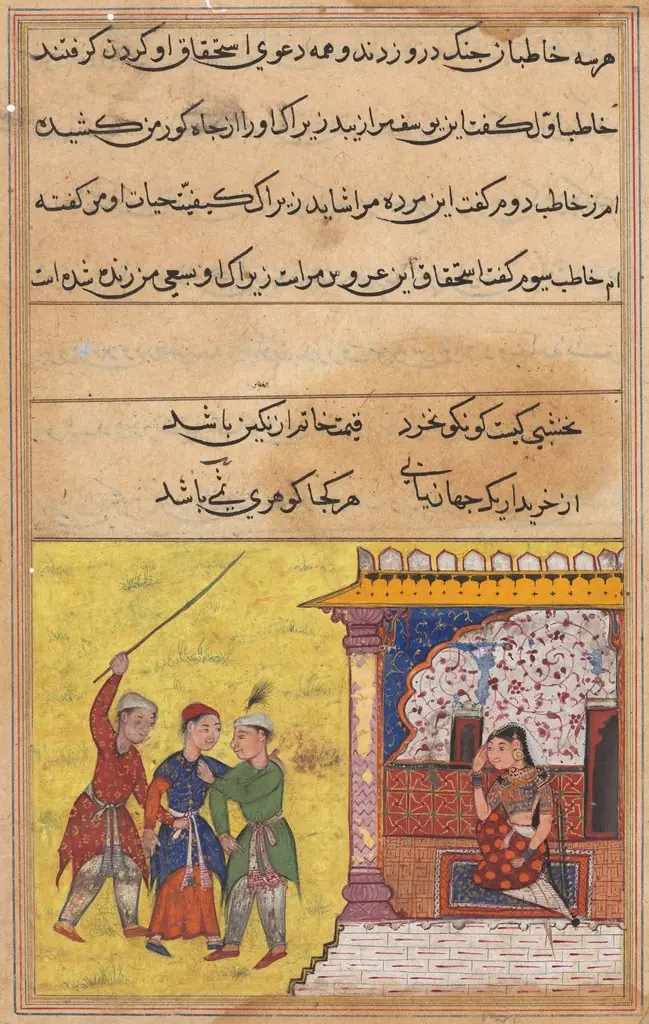 The three suitors again begin to quarrel among themselves for the hand of the devotee’s daughter, from a Tuti-nama (Tales of a Parrot): Twentieth Night
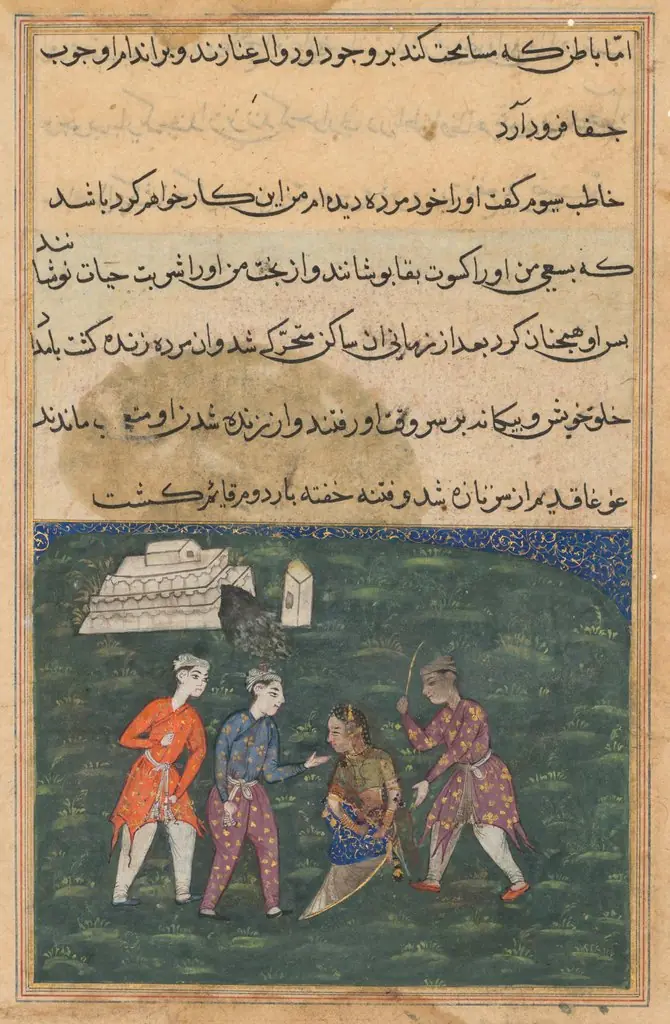 The third suitor strikes the devotee’s daughter and thus restores her to life, from a Tuti-nama (Tales of a Parrot): Twentieth Night
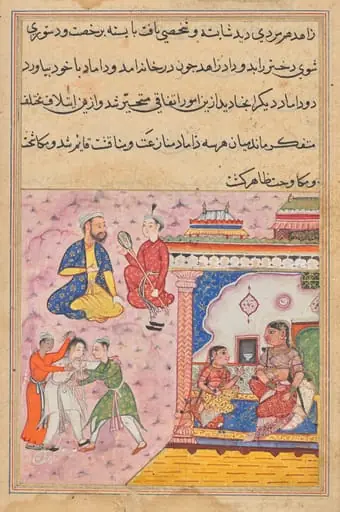 Three suitors fight amongst themselves for the hand of the devotee’s daughter, from a Tuti-nama (Tales of a Parrot): Twentieth Night
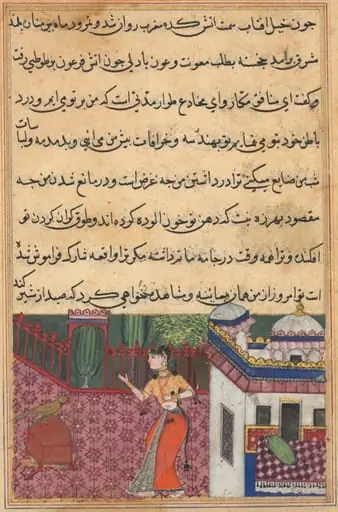 The parrot addresses Khujasta at the beginning of the thirty-third night, from a Tuti-nama (Tales of a Parrot)
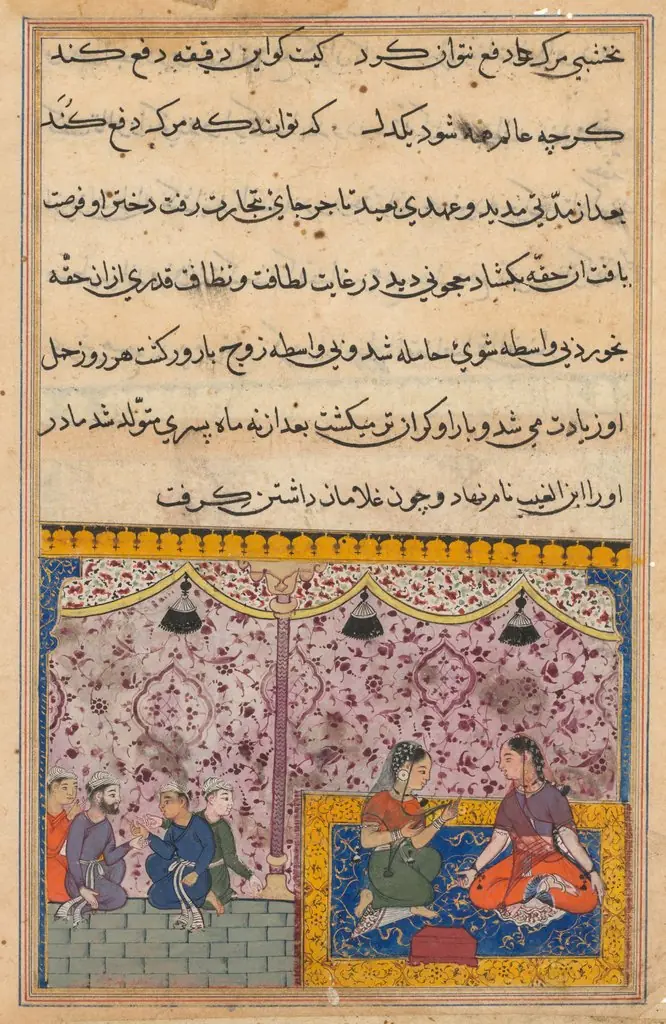 The merchant’s daughter gives birth to a son as a result of eating out of the box. The clever child recognizes the false gems from true, from a Tuti-nama (Tales of a Parrot): Twenty-third Night
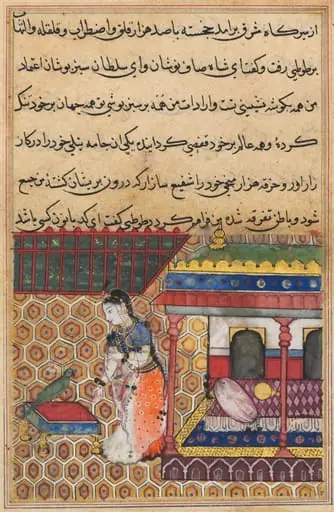 The parrot addresses Khujasta at the beginning of the thirty-eighth night, from a Tuti-nama (Tales of a Parrot)