Artwork
Three suitors fight amongst themselves for the hand of the devotee’s daughter, from a Tuti-nama (Tales of a Parrot): Twentieth Night
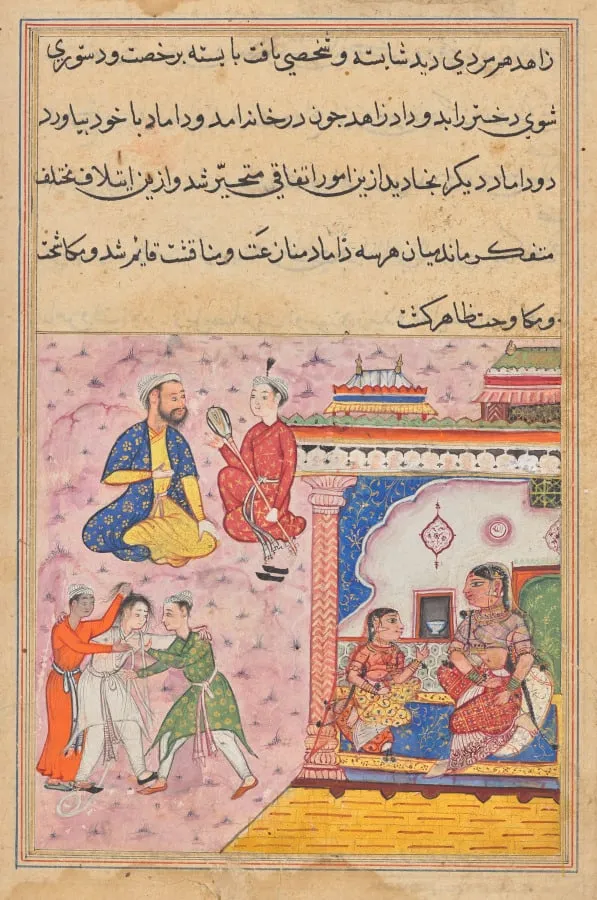
Three suitors fight amongst themselves for the hand of the devotee’s daughter, from a Tuti-nama (Tales of a Parrot): Twentieth Night is an unspecified painting by the Mughal Painting artist Unknown. It dates from 1560 and is held in the collection of the Cleveland Museum of Art.
About this work
To see more art from this time, look up Mughal India, court of Akbar (reigned 1556–1605).
You see three men wrestling on a palace floor while a woman collapses in grief nearby. Her father and brother watch from a balcony, helpless.
This painting comes from a book of parrot tales told at the court of Emperor Akbar. The story is meant to teach a lesson: greed and rivalry can destroy what you love. The bright colors and tiny details show how artists worked for royal patrons.
To see more art from this time, look up Mughal India, court of Akbar (reigned 1556–1605).
Overview
This painting is one of thirty-two illustrations from the Tuti-nama, a collection of Persian tales translated and illustrated under the patronage of Emperor Akbar in late 16th-century India. It depicts a moment of violent rivalry among three suitors, rendered with meticulous detail and vivid color, characteristic of Mughal court painting. The scene serves as a moral vignette within a larger narrative framework designed to instruct royal audiences.
Subject & Meaning
Three men, each promised marriage to the daughter of a pious man, engage in a physical struggle over her hand, convinced of their own superiority. Their conflict causes the young woman to collapse in grief, appearing lifeless, while her mother watches in despair. The father and his son observe from above, powerless to intervene. The tale warns that selfish ambition and unchecked competition can unravel familial bonds and lead to irreversible loss.
Technique & Style
The scene is rendered in opaque watercolor with fine brushwork, typical of Mughal atelier practices. Figures are rendered with precise anatomy and expressive gestures, set against an ornate architectural backdrop. Rich pigments—lapis lazuli, gold leaf, vermilion—create luminous contrasts, while intricate patterns in textiles and tiles reflect the court’s aesthetic refinement. The composition directs the viewer’s eye from the chaotic foreground to the still, sorrowful figures above.
History & Provenance
Commissioned during Akbar’s reign (1556–1605), the Tuti-nama was produced by a team of artists in the imperial atelier, blending Persian narrative traditions with Indian visual conventions. The manuscript was likely intended for royal contemplation and education. Though the original volume has been dispersed, this folio survives as part of a known set, documented in 19th-century collections and now held in a major institutional archive.
Context
The Tuti-nama was part of Akbar’s broader effort to synthesize cultural traditions across his empire. By commissioning illustrated versions of Persian stories, the court promoted literary and artistic exchange while embedding moral lessons suited to governance. These paintings were not merely decorative; they functioned as tools of ethical instruction, reflecting the emperor’s interest in philosophy, religion, and human behavior.
Legacy
The Tuti-nama’s illustrations influenced later Mughal manuscript painting, establishing conventions for narrative composition and emotional expression. Though the text itself was less enduring than other courtly works, its visual language contributed to the development of Indo-Persian artistic identity. Surviving folios remain key references for understanding the intellectual and aesthetic priorities of Akbar’s reign.
Artist & collection

 Domestic Scene
 Giacomo and Cardinal Marco, investing Andrea, Abbot of San Zeno, with his Benefice
 The Nymph of Fontainebleau
 Portrait of a Woman
 Madonna and Child with Saints in the Enclosed Garden
 Venus and Minerva
 Family Group of Four on Sofa
 Wall painting from Room H of the Villa of P. Fannius Synistor at Boscoreale
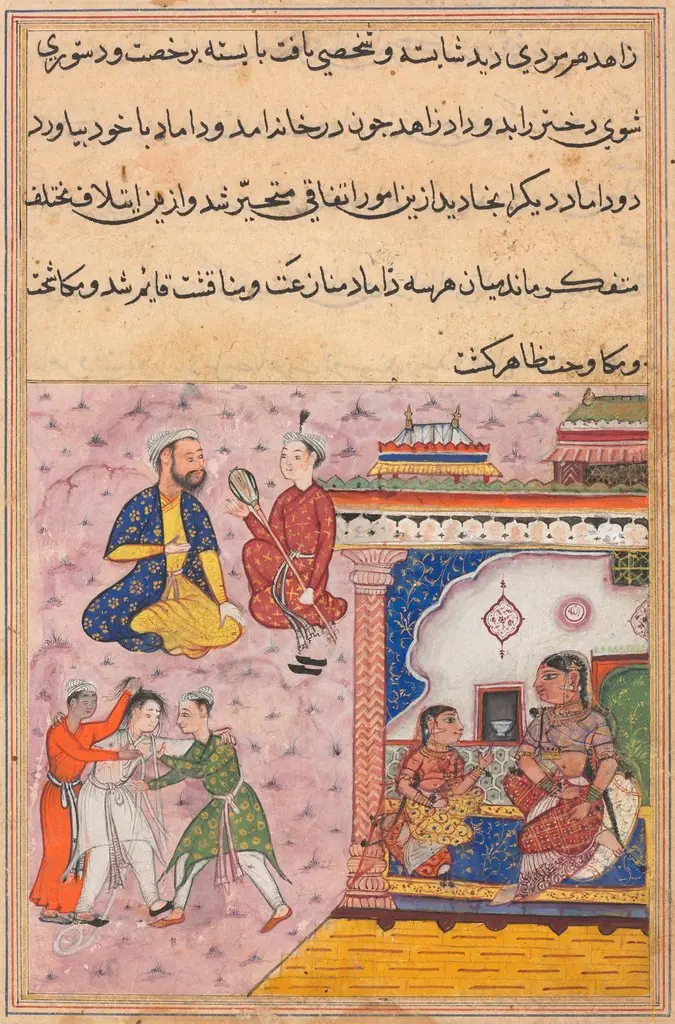 Three suitors fight amongst themselves for the hand of the devotee’s daughter, from a Tuti-nama (Tales of a Parrot): Twentieth Night
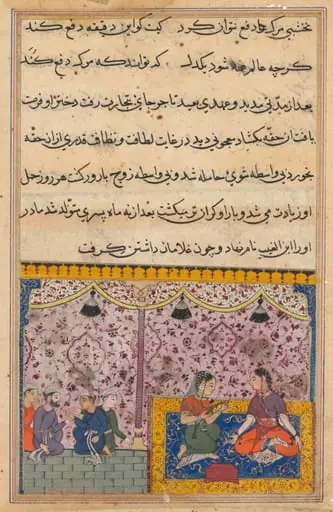 The merchant’s daughter gives birth to a son as a result of eating out of the box. The clever child recognizes the false gems from true, from a Tuti-nama (Tales of a Parrot): Twenty-third Night
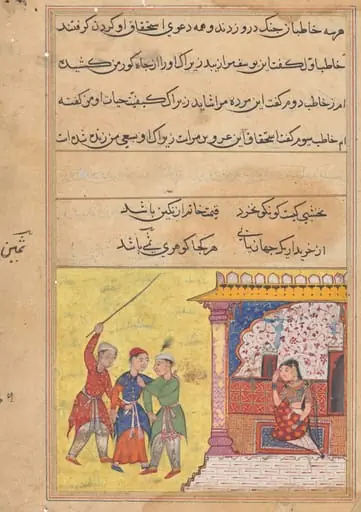 The three suitors again begin to quarrel among themselves for the hand of the devotee’s daughter, from a Tuti-nama (Tales of a Parrot): Twentieth Night
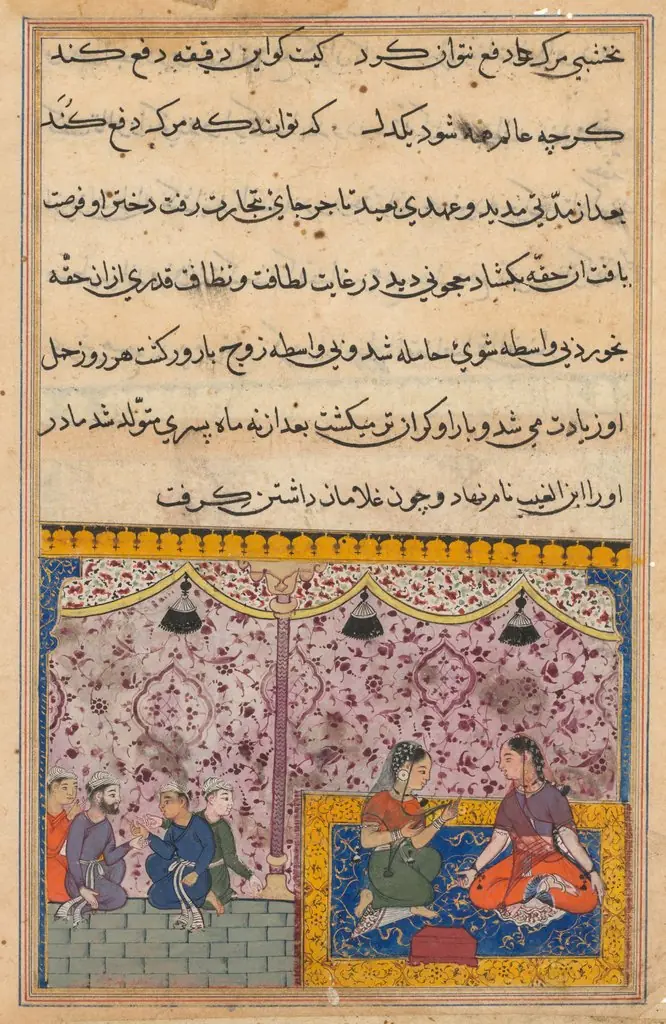 The merchant’s daughter gives birth to a son as a result of eating out of the box. The clever child recognizes the false gems from true, from a Tuti-nama (Tales of a Parrot): Twenty-third Night
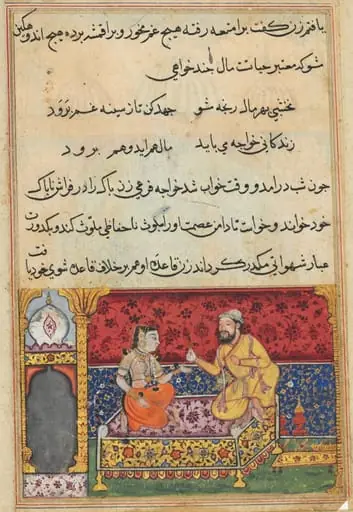 The young man changes himself to look like Mansur, and thus inveigles himself into the bed of Mansur’s wife, but is put off by her, from a Tuti-nama (Tales of a Parrot): Seventeenth Night
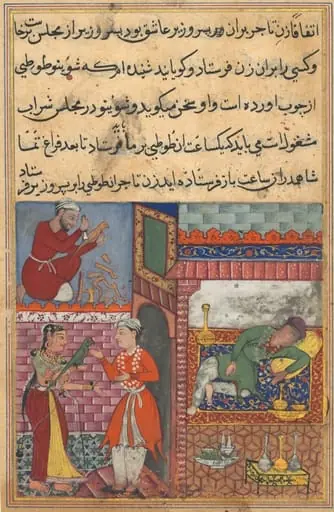 The vizier’s son receives the magic wooden parrot from the wife of the merchant, who is drunk, and has a replica made by a carpenter, from a Tuti-nama (Tales of a Parrot): Tenth Night