Artwork
The young man changes himself to look like Mansur, and thus inveigles himself into the bed of Mansur’s wife, but is put off by her, from a Tuti-nama (Tales of a Parrot): Seventeenth Night
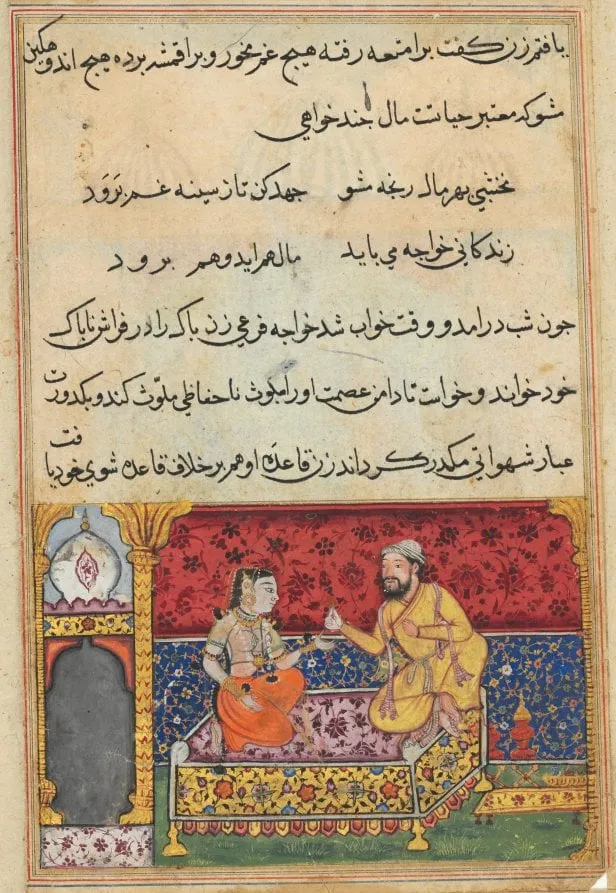
The young man changes himself to look like Mansur, and thus inveigles himself into the bed of Mansur’s wife, but is put off by her, from a Tuti-nama (Tales of a Parrot): Seventeenth Night is an unspecified painting by the Mughal Painting artist Unknown. It dates from 1560 and is held in the collection of the Cleveland Museum of Art.
About this work
The story is about trickery and quick thinking—here, the wife spots the fake husband because his behavior doesn’t match his face.
A man kneels on a richly patterned bed, pretending to be someone else. A woman lies beside him, turning away with a hand to her head.
This painting comes from a book of parrot tales told in Mughal India. The story is about trickery and quick thinking—here, the wife spots the fake husband because his behavior doesn’t match his face. The bright colors and fine details show how artists in Emperor Akbar’s court told stories with pictures.
To see more art from this time, look up Mughal India, court of Akbar (reigned 1556–1605).
Overview
This painting illustrates a scene from the Tuti-nama, a collection of frame tales translated and illustrated in the Mughal court during the late 16th century. It depicts a moment of deception in which a young man, having assumed the form of the merchant Mansur, attempts to seduce Mansur’s wife. The narrative hinges on the dissonance between appearance and behavior, a recurring theme in the parrot’s stories.
Subject & Meaning
The woman, though confronted by a perfect physical replica of her husband, senses his false identity through his mannerisms and intent. Her turned posture and hand to her head signal distrust and feigned illness, a clever resistance to the intruder’s advance. The scene underscores the tale’s moral: identity cannot be fully mimicked, and perception reveals truth beyond surface appearances.
Technique & Style
Rendered in fine brushwork and vivid mineral pigments, the composition reflects the refined aesthetic of Akbar’s atelier. The bed’s intricate arabesques and the figures’ detailed garments demonstrate meticulous attention to texture and pattern. The spatial arrangement, with the kneeling figure leaning toward the recumbent woman, creates subtle tension without overt drama, characteristic of Mughal narrative painting.
History & Provenance
Produced in the imperial workshop under Emperor Akbar’s patronage, this folio belonged to a manuscript of the Tuti-nama commissioned around 1560. The text, originally Persian, was translated into Persian and illustrated with over 250 miniatures. This particular scene survives as part of a dispersed set, now held in collections across Europe and South Asia.
Context
The Tuti-nama was adapted from an Arabic frame story and reimagined in Mughal India as a vehicle for moral instruction wrapped in entertainment. Illustrated manuscripts like this one served both as courtly amusement and as demonstrations of imperial cultural sophistication. Artists blended Persian, Indian, and emerging European influences to craft visually rich narratives for elite audiences.
Legacy
The painting exemplifies how Mughal artists translated literary themes into visual language with psychological nuance. Its emphasis on subtle emotional cues over dramatic action influenced later courtly illustration. Though the Tuti-nama manuscript was never completed in full, its surviving folios remain key references for understanding early Mughal narrative art and its engagement with human deception.
Artist & collection

 Domestic Scene
 Giacomo and Cardinal Marco, investing Andrea, Abbot of San Zeno, with his Benefice
 The Nymph of Fontainebleau
 Portrait of a Woman
 Madonna and Child with Saints in the Enclosed Garden
 Venus and Minerva
 Family Group of Four on Sofa
 Wall painting from Room H of the Villa of P. Fannius Synistor at Boscoreale
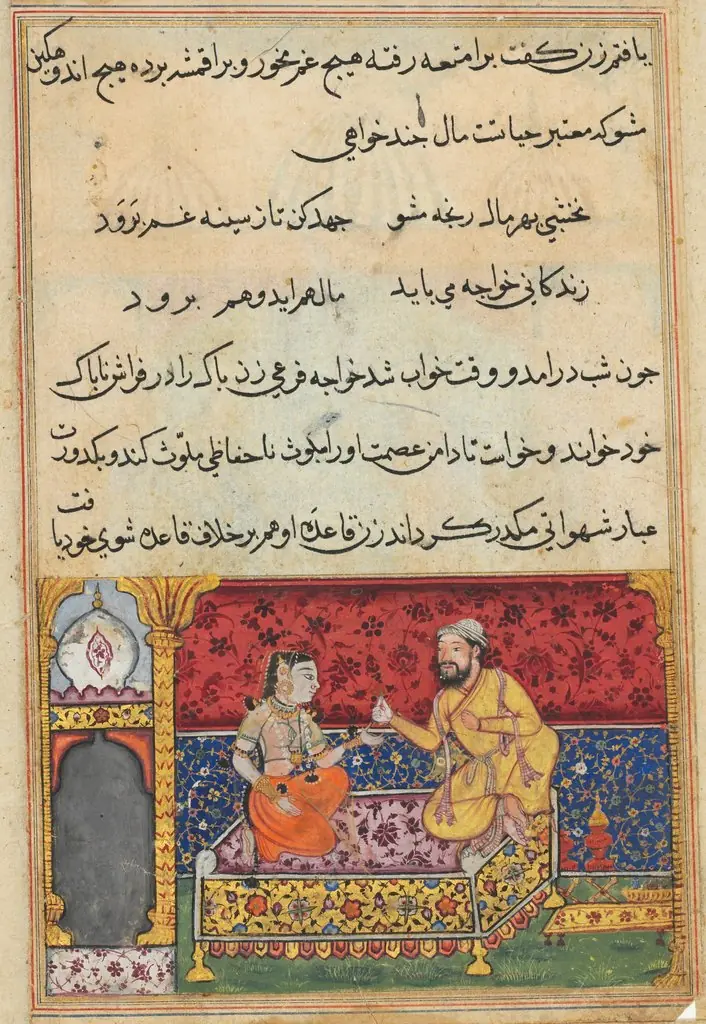 The young man changes himself to look like Mansur, and thus inveigles himself into the bed of Mansur’s wife, but is put off by her, from a Tuti-nama (Tales of a Parrot): Seventeenth Night
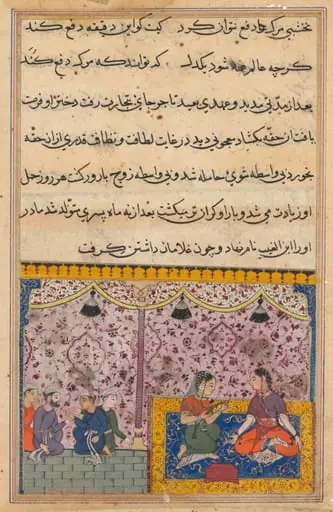 The merchant’s daughter gives birth to a son as a result of eating out of the box. The clever child recognizes the false gems from true, from a Tuti-nama (Tales of a Parrot): Twenty-third Night
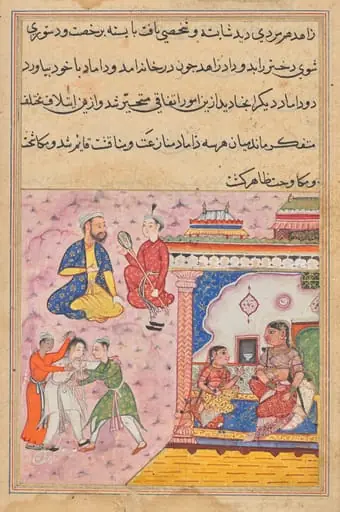 Three suitors fight amongst themselves for the hand of the devotee’s daughter, from a Tuti-nama (Tales of a Parrot): Twentieth Night
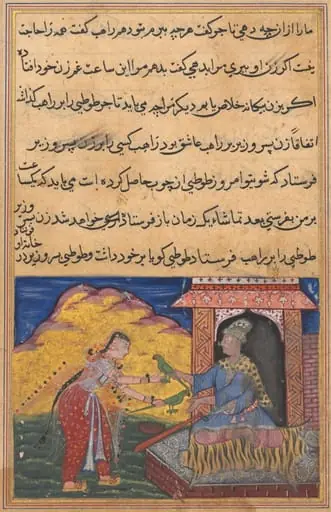 The wife of the son of the vizier brings the magic wooden parrot to her lover, the monk, who exchanges it for the replica, from a Tuti-nama (Tales of a Parrot): Tenth Night
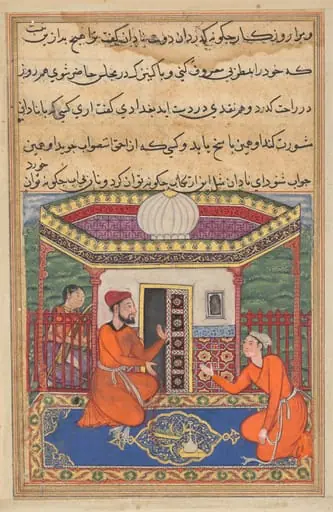 The young man of Baghdad solicits advice from a friend as his slave girl, who is adept at music, awaits, from a Tuti-nama (Tales of a Parrot): Forty-eighth Night
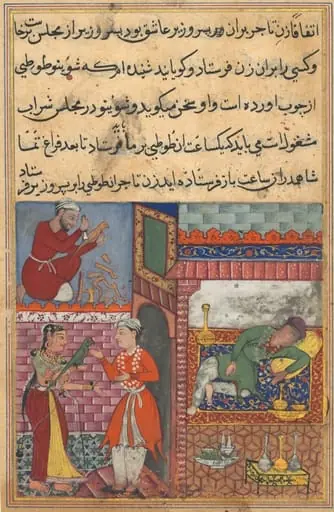 The vizier’s son receives the magic wooden parrot from the wife of the merchant, who is drunk, and has a replica made by a carpenter, from a Tuti-nama (Tales of a Parrot): Tenth Night
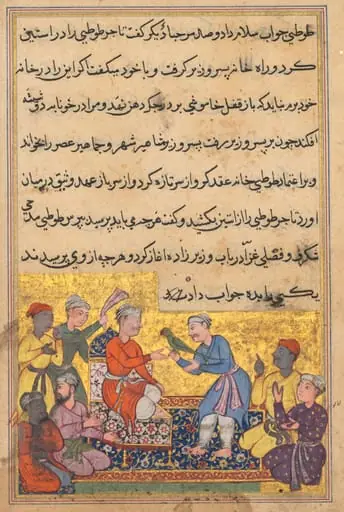 The magic parrot of the merchant talks to the vizier’s son, from a Tuti-nama (Tales of a Parrot): Tenth Night
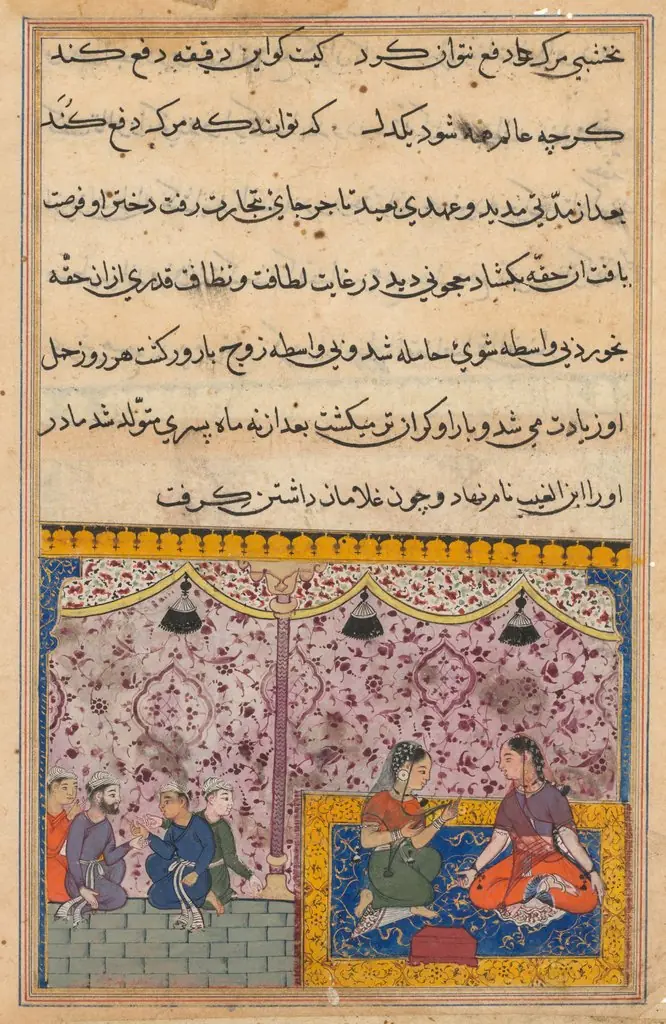 The merchant’s daughter gives birth to a son as a result of eating out of the box. The clever child recognizes the false gems from true, from a Tuti-nama (Tales of a Parrot): Twenty-third Night
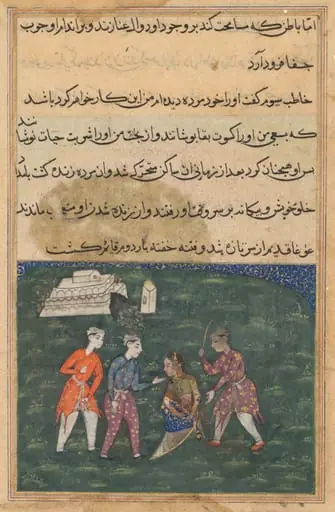 The third suitor strikes the devotee’s daughter and thus restores her to life, from a Tuti-nama (Tales of a Parrot): Twentieth Night
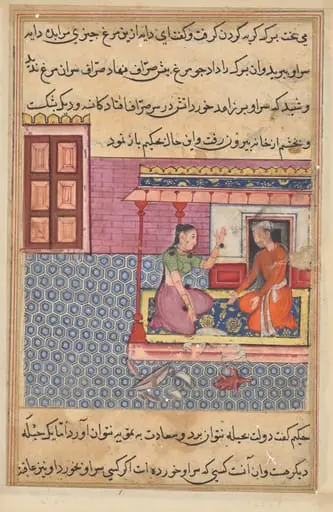 The pious man’s wife offers the seven-colored bird as food to her lover, but not finding its head, he breaks the pot and bowl in anger, from a Tuti-nama (Tales of a Parrot): Fifty-second Night
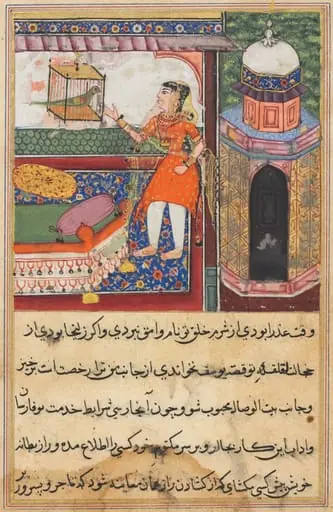 The Parrot Addresses Khujasta at the Beginning of the Tenth Night, from a Tuti-nama (Tales of a Parrot)