Artwork
Two Persian Buttercups (<i>Ranunculus asiaticus</i>)
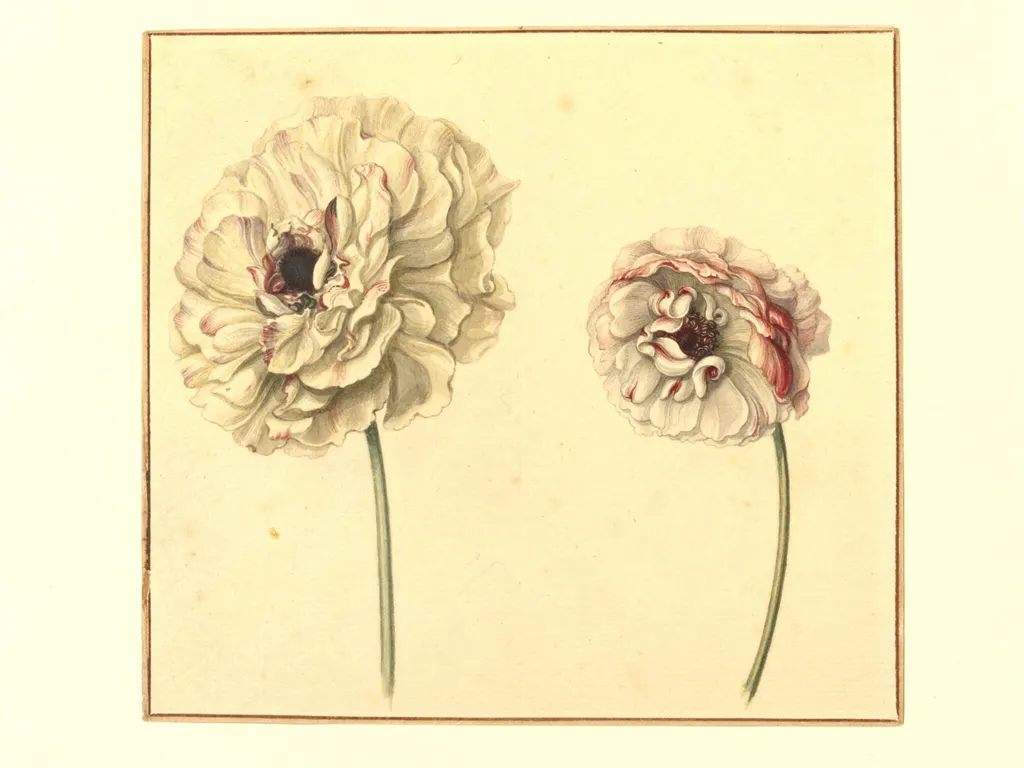
Two Persian Buttercups (<i>Ranunculus asiaticus</i>) is a watercolor work on paper by the Rococo painting artist Unknown. It dates from 1750 and is held in the collection of the Victoria and Albert Museum. This watercolour depicts two Persian buttercups, rendered with delicate precision on a bare white ground.
About this work
Overview
This watercolour depicts two Persian buttercups, rendered with delicate precision on a bare white ground. The flowers, one in full bloom and the other just opening, are isolated without context, emphasizing their form and colour. Created by Simon Verelst, the work belongs to a series of botanical studies made for later use in larger decorative compositions, not for scientific documentation.
Subject & Meaning
The two buttercups are chosen for their vivid orange petals and elegant structure, valued for their visual impact rather than botanical accuracy.
The two buttercups are chosen for their vivid orange petals and elegant structure, valued for their visual impact rather than botanical accuracy. By depicting flowers that would not naturally bloom together, Verelst prioritized aesthetic harmony over ecological truth. The composition reflects a tradition where beauty was constructed through selective assembly, turning nature into an idealized arrangement.
Technique & Style
Executed in transparent watercolour, the petals glow with layered washes that capture their translucence and subtle gradients. Fine lines define the curl of petals and the delicate veins of leaves, while the absence of background or shadow focuses attention on the flowers’ form. The technique balances spontaneity with control, typical of preparatory studies meant to preserve colour fidelity across seasons.
History & Provenance
Simon Verelst, born in The Hague in 1644, settled in London in 1669 and became a favoured artist among English aristocrats. He maintained a personal archive of floral sketches, reused in oil paintings commissioned by patrons including King Charles II. This study likely dates from his early decades in England, when he was building the visual library that underpinned his commercial success.
Context
In late 17th-century England, floral painting flourished as a decorative art form, driven by aristocratic interest in exotic plants and cultivated gardens. Artists like Verelst compiled seasonal studies to overcome the limitations of nature’s timing. These sketches were practical tools, enabling the creation of lush, impossible bouquets that satisfied contemporary tastes for opulent, curated beauty.
Legacy
Verelst’s watercolours contributed to a broader tradition of botanical illustration adapted for decorative arts. His method of reusing studies across multiple works influenced later flower painters and helped standardize the practice of maintaining visual reference collections. Though not scientific, these studies remain valuable records of horticultural preferences and artistic process in early modern England.
Artist & collection

 Domestic Scene
 Giacomo and Cardinal Marco, investing Andrea, Abbot of San Zeno, with his Benefice
 The Nymph of Fontainebleau
 Portrait of a Woman
 Madonna and Child with Saints in the Enclosed Garden
 Venus and Minerva
 Family Group of Four on Sofa
 Wall painting from Room H of the Villa of P. Fannius Synistor at Boscoreale
 Eight Beautiful Groups of Natural Flowers in Outlines by de la Cour: Tulips
 Paeonia officinalis (bonderose)
 Ranunculus Hortensis
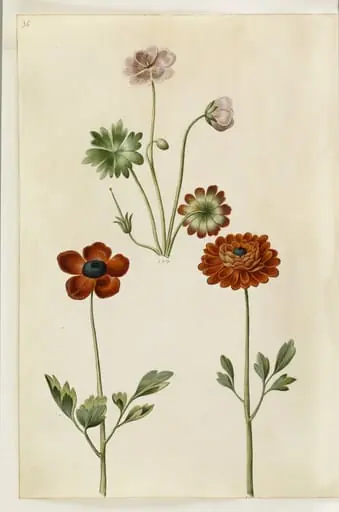 Geranium sanguineum striatum (stribet storkenæb); Ranunculus asiaticus (have-ranunkel)
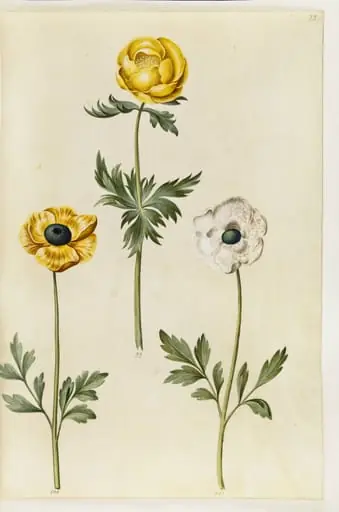 Trollius europaeus (europæisk engblomme); Ranunculus asiaticus (have-ranunkel)
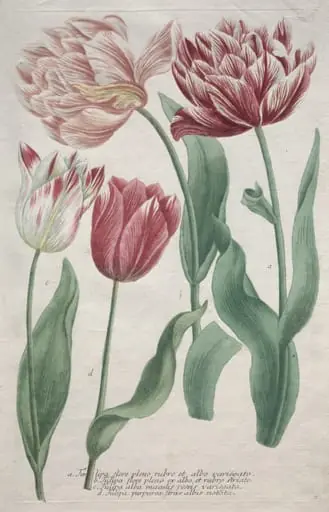 Tulips
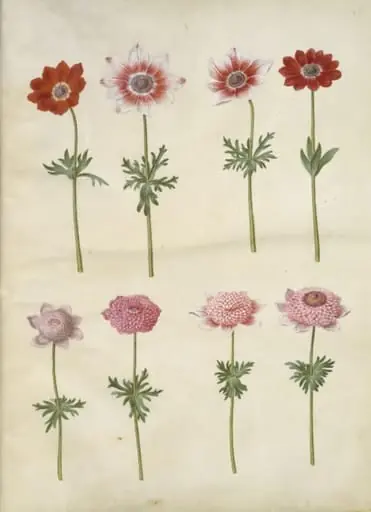 Anemone coronaria L. (fransk anemone); Anemone pavonina (påfugle-anemone)
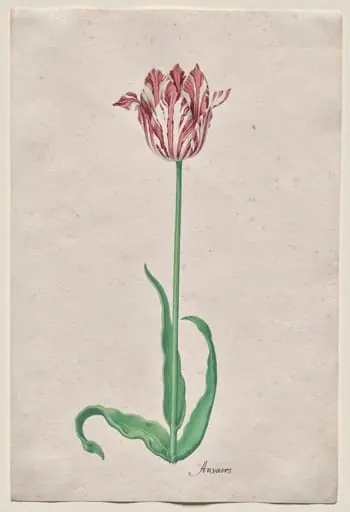 Study of a Tulip (Anvaers)
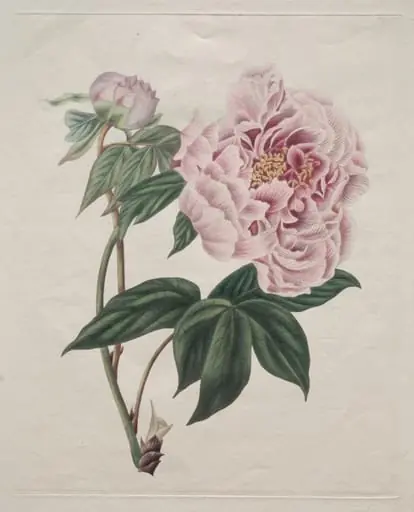 Chinese Tree Peony (Paeonia suffruticosa)