Artwork
Elevation of the front of the mausoleum of the Emperor Akbar at Sikandra near Agra
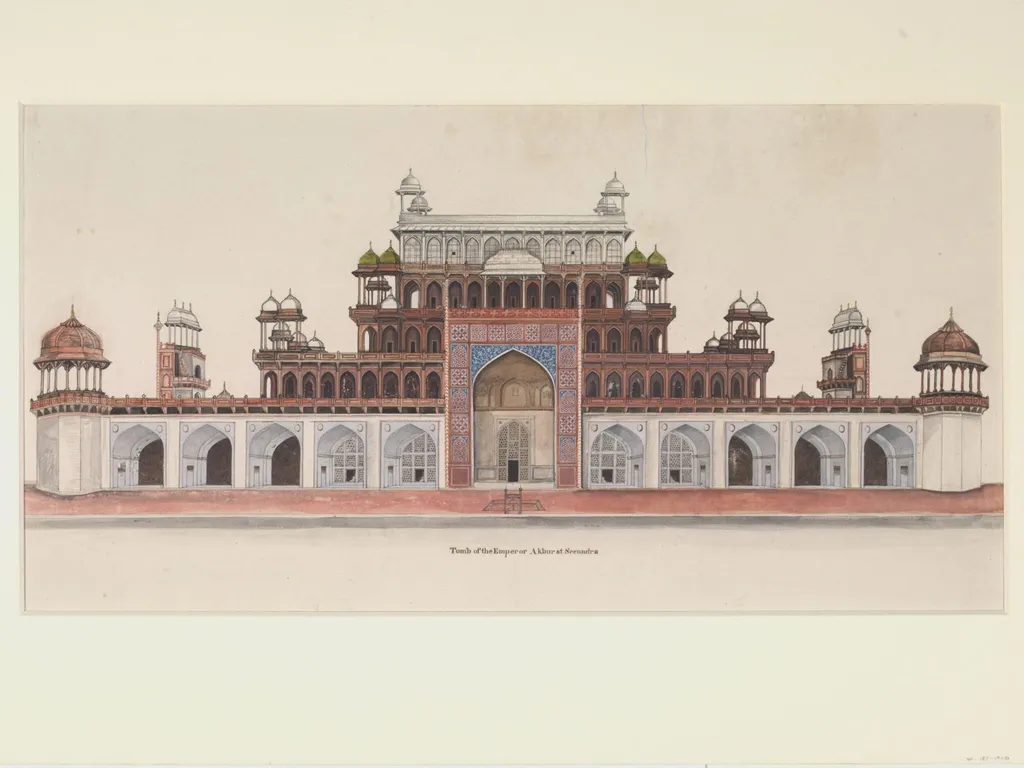
Elevation of the front of the mausoleum of the Emperor Akbar at Sikandra near Agra is a drawing by the Romanticist artist Unknown. It dates from 1819 and is held in the collection of the Victoria and Albert Museum.
About this work
They were working in Calcutta, but the building is actually near Agra, and it was finished in 1616.
This drawing shows the front of a big building, the mausoleum of Emperor Akbar.
It's interesting because the artists copied it from earlier paintings they had.
They were working in Calcutta, but the building is actually near Agra, and it was finished in 1616.
The details in the drawing are pretty accurate, which suggests the artists were skilled.
You can learn more about this style of drawing using the technique: cross-hatching.
Overview
This drawing is part of a series created by Indian artists based in Calcutta during the early 19th century, commissioned by British colonial official Colonel Pownell Phipps. Though depicting a Mughal monument near Agra, the work was produced far from its subject, relying on pre-existing visual models brought by the artists. It exemplifies the Company painting tradition, where Indian artisans adapted their techniques to meet European tastes for topographical and architectural documentation.
Subject & Meaning
The drawing records the front elevation of Akbar’s mausoleum at Sikandra, completed in 1616 as a monumental tomb for the Mughal emperor who ruled from 1556 to 1605. Unlike devotional or narrative imagery, this work serves a documentary function, capturing the structure’s architectural form with precision. Its purpose was not symbolic but evidentiary—to preserve a visual record of a significant monument for a colonial audience unfamiliar with the Indian landscape.
Technique & Style
The artist employed fine linear detail and cross-hatching to model surfaces and suggest depth, reflecting a hybrid approach that merged Indian miniature traditions with Western draftsmanship. While the composition adheres to European conventions of elevation drawing, the rendering of ornamentation retains a sensitivity to Mughal decorative patterns. The work demonstrates technical skill in translating three-dimensional architecture into two-dimensional planar representation.
History & Provenance
Commissioned by Colonel Pownell Phipps during his tenure as Superintendent of Public Buildings in Calcutta (1816–1822), the drawing was later donated to the museum by his son, Colonel Ramsay W. Phipps. The artists, likely trained in Delhi, relocated to Calcutta and reproduced known architectural views from memory or earlier sketches. This practice of replication was common, as artists relied on established visual templates to meet demand for standardized imagery.
Context
Company paintings emerged as a distinct genre under British colonial rule, catering to officials, travelers, and collectors seeking accurate depictions of Indian monuments, people, and customs. These works bridged indigenous artistic practices and Western aesthetic expectations, often produced for export or personal collections. The replication of known subjects like Akbar’s tomb reflects both the artists’ resourcefulness and the colonial appetite for curated visual knowledge of India.
Legacy
This drawing contributes to a broader archive of colonial-era visual documentation that shaped European perceptions of Mughal architecture. While not original in composition, its precision and craftsmanship preserve a record of how Indian artists interpreted and transmitted architectural heritage under colonial patronage. Such works remain valuable for understanding the intersection of artistic tradition and imperial inquiry in early 19th-century India.
Artist & collection

 Domestic Scene
 Giacomo and Cardinal Marco, investing Andrea, Abbot of San Zeno, with his Benefice
 The Nymph of Fontainebleau
 Portrait of a Woman
 Madonna and Child with Saints in the Enclosed Garden
 Venus and Minerva
 Family Group of Four on Sofa
 Wall painting from Room H of the Villa of P. Fannius Synistor at Boscoreale
 Untitled
 Mausoleum of Itimad ud-Daula.
 The Buland Darwaza of the Jami Masjid, Fatehpur Sikri
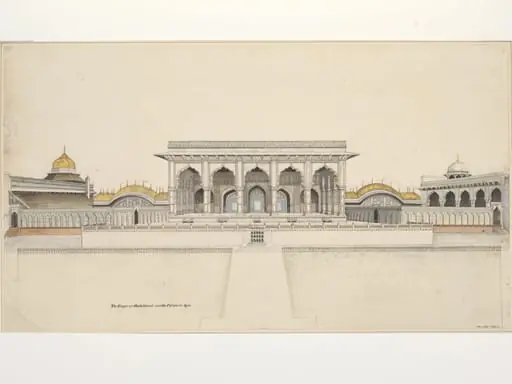 Elevation of the facade of the Khas Mahal, private apartments, Agra Fort, with the adjoining golden pavilions
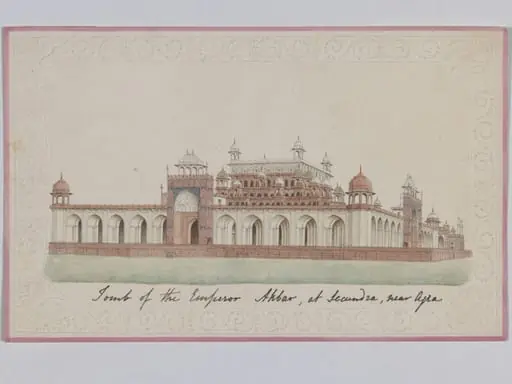 Akbar's mausoleum, Sikandra
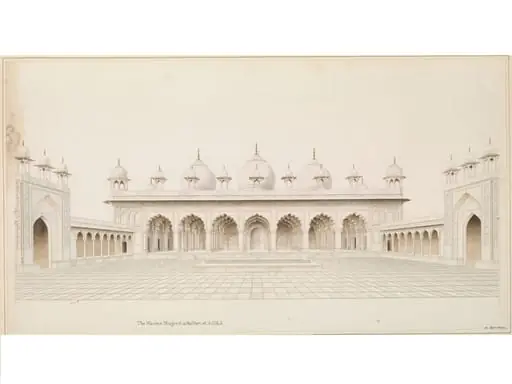 Elevation of the Moti Masjid (Pearl Mosque), Agra
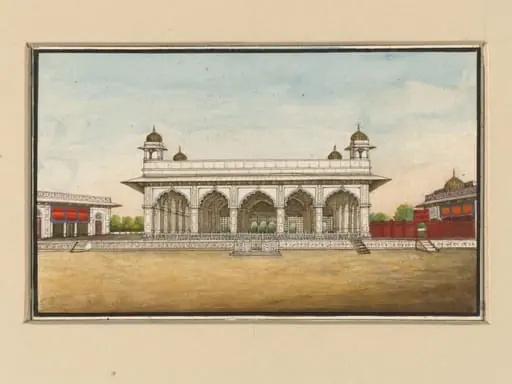 One of four drawings of Mughal architecture.
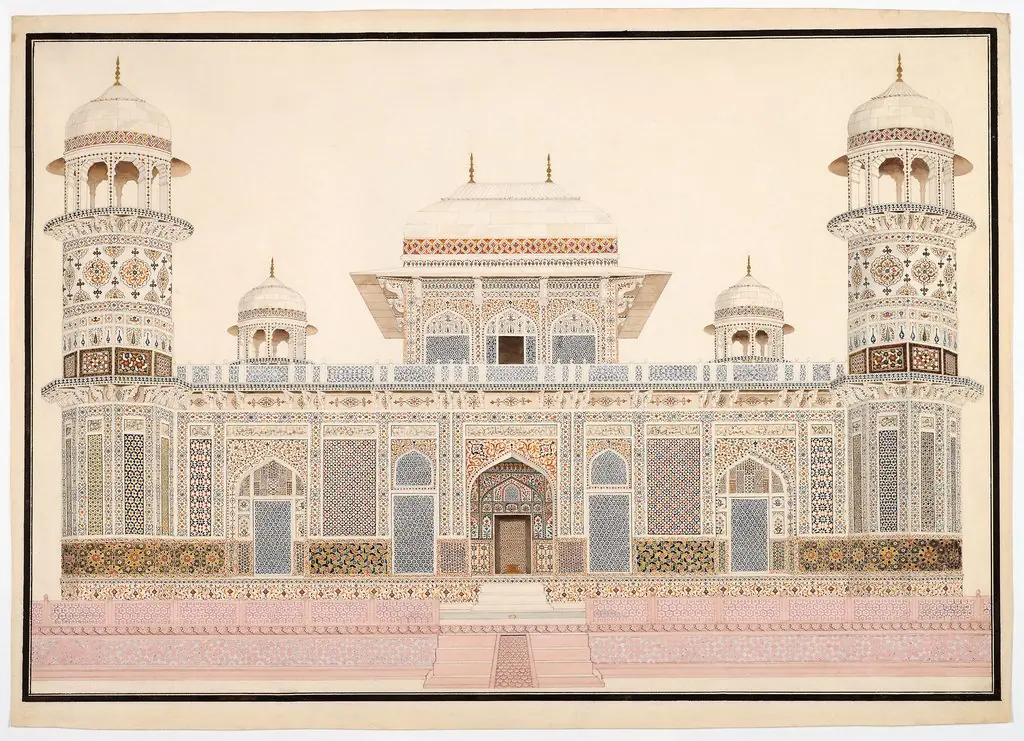 I'timad-ud-Daula's Tomb at Agra
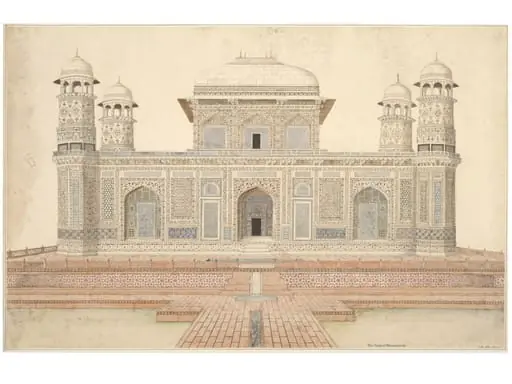 The facade of the tomb of I'timad ad-daula and his wife Asmat Begum, Agra.