Artwork
View of St. Geertruidenberg
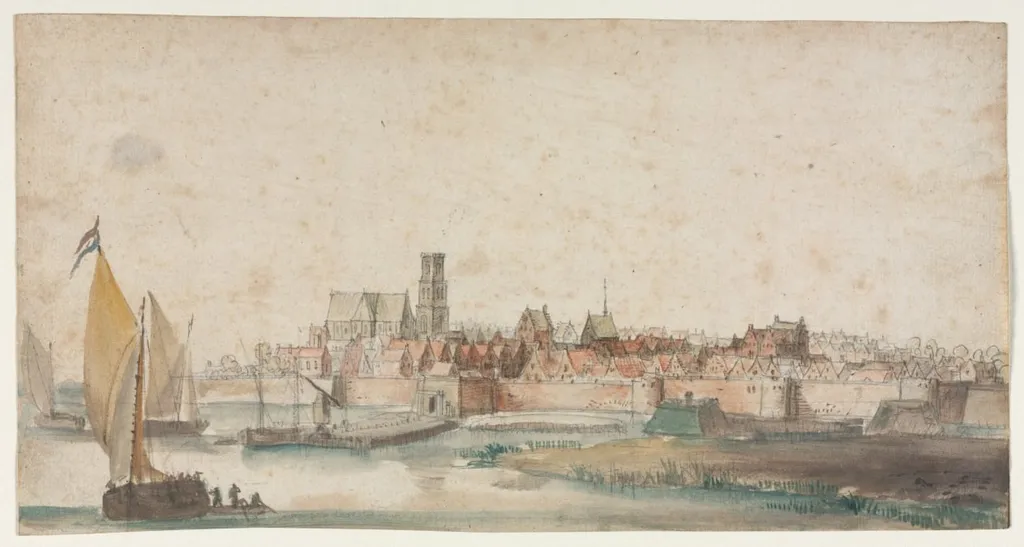
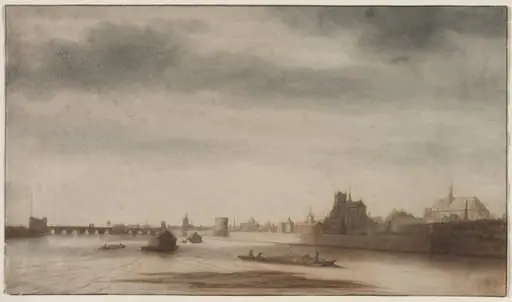
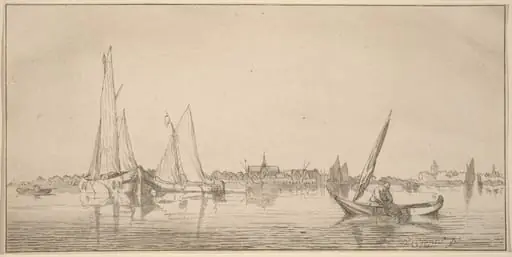
View of St. Geertruidenberg is a drawing by the Baroque artist Unknown. It dates from 1604 and is held in the collection of the Cleveland Museum of Art. This watercolor drawing depicts the Dutch town of St.
About this work
Overview
The artist favors delicate lines and translucent washes, avoiding bold contrasts to sustain a tranquil, observational mood.
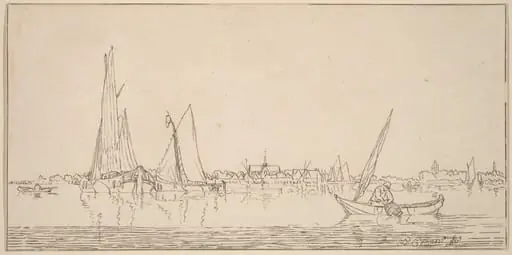
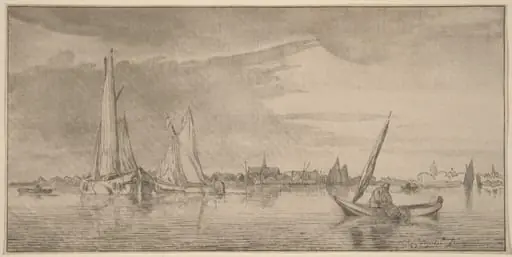
This watercolor drawing depicts the Dutch town of St. Geertruidenberg, captured with restrained brushwork and muted tones. The composition centers on a prominent church tower, flanked by modest residential and commercial buildings. Calm waters reflect the sky and vessels, while a few sailing ships rest near the riverbank. The artist favors delicate lines and translucent washes, avoiding bold contrasts to sustain a tranquil, observational mood.
Subject & Meaning
The scene presents an unembellished view of daily life in a modest river town, emphasizing quiet commerce and local architecture. The anchored ships suggest economic activity tied to waterways, while the church’s height implies spiritual or civic centrality. No figures are present, reinforcing a sense of stillness and introspection. The work functions as a record of place rather than a narrative or symbolic statement.
Technique & Style
The artist employs light watercolor washes with minimal layering, allowing the paper’s texture to contribute to the atmosphere. Soft edges and subtle gradations define forms, avoiding sharp outlines. Buildings are rendered with simple geometric shapes, while the river is suggested through faint horizontal strokes. The restrained palette—dominated by earth reds, browns, and pale blues—enhances the sense of calm and restraint.
History & Provenance
Created during the 17th century, the drawing likely served as a topographical record or personal sketch rather than a commissioned work. Its survival suggests it was preserved within a private collection, possibly by a local resident or traveler. No documented exhibition history exists, and its attribution remains tentative, though stylistic traits align with Dutch regional draftsmen of the period.
Context
This work emerges from a Dutch tradition of topographical drawing, where artists documented towns and landscapes with precision and modesty. Unlike grand Baroque compositions, it avoids theatricality, reflecting the values of civic pride and quiet observation common in provincial communities. River scenes like this were frequently studied for their utility in mapping and land management.
Legacy
The drawing contributes to a broader corpus of unassuming Dutch watercolors that prioritize observation over spectacle. While not widely known, it exemplifies how regional artists captured everyday environments with sensitivity and restraint. Its influence lies in its quiet fidelity to place, offering insight into the visual culture of small Dutch towns beyond major urban centers.
Artist & collection

 Domestic Scene
 Giacomo and Cardinal Marco, investing Andrea, Abbot of San Zeno, with his Benefice
 The Nymph of Fontainebleau
 Portrait of a Woman
 Madonna and Child with Saints in the Enclosed Garden
 Venus and Minerva
 Family Group of Four on Sofa
 Wall painting from Room H of the Villa of P. Fannius Synistor at Boscoreale
![View of Scheveningen [recto], by Jan van Goyen](https://artifactworldgallery.com/img/jan-van-goyen--view-of-scheveningen-recto--0f9cb319c9b082d3-w320.webp)