Artwork
Woman from Fengyang
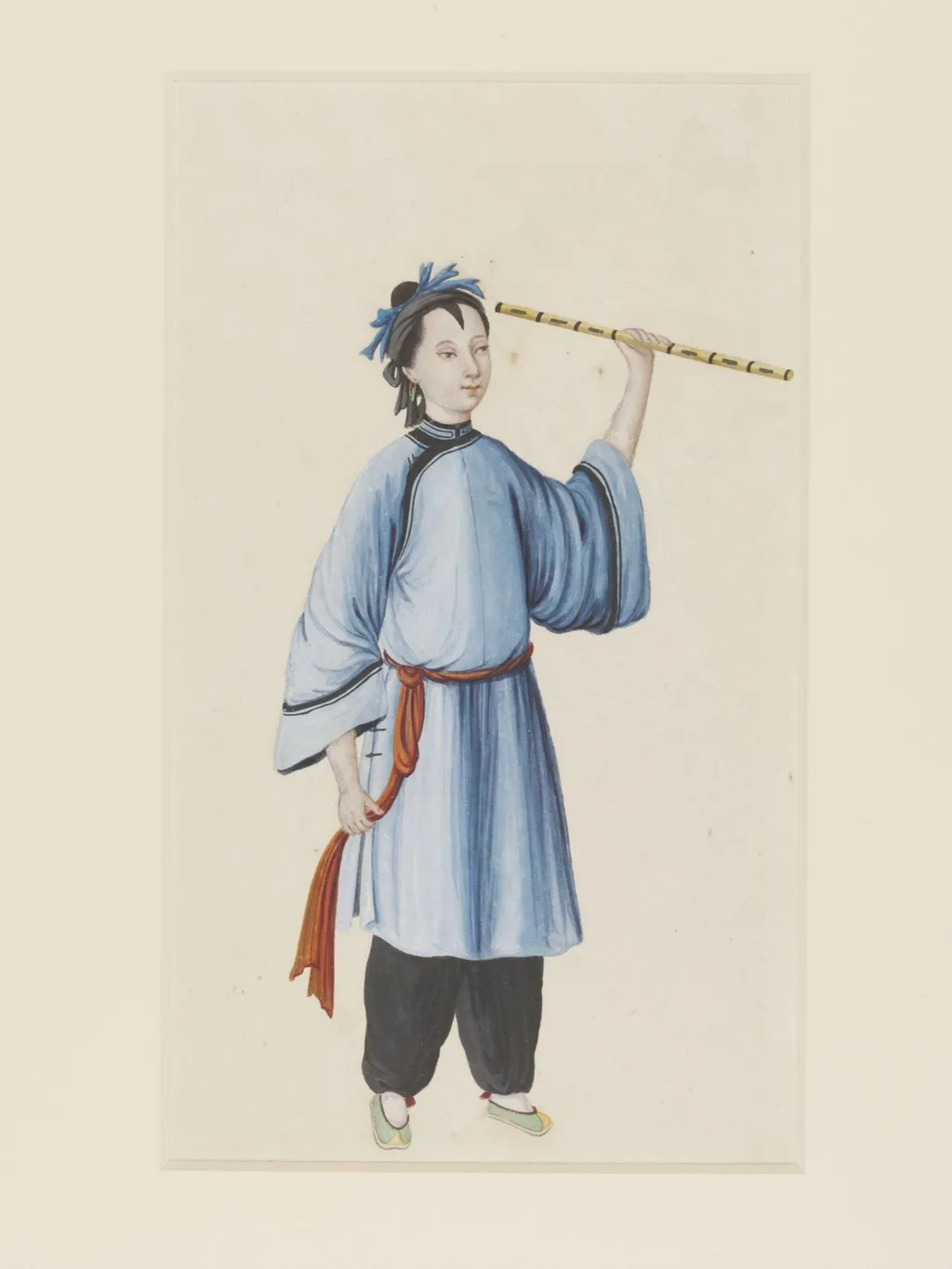
Woman from Fengyang is a paint painting by the Romanticist artist Unknown. It dates from 1800 and is held in the collection of the Victoria and Albert Museum. This painting originates from Canton (Guangzhou) in the early 19th century, created as part of a series illustrating regional Chinese dress.
About this work
Overview
This painting originates from Canton (Guangzhou) in the early 19th century, created as part of a series illustrating regional Chinese dress.
This painting originates from Canton (Guangzhou) in the early 19th century, created as part of a series illustrating regional Chinese dress. It portrays a woman holding a flute, accompanied by a handwritten label in English noting her origin as a beggar from Fengyang. The label’s misspelled wording suggests the writer had minimal command of English, reflecting the commercial, rather than scholarly, context of its production for foreign buyers.
Subject & Meaning
The woman depicted is identified as a native of Fengyang, a region in Anhui known for poverty and seasonal migration. Her inclusion in the series likely reflects European interest in social types rather than individual identity. The flute may symbolize her role as a street performer or itinerant musician, common among displaced rural populations. The label frames her as an object of curiosity, reducing personal circumstance to a marketable exoticism.
Technique & Style
Executed in watercolor on paper, the painting employs fine brushwork to render textile patterns and facial features with delicate precision. The composition is straightforward, emphasizing costume and posture over narrative depth. Backgrounds are minimal, focusing attention on the figure and the attached label. This style aligns with export art traditions, prioritizing clarity and decorative detail for Western consumers.
History & Provenance
Produced in Guangzhou during the Canton System era, when European trade was restricted to this single port, the painting was made for foreign merchants and travelers. Such works were commonly sold as souvenirs, often labeled in broken English by local artisans or intermediaries. The attached note, though poorly written, confirms its function as a cultural artifact designed to satisfy European fascination with Chinese social diversity.
Context
In the late 18th and early 19th centuries, Guangzhou became a hub for export art, where Chinese painters adapted traditional techniques to meet foreign demand. Images of regional costumes, occupations, and customs were popular, reflecting both genuine ethnographic interest and orientalist stereotypes. This painting fits within a broader genre that commodified Chinese life for Western audiences, often without understanding the social realities behind the subjects.
Legacy
Works like this remain in museum collections as evidence of cross-cultural exchange and the commercialization of cultural difference. They illustrate how visual representation was used to construct perceptions of China abroad. Today, they are studied not only for their aesthetic qualities but also for the power dynamics embedded in their creation and reception by Western collectors.
Artist & collection

 Domestic Scene
 Giacomo and Cardinal Marco, investing Andrea, Abbot of San Zeno, with his Benefice
 The Nymph of Fontainebleau
 Portrait of a Woman
 Madonna and Child with Saints in the Enclosed Garden
 Venus and Minerva
 Family Group of Four on Sofa
 Wall painting from Room H of the Villa of P. Fannius Synistor at Boscoreale