Artwork
The Municipio, Florence
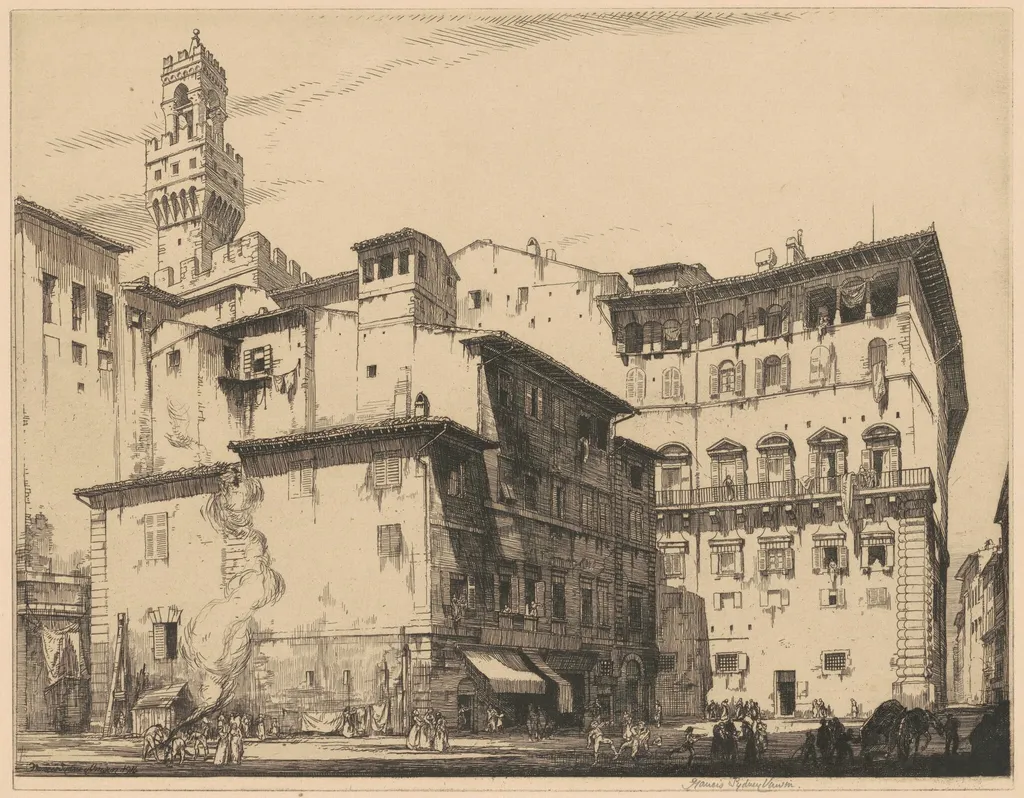
The Municipio, Florence is an ink print by Francis Sydney Unwin. It dates from 1914 and is held in the collection of the National Gallery of Art.
About this work
Overview
The composition emphasizes verticality and texture, with closely spaced lines suggesting depth and the tactile quality of aged stone.
Created in 1914, this etching by Francis Sydney Unwin depicts a public square in Florence. Rendered in black ink on laid paper, the work captures the architectural character of the city’s civic center. The composition emphasizes verticality and texture, with closely spaced lines suggesting depth and the tactile quality of aged stone. The paper’s natural grain enhances the sense of age and materiality in the scene.
Subject & Meaning
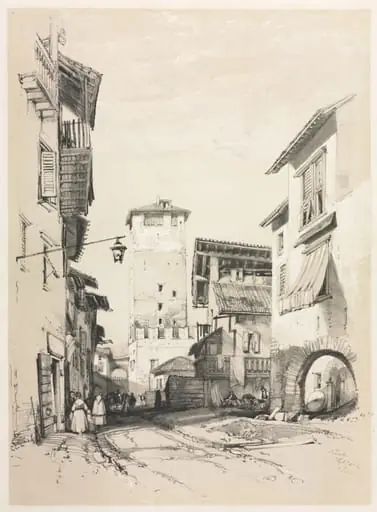
The scene portrays a bustling municipal square, likely near Florence’s town hall, with figures and animals moving among tall, shuttered buildings. The presence of a prominent tower with arched windows signals civic authority. The quiet activity—pedestrians, horses, and still figures—conveys daily urban life without drama. The image reflects observation rather than idealization, focusing on the rhythm of ordinary moments in a historic setting.
Technique & Style
Unwin employed etching to incise fine lines into a metal plate, using acid to define form through tonal variation. The dense, controlled hatching models light and shadow across building facades, giving them volume. The textured laid paper interacts with the ink, adding subtle grain that echoes the roughness of masonry. The absence of color and the precision of line reflect a restrained, observational approach typical of early 20th-century topographical printmaking.
History & Provenance
The work was produced during Unwin’s time in Italy, likely as part of his study of Italian architecture. It was created shortly before the outbreak of the First World War, a period when many European artists documented historic urban landscapes. The print remains in private collections and institutional archives, primarily in Britain and Italy, with no known public exhibition history beyond early 20th-century print shows.
Context
In 1914, Florence was a city preserving its medieval and Renaissance heritage amid modernization. Artists like Unwin, often British or American, traveled there to record its architecture before industrial change altered its character. Etching was a favored medium for such documentation—portable, precise, and suited to capturing detail. This work aligns with a broader trend of topographical prints made by foreign artists documenting European cities.
Legacy
Though not widely reproduced, the etching contributes to a modest but persistent body of early 20th-century British printmaking focused on Italian urban scenes. It reflects a quiet, documentary impulse rather than artistic innovation. Today, it serves as a visual record of Florence’s streetscape before the upheavals of the 20th century, valued more for its historical testimony than its stylistic influence.
Artist & collection

![Le Preson. V. [lower left], by Canaletto](https://artifactworldgallery.com/img/canaletto--le-preson-v-lower-left--26be544f774fb814-w320.webp)