Artwork
Views of Rome: The The Isola Tiberina
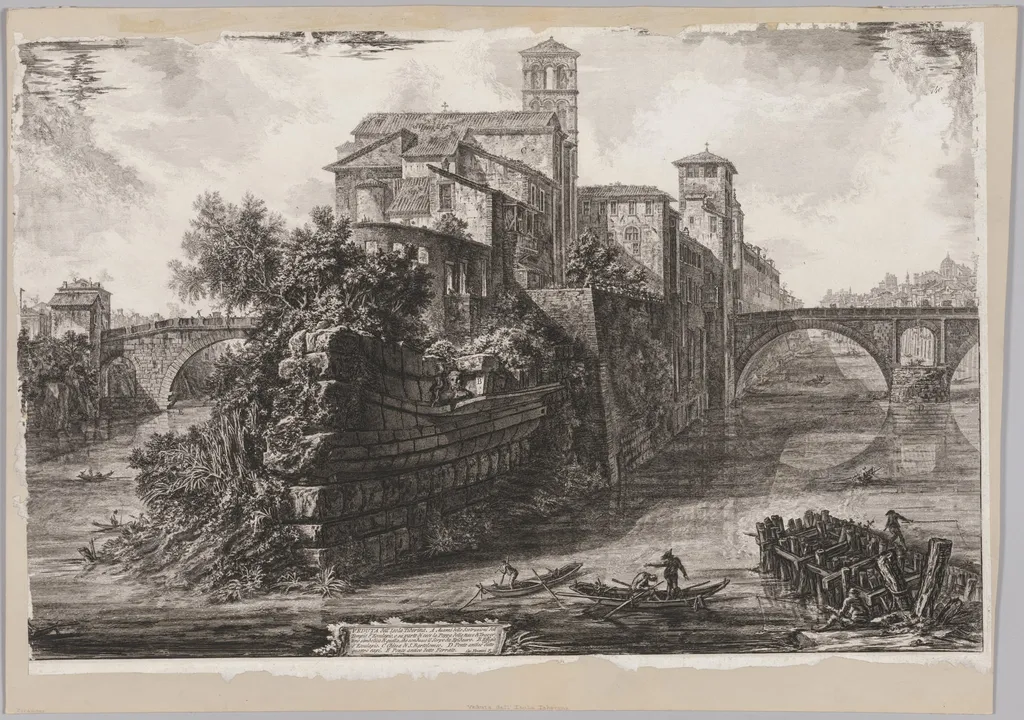
Views of Rome: The The Isola Tiberina is a print by the Romanticist artist Giovanni Battista Piranesi. It dates from 1775 and is held in the collection of the Cleveland Museum of Art.
About this work
Overview
The piece is held in the collection of the Cleveland Museum of Art, where it serves as an example of 18th-century topographical printmaking.
This print, dated 1775, is part of Giovanni Battista Piranesi’s series documenting Roman landscapes. It depicts the Tiber Island and its surrounding structures with precise architectural detail. Executed as an etching, it belongs to a body of work that systematically records the city’s topography. The piece is held in the collection of the Cleveland Museum of Art, where it serves as an example of 18th-century topographical printmaking.
Subject & Meaning
The scene centers on Tiber Island, a small, boat-shaped landmass in the Tiber River, connected to the mainland by two ancient bridges. Figures and vessels along the shore suggest daily urban life, while the dense clustering of buildings reflects Rome’s layered urban fabric. The composition conveys neither idealization nor narrative, but rather a documentary interest in the city’s physical and spatial organization.
Technique & Style
Piranesi employed etching to achieve fine lines and deep tonal contrasts, emphasizing the weight of stone architecture and the fluidity of water. His use of cross-hatching and varying line density creates a sense of volume and atmospheric perspective. The meticulous rendering of textures—brick, timber, foliage—demonstrates his training as an architect and his commitment to observed detail over romantic embellishment.
History & Provenance
Created during Piranesi’s decades-long residence in Rome, this print was likely produced for collectors and travelers drawn to the city’s antiquities. It was part of a larger series published in the 1770s, intended to catalog Rome’s monuments and waterways. The Cleveland Museum of Art acquired the work in the 20th century, where it remains among the most comprehensive holdings of Piranesi’s prints in North America.
Context
Piranesi’s views emerged amid the Grand Tour’s popularity, when European elites sought visual records of classical sites. Unlike idealized vedute by contemporaries, his works emphasized structural complexity and the passage of time. This print reflects a growing scholarly interest in Rome’s physical history, aligning with antiquarian studies rather than picturesque aesthetics.
Legacy
Piranesi’s prints influenced later architects and urban planners through their precise documentation of Roman infrastructure. His technique set a standard for topographical accuracy in printmaking. While not widely imitated in style, his method of combining architectural rigor with atmospheric depth became a reference point for 19th-century surveying and architectural illustration.
Artist & collection

Artist
Giovanni Battista (or Giambattista) Piranesi (Italian pronunciation: ; also known as simply Piranesi; 4 October 1720 – 9 November 1778) was an Italian classical archaeologist, architect, and artist, famous for his…


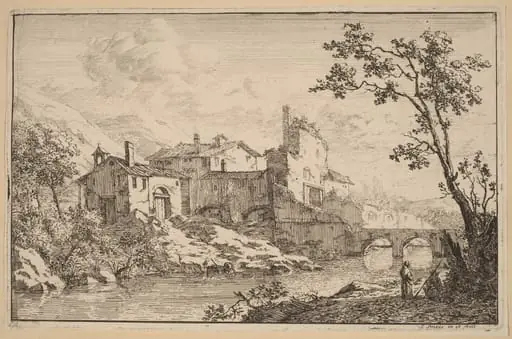 Houses at the Side of a River
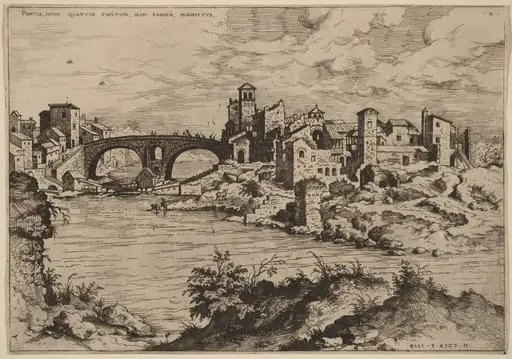 View of the Ponte Quattro Capi and the Island of the Tiber
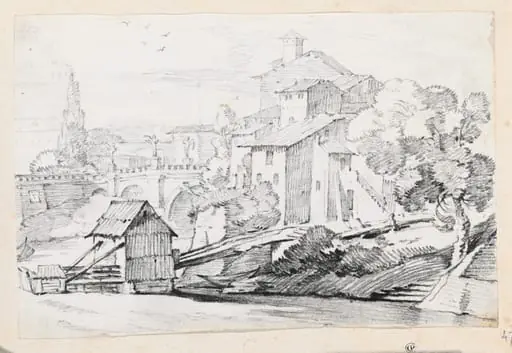 The Ponte Sant'Angelo and Houses on the East Bank of the Tiber
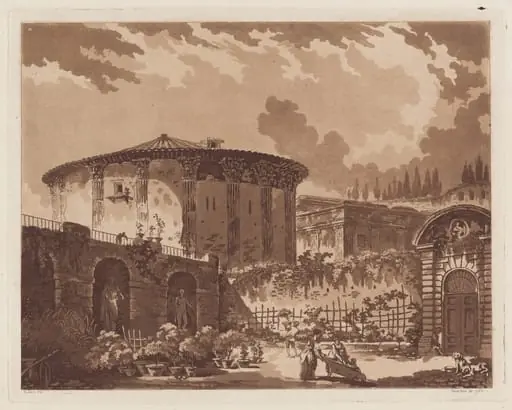 View in the Garden of a Roman Villa, with the Temple of Hercules Victor and the Temple of Portunus
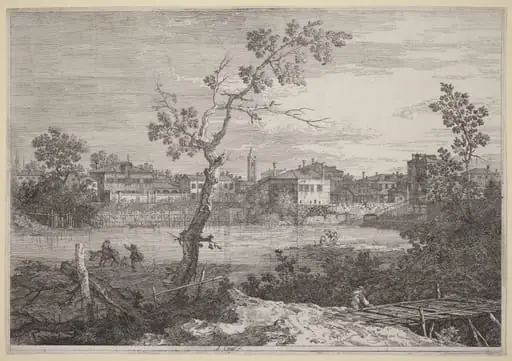 View of a Town on a River Bank
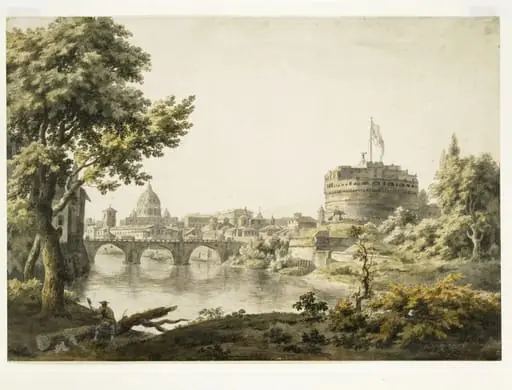 A view of Rome with the Tiber, the Castle of S. Angelo, and in the background St. Peter's
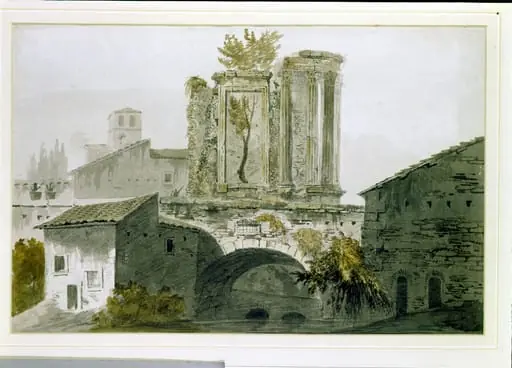 Italian Ruins
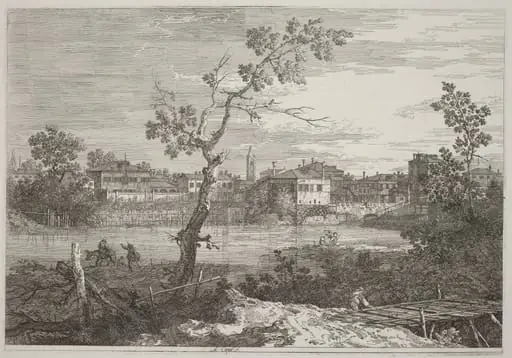 View of a Town on a River Bank
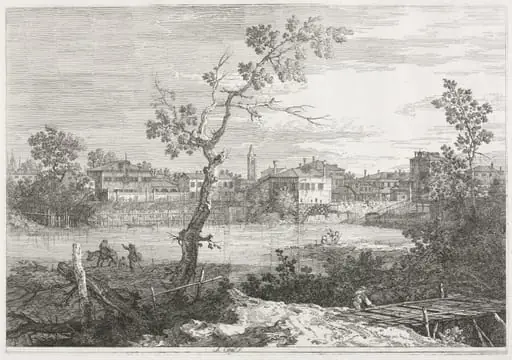 Views: View of Burano, a Town on an Island in the Venetian Lagoon
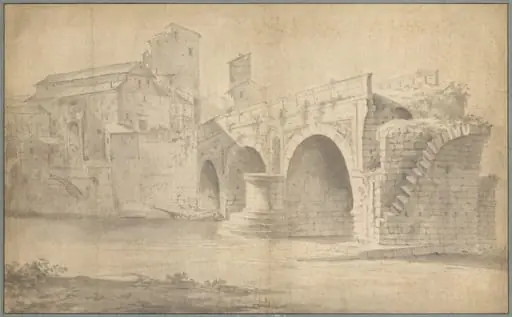 View of the Ponte Rotto, Rome
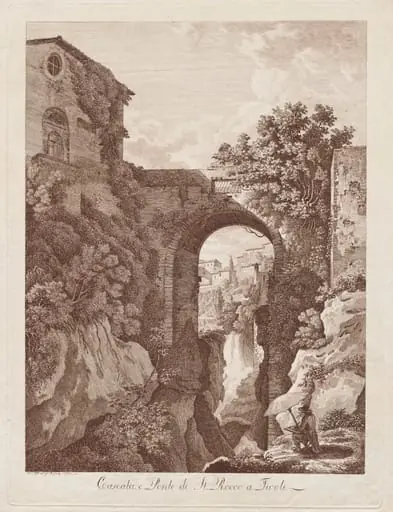 St. Rocco Waterfall and Bridge at Tivoli (Cascata e Ponte di St. Rocco a Tivoli)
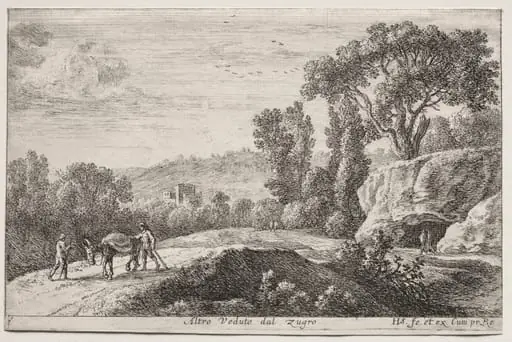 Diverse Views in and around Rome: Second View of Zugro (Altro Veduto dal Zugro)