Artwork
歌川広重画 楓に孔雀|A Peacock Perched on a Maple Tree
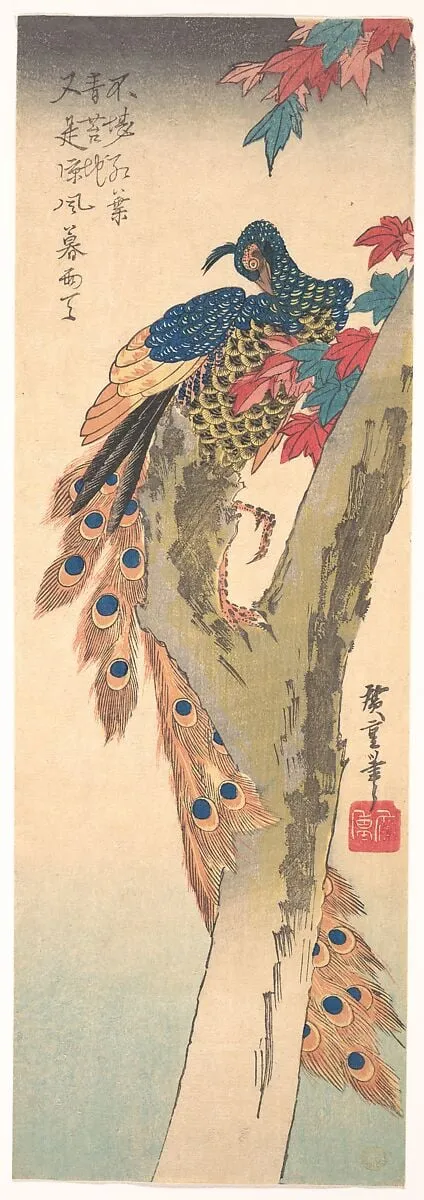
歌川広重画 楓に孔雀|A Peacock Perched on a Maple Tree is an ink print by the Romanticist artist Utagawa Hiroshige. It dates from 1833 and is held in the collection of the Metropolitan Museum of Art.
About this work
Overview
Created circa 1833, this woodblock print by Utagawa Hiroshige presents a solitary peacock resting on a bare maple branch. Unlike his more famous landscapes, this work focuses on a single natural subject, showcasing a shift in his artistic focus toward intimate botanical and avian forms. The composition is vertical, emphasizing the bird’s elongated form against a minimal background.
Subject & Meaning
The peacock, perched amid falling maple leaves, symbolizes seasonal transition and quiet beauty. Its presence in a Japanese print, rather than as a mythic or decorative motif, reflects a growing interest in observed nature during the Edo period. The bird’s poised stillness contrasts with the drifting leaves, suggesting impermanence and the elegance of fleeting moments.
Technique & Style
The print’s two-dimensional quality and lack of perspective reflect traditional ukiyo-e conventions, prioritizing pattern and form over illusionistic depth.
Hiroshige employed bold, flat areas of color—blue, green, and gold—to define the peacock’s plumage, using clean outlines to enhance clarity. The background is deliberately sparse, with only faintly rendered sky and scattered leaves, allowing the bird to dominate. The print’s two-dimensional quality and lack of perspective reflect traditional ukiyo-e conventions, prioritizing pattern and form over illusionistic depth.
History & Provenance
The print is part of the collection at The Metropolitan Museum of Art, acquired as part of a broader effort to document Japanese printmaking in the 19th century. While its exact early ownership is undocumented, its preservation suggests it was valued by collectors for its refined execution and departure from Hiroshige’s typical urban themes.
Context
During the 1830s, ukiyo-e artists increasingly turned to nature as a subject, responding to urban audiences’ longing for rural tranquility. Hiroshige’s focus on birds and trees aligned with this trend, while his use of vertical format and stylized flora echoed earlier ink-painting traditions, blending Japanese aesthetics with the commercial print medium.
Legacy
This print exemplifies Hiroshige’s later experimentation beyond landscape, influencing later artists interested in natural forms within printmaking. Its restrained palette and emphasis on singular subjects contributed to a quieter, more contemplative strand of ukiyo-e, distinct from the bustling scenes of Edo life that defined the genre’s earlier years.
Artist & collection
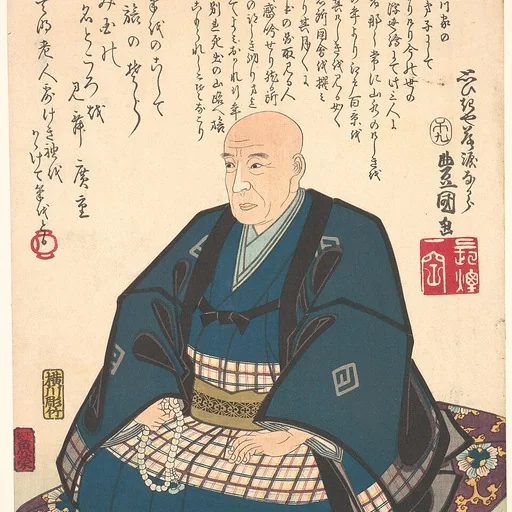
Artist
Utagawa Hiroshige (歌川 広重) or Andō Hiroshige (安藤 広重), born Andō Tokutarō (安藤 徳太郎; 1797 – 12 October 1858), was a Japanese ukiyo-e artist, considered the last great master of that tradition.

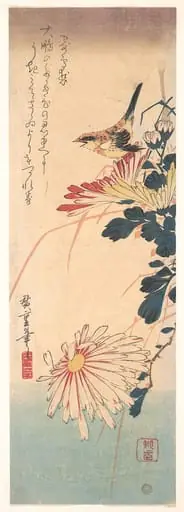 歌川広重画 菊に鷦鷯 |A Wren and Chrysanthemums
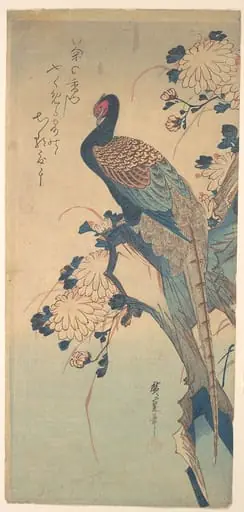 歌川広重画 菊に雉|Pheasant with Chrysanthemums
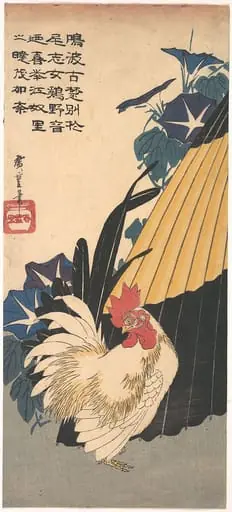 歌川広重画 朝顔に鶏と傘|Rooster, Umbrella, and Morning Glories
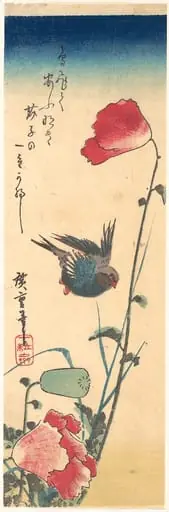 歌川広重画 芥子に瑠璃鳥|A Bluebird and Poppies
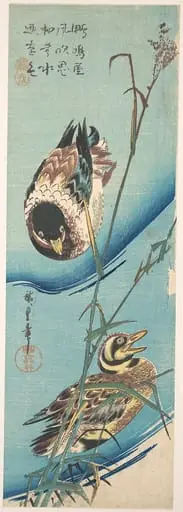 歌川広重画 雪中芦に鴨|Mallard Ducks and Snow-covered Reeds
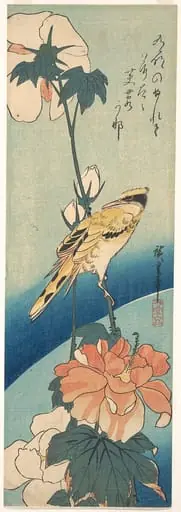 歌川広重画 扶養に高麗鶯|A Black-Naped Oriole on a Stem of Rose Mallow
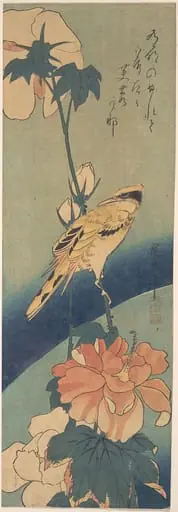 歌川広重画 芙蓉に高麗鶯|Black-naped Oriole Perched on a Stem of Rose Mallow