Artwork
Peasants Lunching in Open Air
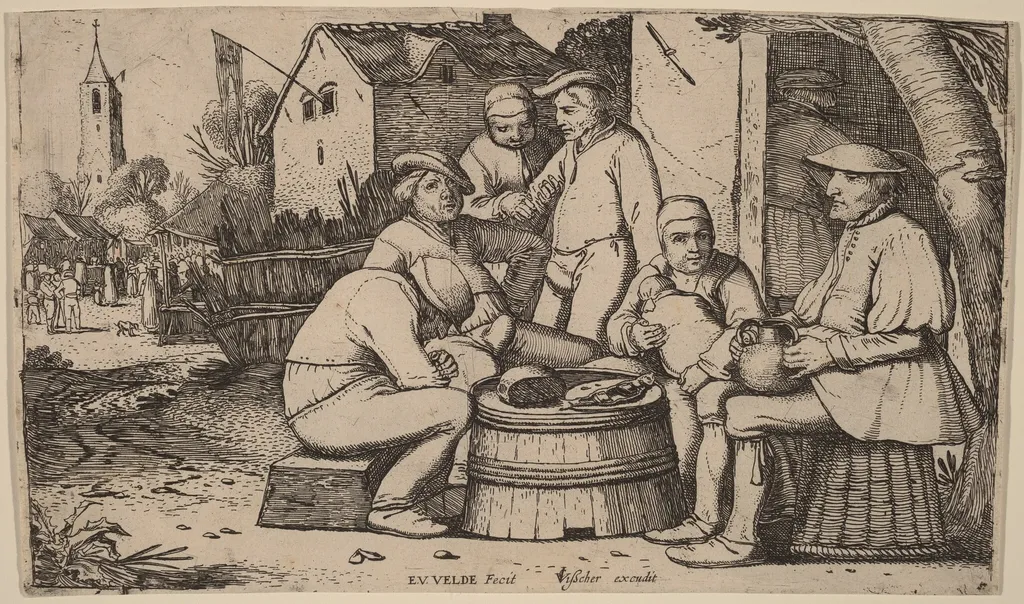
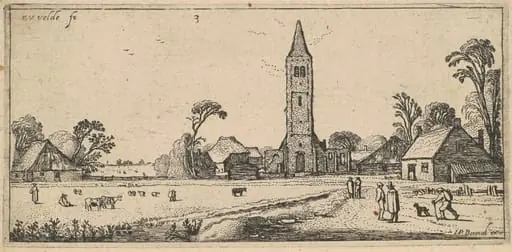
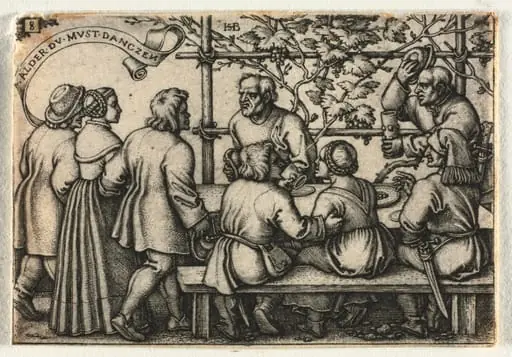
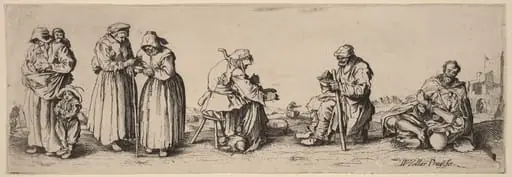
Peasants Lunching in Open Air is an ink print by the Renaissance artist Velde, Esaias van de, I. It dates from 1610 and is held in the collection of the National Gallery of Art. Created around 1610 by Esaias van de Velde the Elder, this etching depicts a quiet rural scene of laborers taking a midday break.
About this work
Overview
The work belongs to a tradition of Northern European prints that documented peasant life with observational precision rather than idealization.
Created around 1610 by Esaias van de Velde the Elder, this etching depicts a quiet rural scene of laborers taking a midday break. The composition centers on five figures gathered outdoors near a modest village, engaged in simple, everyday actions. A church steeple anchors the background, while distant figures suggest a broader community. The work belongs to a tradition of Northern European prints that documented peasant life with observational precision rather than idealization.
Subject & Meaning
The scene captures an unremarkable moment of rest among agricultural workers, emphasizing routine over drama. One man pours liquid into a barrel, others eat or observe, their postures and attire reflecting modest means. The presence of the church and passing travelers situates the figures within a larger social fabric. There is no overt moralizing; instead, the image values the dignity of ordinary labor and the rhythm of rural existence.
Technique & Style
Van de Velde employed fine, incised lines to define forms, avoiding tonal shading in favor of linear clarity. Textures such as thatched roofs, wooden barrels, and woven garments are suggested through rhythmic strokes rather than hatching or crosshatching. The etching’s restrained palette and deliberate line work reflect the technical conventions of early 17th-century printmaking, where precision and economy of mark were essential to reproduction.
History & Provenance
The print originates from a period when Dutch artists increasingly turned to landscape and genre scenes as subjects for printmaking. Van de Velde, active in Amsterdam and Utrecht, was part of a generation that documented rural life with growing interest. While specific early ownership records are sparse, the work aligns with the broader circulation of such prints among middle-class collectors seeking depictions of authentic, non-aristocratic life.
Context
In early 1600s the Netherlands, economic prosperity and rising urban literacy fostered demand for prints depicting everyday life. Artists like Van de Velde responded by translating observed rural scenes into accessible images. Unlike religious or mythological subjects, these works appealed to viewers’ familiarity with local customs. Etching allowed for relatively quick reproduction, making such imagery widely available beyond elite circles.
Legacy
This etching contributes to a broader shift in Northern European art toward secular, observational subject matter. Van de Velde’s focus on unidealized laborers influenced later genre painters and printmakers who sought to capture the textures of daily existence. Though not widely known today, such works helped establish the legitimacy of peasant life as a worthy subject for artistic representation in the early modern period.
Artist & collection