Artwork
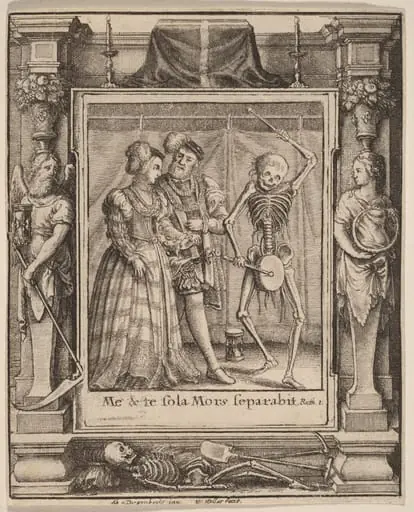
Death Taking a Couple by Surprise
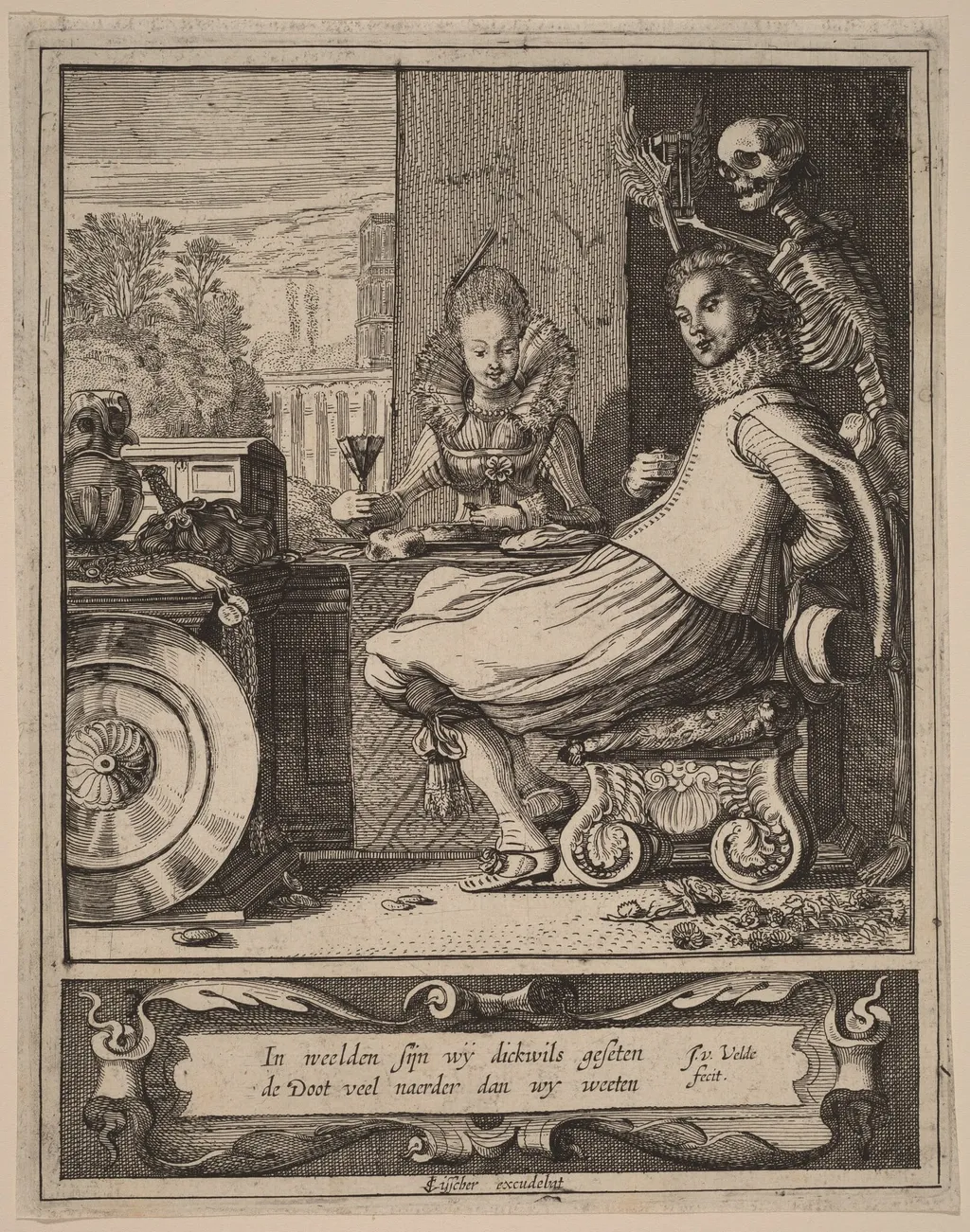
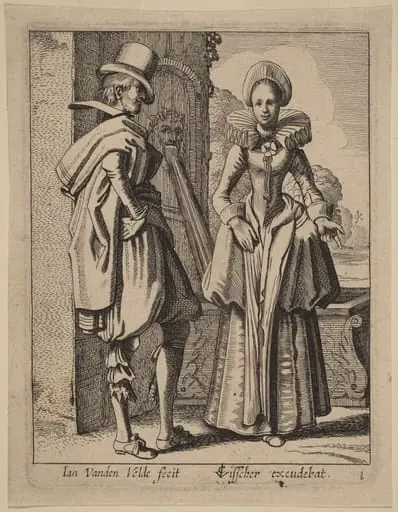
Death Taking a Couple by Surprise is an ink print by the Renaissance artist Jan van de Velde. It dates from 1617 and is held in the collection of the National Gallery of Art.
About this work
Overview
The image belongs to a broader tradition of vanitas imagery in early 17th-century Northern Europe.
Created in 1617 by Jan van de Velde the Younger, this etching is part of a flourishing Dutch print culture that combined technical precision with moral storytelling. Unlike his more common animal and landscape subjects, this work engages with the theme of mortality, using the medium’s fine lines to capture both domestic intimacy and sudden dread. The image belongs to a broader tradition of vanitas imagery in early 17th-century Northern Europe.
Subject & Meaning
Two women, one holding a wine glass, the other a book, are seated at an ornate table laden with food and vessels. Behind them, a crowned skeleton emerges, scythe in hand, intruding on their quiet moment. The scene conveys the unpredictability of death, suggesting it arrives unannounced even amid comfort and privilege. The Dutch inscription beneath reinforces that death is nearer than human awareness allows.
Technique & Style
Van de Velde employed etching to render intricate textures: the weave of fabric, the gleam of glass, the grain of wood, and the delicate tracery of the garden beyond the window. Fine, controlled lines define the skeleton’s bony form, contrasting with the softness of the figures’ poses. The composition directs attention to the intrusion of death through spatial depth and the starkness of the black-and-white medium.
History & Provenance
The print was made during Van de Velde’s early career, when he was active in Haarlem and known for his skill in reproductive and original prints. Though few of his etchings survive in large numbers, this work is documented in several European collections. Its survival reflects its resonance within contemporary moralizing print cycles, often circulated among educated urban audiences.
Context
In early 17th-century Netherlands, printmaking served as a vehicle for ethical reflection, especially amid rising prosperity. Vanitas themes—reminders of life’s transience—were common in art, literature, and domestic objects. This print aligns with contemporaneous works that juxtaposed luxury with mortality, responding to religious and philosophical currents that questioned worldly attachments.
Legacy
Van de Velde’s etching contributed to a visual language of death as an intimate, unexpected visitor rather than a distant specter. While not widely reproduced, its composition influenced later Dutch and Flemish printmakers who explored similar themes. The work remains a quiet but potent example of how printmaking could distill complex moral ideas into a single, finely wrought image.
Artist & collection
Artist
Jan van de Velde the younger (1593 – c. 1 November 1641) was a Dutch Golden Age painter and printmaker, mostly of animal, landscape and still-life subjects. He was the son of Jan van de Velde the Elder and the father of…