Artwork
Saint Peter's Basilica and the Papal Palace
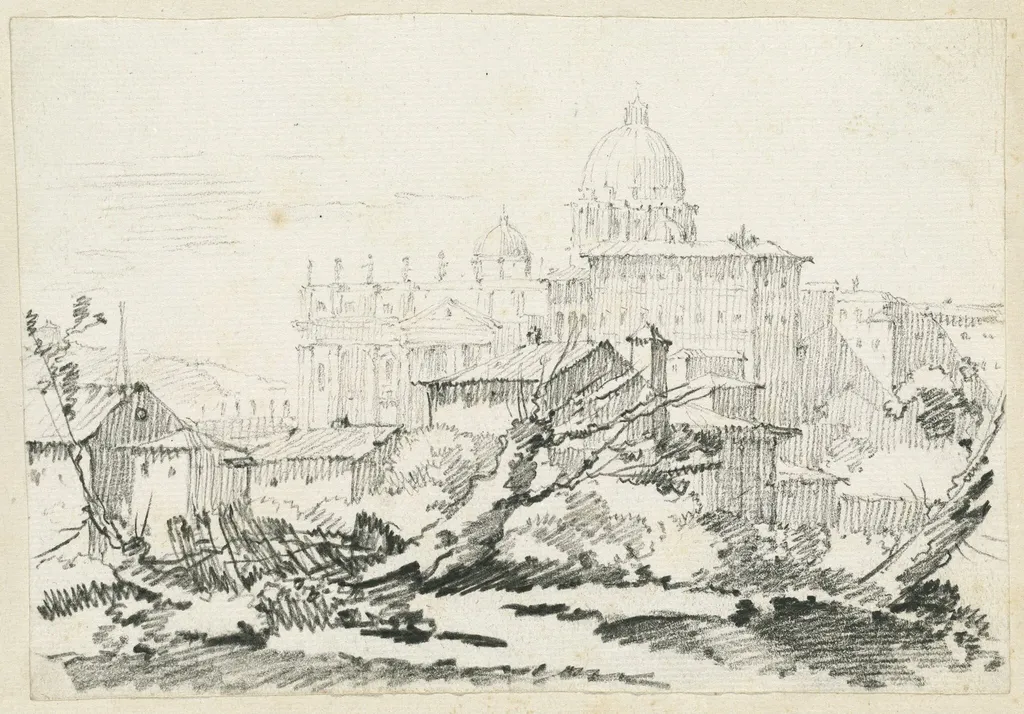
Saint Peter's Basilica and the Papal Palace is a chalk drawing by the Baroque artist Joseph-Marie Vien. It dates from 1748 and is held in the collection of the National Gallery of Art.
About this work
Overview
Created in 1748 by French artist Joseph-Marie Vien, this drawing renders Saint Peter’s Basilica and the adjacent Papal Palace in black chalk on laid paper.
Created in 1748 by French artist Joseph-Marie Vien, this drawing renders Saint Peter’s Basilica and the adjacent Papal Palace in black chalk on laid paper. As a study from Vien’s early travels in Italy, it reflects his engagement with Roman architecture during his formative years, prior to his later appointment as Premier peintre du Roi. The medium and precision suggest a deliberate observational exercise rather than a finished composition.
Subject & Meaning
The drawing focuses on two central structures of papal authority in Rome: the basilica, with its monumental dome, and the papal palace, rising behind it. These buildings symbolize the spiritual and administrative power of the papacy. The inclusion of foreground vegetation grounds the architecture in a lived environment, subtly emphasizing its presence within the city rather than as an isolated monument.
Technique & Style
Executed in fine black chalk, the work demonstrates meticulous hatching and tonal gradation to convey volume and texture. Vien’s handling of architectural details—arches, windows, and dome segments—reveals a disciplined approach to perspective and proportion. The delicate rendering of foliage contrasts with the rigid geometry of the buildings, enhancing spatial depth without overt dramatization.
History & Provenance
This drawing originates from Vien’s time in Rome during the 1740s, when he was studying classical and Renaissance architecture as part of his artistic training. It likely served as a reference for later works or academic exercises. The piece remained within private collections until its acquisition by a public institution, where it now functions as evidence of 18th-century French artists’ engagement with Italian antiquity.
Context
Vien’s drawing aligns with the broader 18th-century European interest in classical and ecclesiastical architecture, particularly among French academicians. While not part of the Baroque movement, it shares its attention to structural grandeur, albeit with a restrained, topographical clarity more characteristic of emerging Neoclassical sensibilities. Such studies were essential for artists preparing for the Prix de Rome or academic commissions.
Legacy
The drawing exemplifies the pedagogical role of architectural sketching in French art training. Vien’s precise technique influenced later generations of academic draftsmen, and this work remains a documented artifact of how French artists interpreted Roman landmarks before the rise of Romanticism. It stands as a quiet testament to the discipline of observation in pre-revolutionary art education.
Artist & collection
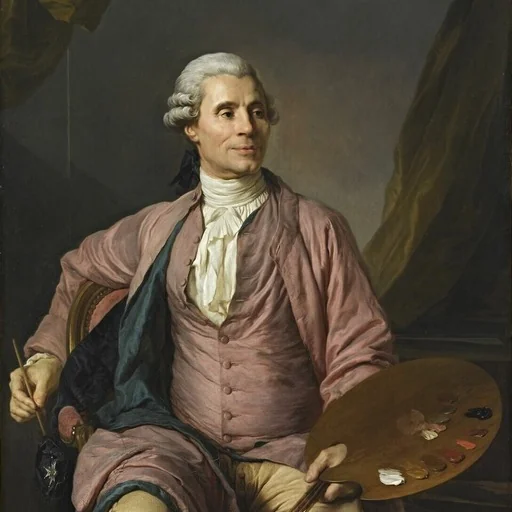
Artist
Joseph-Marie Vien (18 June 1716 – 27 March 1809) was a French painter. He was the last holder of the post of Premier peintre du Roi, serving from 1789 to 1791, before it was abolished during the French Revolution.

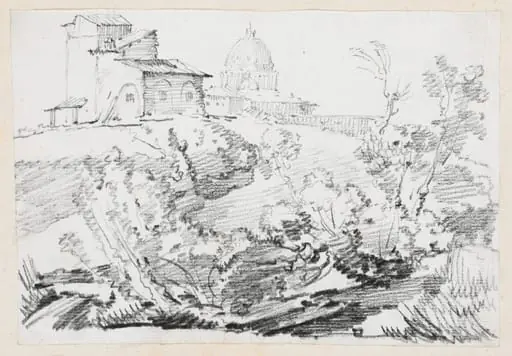 A Building on a Hill with Saint Peter's in the Distance
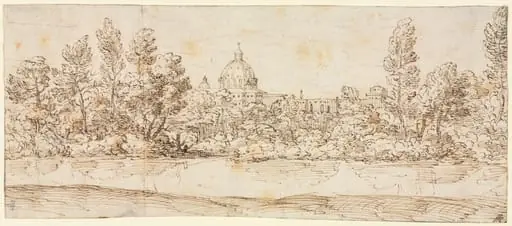 River Landscape with View of St. Peter's Basilica
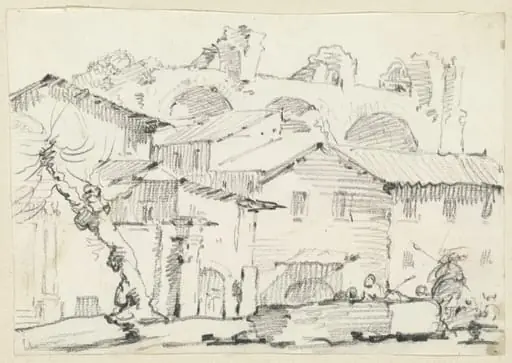 Houses on the North Side of the Forum with the Basilica of Maxentius Beyond
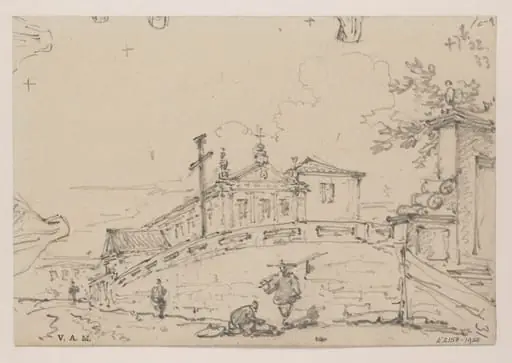 A church in Macau
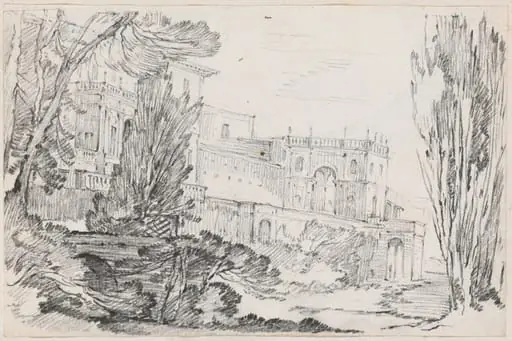 Villa d'Este, Tivoli
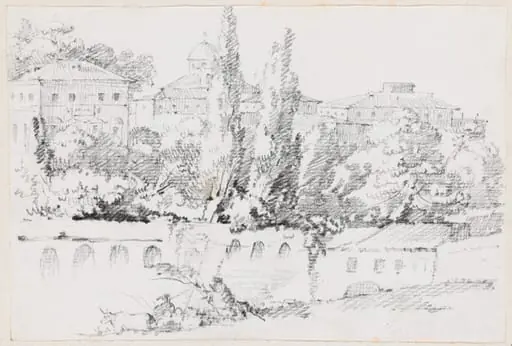 Walls of Rome with Santa Maria del Popolo in the Distance
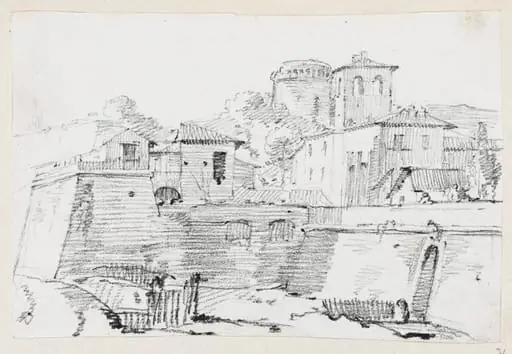 A Fortified Town in Italy
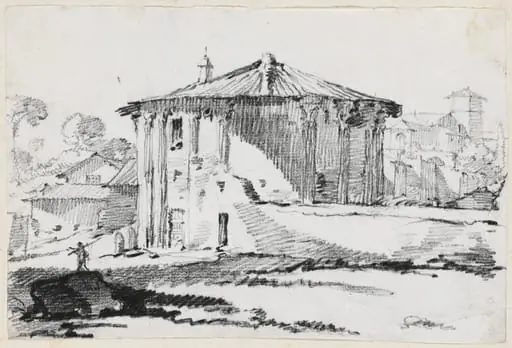 The Round Temple on the Piazza Bocca della Verità, Rome
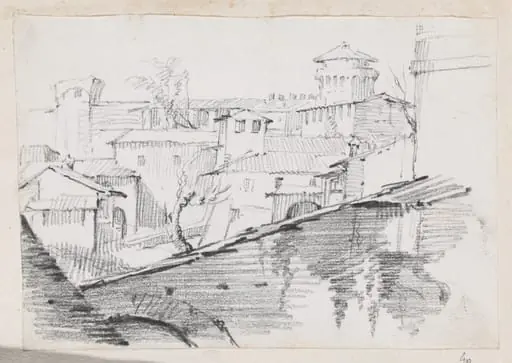 The Forno inside the Walls of the Vatican
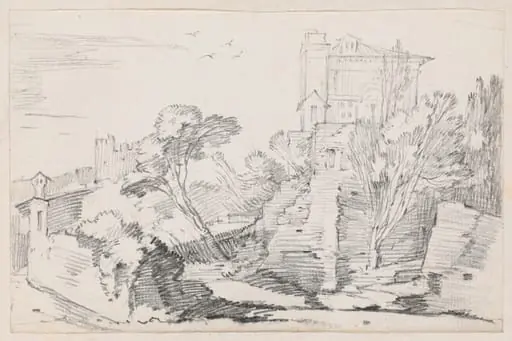 Casino Farnese on the Palatine Hill, Rome