Artwork
In the Hague Woods
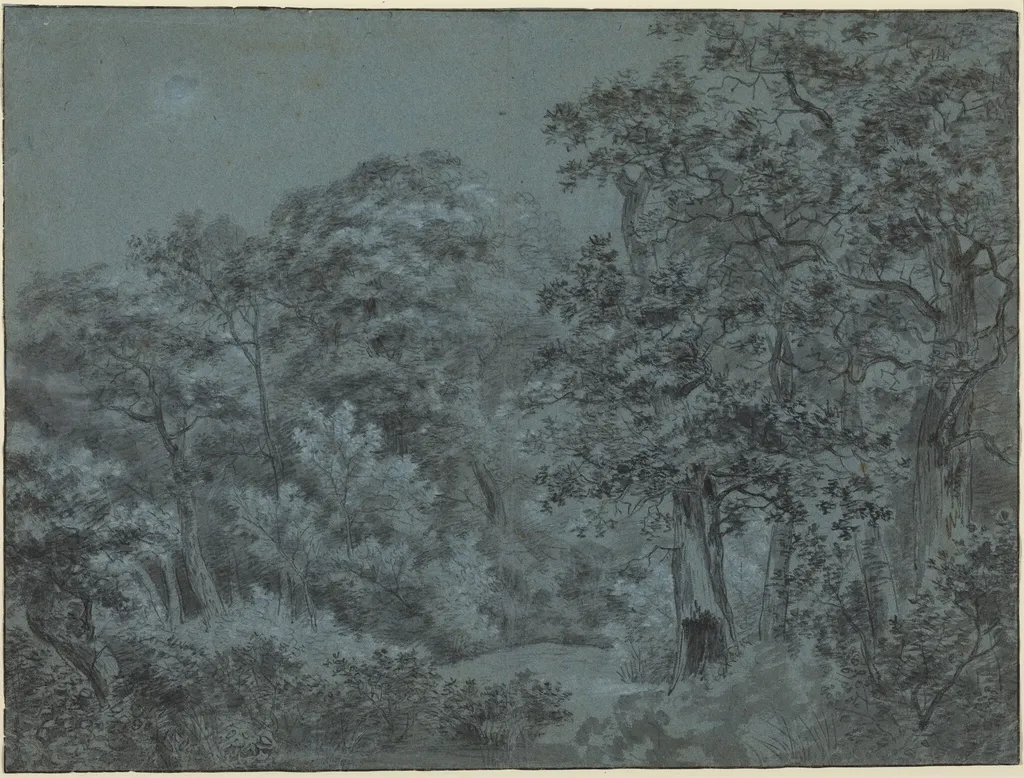
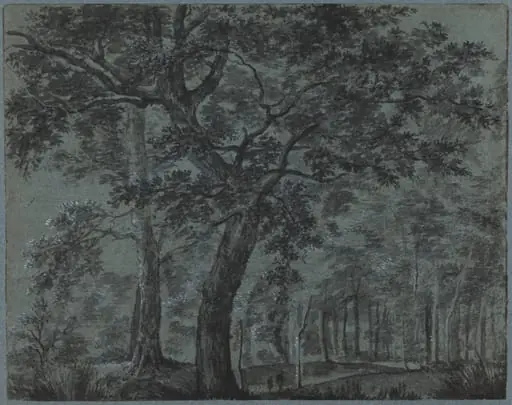
In the Hague Woods is a chalk drawing by the Baroque artist Simon de Vlieger. It dates from 1626 and is held in the collection of the National Gallery of Art.
About this work
Overview
Created in 1626, this drawing by Simon de Vlieger is executed in black chalk, gray wash, and white highlights on blue laid paper. Though best known for maritime subjects, de Vlieger also engaged with landscape themes during this period. The work exemplifies his skill in tonal modulation and delicate draftsmanship, revealing a sensitivity to natural form beyond his more familiar seascapes.
Subject & Meaning
The scene depicts a quiet woodland near The Hague, rendered with attention to the interplay of light and shadow among trees and undergrowth.
The scene depicts a quiet woodland near The Hague, rendered with attention to the interplay of light and shadow among trees and undergrowth. A faint path suggests human presence without narrative intrusion. The composition invites contemplation rather than storytelling, aligning with early 17th-century Dutch interest in the quiet dignity of the natural world, free from idealization or mythological reference.
Technique & Style
De Vlieger employed black chalk for precise linear definition, layered with gray wash to establish atmospheric depth. White pigment lifts highlights on leaves and branches, contrasting against the blue paper’s cool undertone. The varied stroke weight—thick for trunks, fine for foliage—creates tactile richness. This method reflects his experience in textile and glass design, where tonal gradation was essential for visual harmony.
History & Provenance
The drawing dates from de Vlieger’s early career, shortly after his move to Amsterdam. It likely served as a preparatory study or independent work for private collectors. Its survival is notable, as many such drawings were lost or reused. The blue paper, a common support in Dutch workshops of the time, indicates its origin in a professional studio context.
Context
In the 1620s, Dutch artists increasingly turned to landscape as a subject worthy of independent study, moving away from religious or historical themes. De Vlieger’s woodland scene fits within this trend, paralleling works by contemporaries like Jan van Goyen. The use of colored paper and heightened washes was a refined technique among draftsmen seeking to capture transient effects of light and season.
Legacy
Though de Vlieger’s marine works overshadowed his landscapes in later scholarship, this drawing illustrates his versatility and technical command. It contributes to understanding how Dutch draftsmen bridged commercial design and observational art. The piece remains a quiet testament to the period’s growing reverence for nature as a subject in its own right.
Artist & collection
Artist
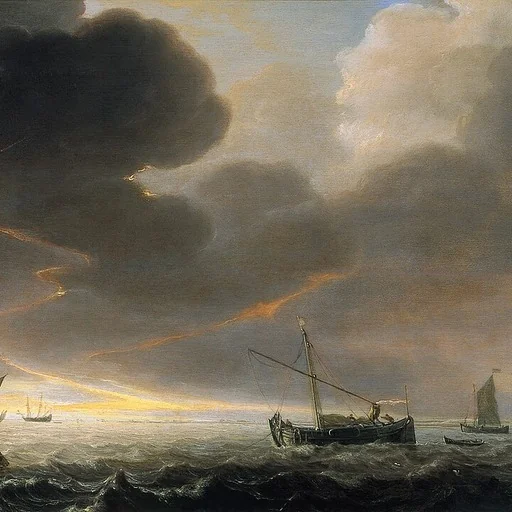
Simon de Vlieger (c. 1601 – buried 13 March 1653) was a Dutch painter, draughtsman and designer of tapestries, etchings, stained glass windows. While he is mainly known for his marine paintings, he also painted beach…

 Woods at Night with Travelers
 Wooded Landscape
 Landscape
 Stream through an Ancient Forest
 The Big Trees
 Untitled
 Trees at Fordland, Devon
 River scene with a temple or palace in the clouds
 Study of Old Tree Trunk
 Landscape with a Peasant Carrying Firewood
 Near the Woods, Veronne (Pres du bois, Veronne)
 Deer Park