Artwork
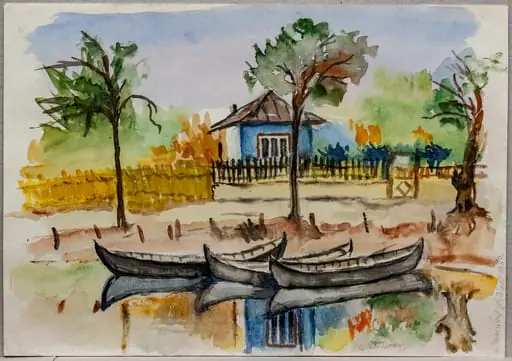
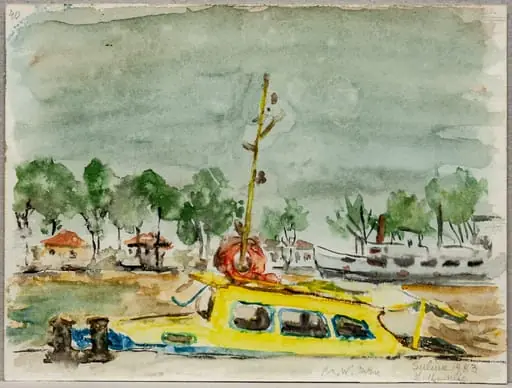
S 15 - Peisaj la Sulina (Barcă legată la cheu)
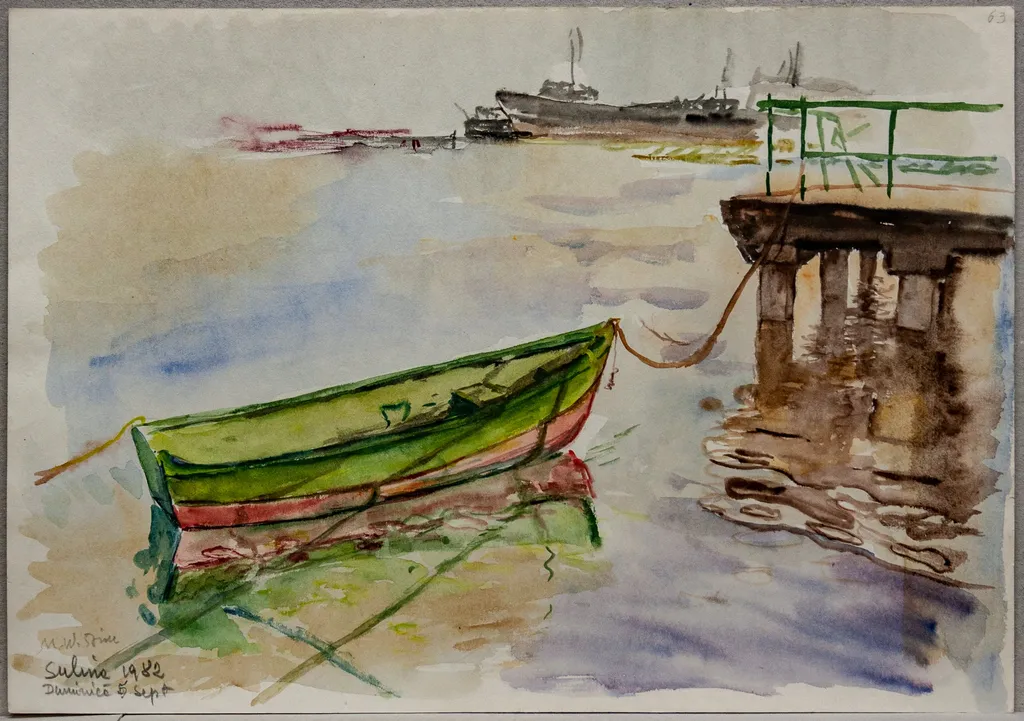
S 15 - Peisaj la Sulina (Barcă legată la cheu) is an unspecified painting by Medi Wechsler Dinu. It dates from 1958 and is held in the collection of the Gavrila Simion Eco-Museum Research Institute Tulcea.
About this work
Overview
The painting belongs to the Museum of Ethnography’s collection and presents a restrained, observational view of river life.
Created around 1958 by Romanian painter Medi Wechsler Dinu, this work captures a quiet moment on the Danube near Sulina. The painting belongs to the Museum of Ethnography’s collection and presents a restrained, observational view of river life. It avoids dramatic narrative, instead focusing on the stillness of a moored vessel and its surroundings, reflecting the artist’s interest in everyday landscapes of postwar Romania.
Subject & Meaning
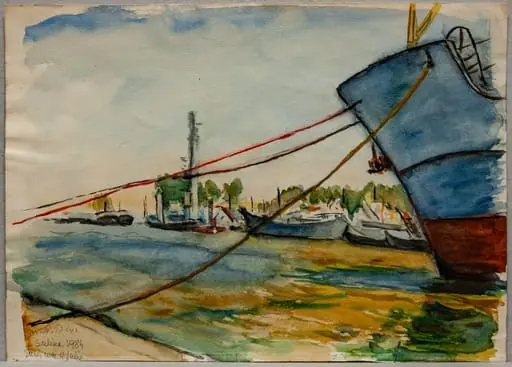
The scene centers on a green boat tied to a wooden dock, its reflection softly blurred in calm water. Behind it, other vessels sit at rest, suggesting a working port at pause. No figures are present, emphasizing solitude and the rhythm of labor suspended. The absence of human activity invites contemplation of time, stillness, and the quiet endurance of maritime life along the Danube’s edge.
Technique & Style
Wechsler Dinu employs loose, fluid brushwork to suggest form without rigid definition. Colors—muted greens, earthy browns, and cool grays—blend subtly, creating atmospheric depth. The water’s reflection is rendered with soft strokes, enhancing the sense of stillness. Light is diffused, avoiding sharp contrasts; the technique favors mood over detail, aligning with a lyrical realism rooted in observation rather than idealization.
History & Provenance
The painting entered the Museum of Ethnography’s holdings after its completion in the late 1950s. Its inclusion reflects institutional interest in documenting regional life during Romania’s socialist period. While Wechsler Dinu’s Jewish heritage and prewar experiences influenced his perspective, this work does not overtly reference political themes, instead focusing on the quiet continuity of place and routine.
Context
Painted during a period of state-directed cultural policy, the work aligns with official preferences for accessible, non-abstract imagery. Yet its subdued tone and lack of propaganda elements distinguish it from more didactic art of the era. Sulina, a port at the Danube Delta, held symbolic weight as a frontier of Romanian geography—here rendered not as a site of national pride, but as a place of quiet, unremarkable existence.
Legacy
Though not widely exhibited outside Romania, the painting remains a quiet example of postwar Romanian landscape painting that prioritizes atmosphere over spectacle. It contributes to a lesser-known strand of modern Romanian art that valued introspective observation over ideological expression. Its preservation in an ethnographic museum underscores its role as a document of everyday visual culture rather than a celebrated artistic achievement.
Artist & collection
Artist
Margareta "Medi" Dinu, née Wechsler (January 4, 1909 – July 18, 2016) was a Romanian classical painter of Jewish origin.
Museum
Gavrila Simion Eco-Museum Research Institute Tulcea
Continue through works from the same source collection.
 S 38 - Peisaj la Sulina (Stradă cu case și pomi)
 S6 - Peisaj la Sulina (Malul Dunării și case)
 S 28 - Peisaj la Sulina (Intrare de casă cu flori)
 S 9 - Peisaj la Sulina
 S 12 - Peisaj la Sulina (Stradă și 2 case)
 S4 - Peisaj la Sulina (Ochi de apă cu bărci și case)
 S 19 - Peisaj la Sulina (Casă și copaci)
 S 27 - Peisaj la Sulina (Dunăre, vapor în prim plan, case în planul doi)