Artwork
Flori
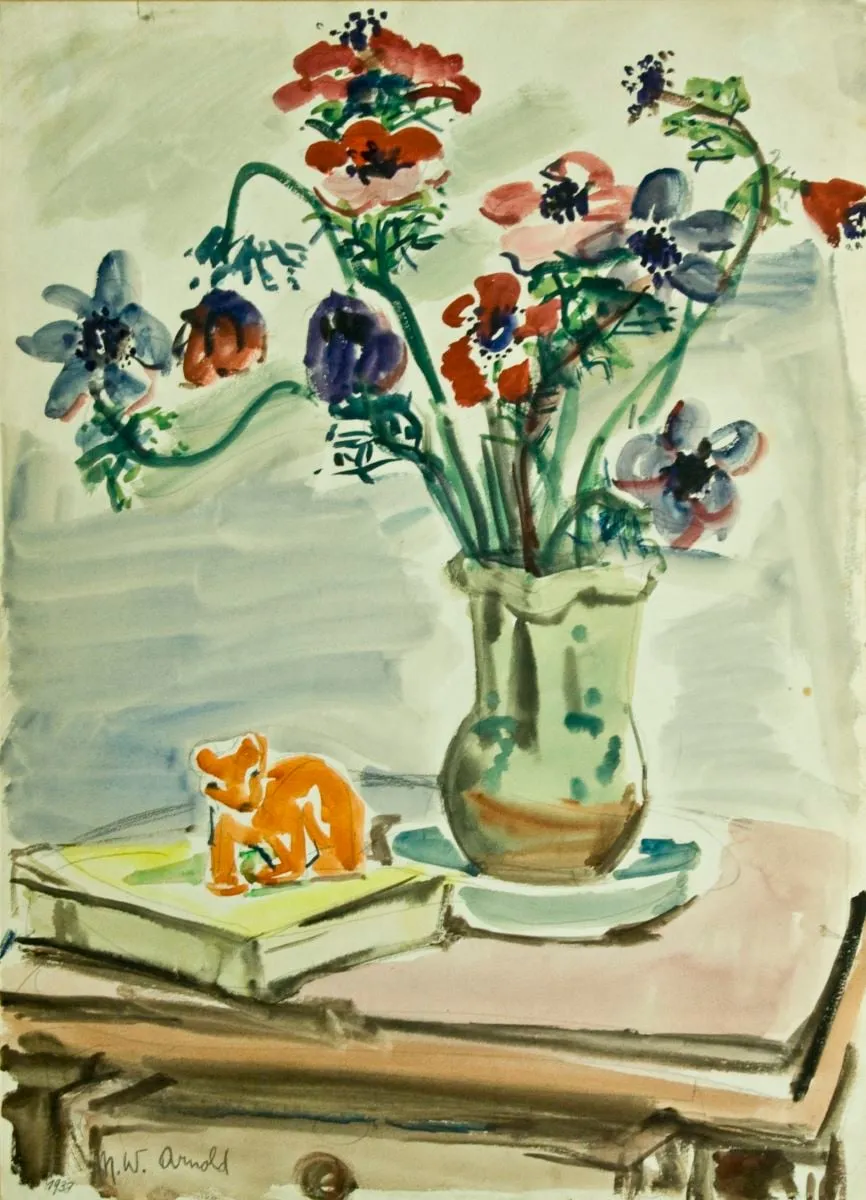
Flori is a drawing by Arnold Max Wexler. It dates from 1938 and is held in the collection of the Gavrilă Simion Eco-Museum Research Institute Tulcea - Art Museum.
About this work
Overview
Rendered with swift, unrefined lines, the composition avoids polished realism in favor of an immediate, almost spontaneous quality.
Created in 1938 by Arnold Max Wexler, this drawing belongs to the Museum of Ethnography’s collection. It presents a modest still life composed of a green vase, vibrant flowers, and a small toy dog resting on a closed book. Rendered with swift, unrefined lines, the composition avoids polished realism in favor of an immediate, almost spontaneous quality. The background is minimal, suggesting a light wall with a subtle suggestion of architectural detail.
Subject & Meaning
The arrangement includes everyday domestic objects—a vase of flowers and a child’s toy—elevated through their placement on a book, implying quiet contemplation. The flowers, though stylized, convey vitality, while the toy dog introduces an element of personal memory or childhood. Together, they form a quiet meditation on ordinary life, devoid of grand symbolism but rich in intimate resonance.
Technique & Style
Wexler employed loose, confident linework to capture form without meticulous detail. The flowers appear slightly unsteady, their contours fluid and uneven, suggesting rapid execution. Cross-hatching is used sparingly to suggest shadow and texture, particularly on the vase and book. The overall approach favors expressiveness over precision, emphasizing gesture and rhythm over anatomical accuracy.
History & Provenance
The drawing entered the Museum of Ethnography’s holdings after its creation in 1938, though its path from studio to collection remains undocumented. Wexler, known for his drawings and illustrations, produced this work during a period of increasing interest in personal, intimate subjects among Central European artists. Its preservation in an ethnographic institution suggests an interest in documenting everyday visual culture.
Context
Made in 1938, the drawing reflects a broader trend among artists in Eastern Europe who turned to domestic scenes amid rising political tensions. Rather than engaging with public narratives, Wexler focused on private, quiet moments. The simplicity of the composition aligns with a growing preference for understated, personal expression in art during the late 1930s, before the disruptions of war.
Legacy
Though not widely exhibited, the work contributes to understanding how artists of the period used still life to explore emotional subtlety. Its presence in an ethnographic museum highlights an institutional recognition of everyday visual practices as culturally significant. The drawing endures as a quiet example of personal observation in a time of uncertainty.
Artist & collection
Artist
Arnold Max Wexler made drawings and paintings of everyday scenes and landscapes around the 1930s–40s.
Museum
Gavrilă Simion Eco-Museum Research Institute Tulcea - Art Museum
Continue through works from the same source collection.
 Flowers in a vase
![Roses in a Bottle [recto], by Paul Cezanne](https://artifactworldgallery.com/img/paul-cezanne--roses-in-a-bottle-recto--7d8cab3439e09800-w320.webp) Roses in a Bottle [recto]
Roses in a Bottle [recto] Vas albastru cu flori
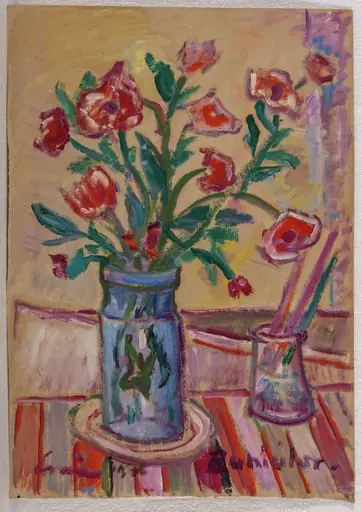 Eboșă cu un vas de sticlă cu flori roșii așezat pe un suport în jumătatea din stânga a lucrării. În jumătatea din dreapta, mult în spate față de vasul cu flori, un alt vas de sticlă, mic, cu trei pensule. Fundal ocru, colorat cu pastă violet și albastră în marginea din dreapta a lucrării. Flori vag schițate cu roșu și alb, iar suportul este acoperit cu un material în dungi colorate în portocaliu, alternând cu gri și violet. Semnat și datat cu violet și brun, stânga jos: Craiu (19)76.
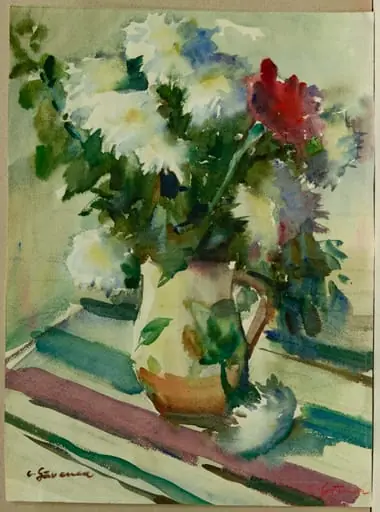 Vas cu crizanteme
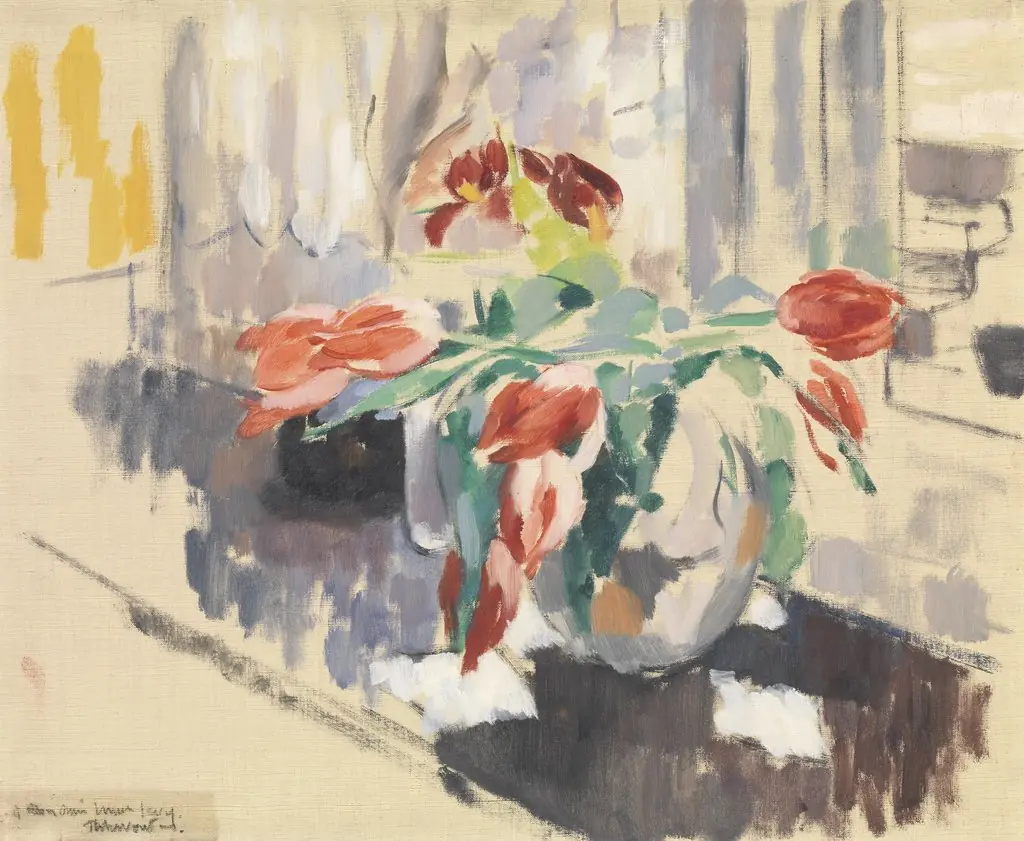 Tulips
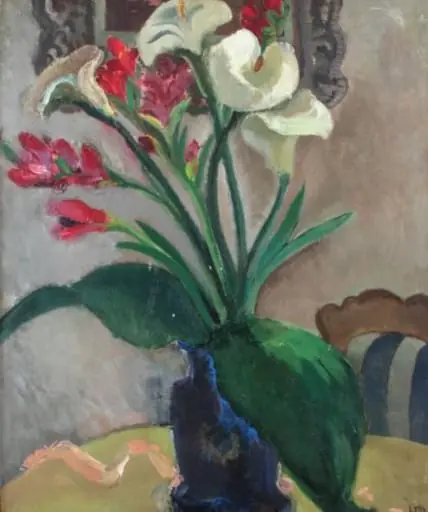 Gladiole (Cale)
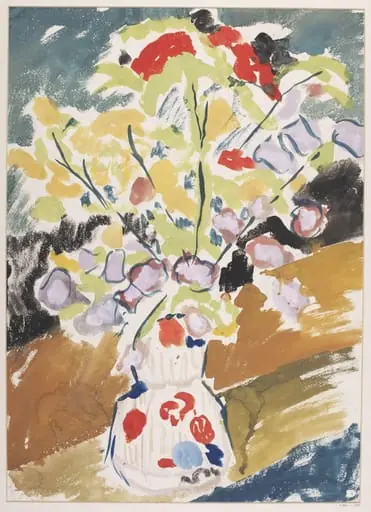 A Vase of Flowers